
Guide
How Crypto Casino Deposits and Withdrawals Work
Crypto is genuinely fast on the network and completely ordinary everywhere else. This is what happens between your wallet and your balance, what it costs, and which of the two casino models you are actually dealing with.
Show moreShow less

A crypto deposit at an online casino is two different products wearing the same button, and telling them apart before you send anything is the most useful thing on this page. At one kind of site your coins are converted on arrival and your balance is euros, pounds or kronor. At another it stays in the asset, moves with the market, and converts only when you cash out, if ever. Bonuses, disputes and the value of a win all behave differently in each.
Everything else is mechanical. You copy an address, pick a network, it confirms, the operator credits you. The rail is fast and the transaction cannot be reversed by anyone, including you. That is the trade: crypto removes the bank from the middle, and the bank was the thing that could undo mistakes.
What crypto does not change is the casino. The pending window, the verification queue, the bonus terms and the complaints procedure are whatever the licence requires. A payment method is not a licence and not a protection.
The two models, and why conflating them costs money
One is a fiat-licensed casino accepting crypto as a way to move money. The other keeps your balance in the coin. Same button, different animal.
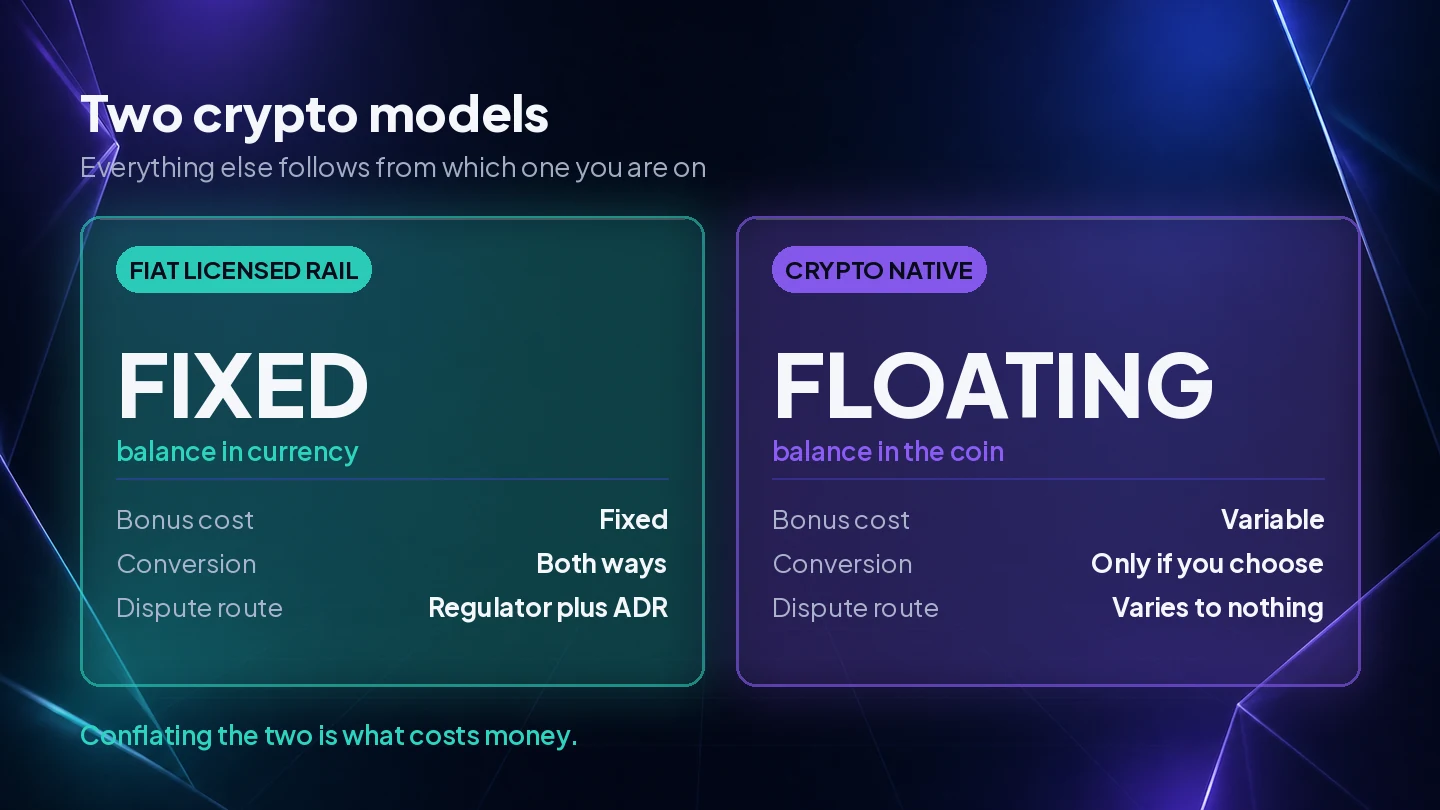
Model A, crypto as a payment rail. The operator holds a licence in a regulated market and its accounts are denominated in a currency. You send an asset, a payment provider converts it on arrival, and your balance reads 500 EUR. From that point nothing is cryptographic. Your bonus, your wagering and your max bet rule are all fiat figures, and your withdrawal converts back at whatever rate applies that day. This is what most European licensed sites mean by crypto, including the operators on our payments hub and the market pages for the Netherlands and Sweden.
Model B, crypto-native. Your balance is 0.0184 of a coin. Bets settle in the coin, wins are paid in the coin, and if the market moves overnight your balance moves with it even though you did not play. Many of these sites are licensed in permissive jurisdictions, some are not licensed in any meaningful sense, and the dispute route ranges from a named adjudicator to an email address. A fiat figure beside the balance is a readability aid, not a guarantee of value.
| Fiat-licensed, crypto as a rail | Crypto-native, balance in the asset | |
|---|---|---|
| What your balance is | Currency, fixed | The coin, floating |
| Bonus and wagering denominated in | Currency, fixed cash cost | The coin, variable cash cost |
| Conversion cost | On deposit and on withdrawal | Only if you convert yourself |
| Typical licence | UK, Sweden, Netherlands, Denmark, Malta | Curacao style, or none stated |
| Dispute route | Regulator plus named ADR body | Varies from named ADR to nothing |
The bonus row deserves a second read. In model B a 100 unit bonus at 35x is 3,500 units of turnover in the coin. If the coin gains 20 percent while you work through it, you have committed 20 percent more real money to the same requirement, and none of that is written in the terms.
The dispute row matters more. When a fiat-licensed operator refuses a payout you have a documented escalation path: its complaints procedure, then the dispute resolution provider named in its terms, then the regulator. Our guide to how to verify a casino licence covers checking that licence is real. In model B, if the site is unlicensed, nobody has authority over the operator’s decision. You have an argument, not a route.
What actually happens when you deposit
The cashier shows a deposit address, usually a long string plus a QR code, and often a network dropdown. You send funds from your wallet or an exchange. The transaction is broadcast, miners or validators include it in a block, and each block built on top of it counts as one confirmation. Once the count passes the operator’s threshold, the balance appears.
Three things go wrong, in descending order of frequency.
The deposit sits unconfirmed
Usually the fee was too low for current conditions. The transaction is valid and waiting, not lost. Some wallets offer replace-by-fee to bump it; otherwise it clears when congestion drops, or falls out of the queue and the funds return to your control.
A second cause: the operator’s threshold is higher than you expected, and “pending network confirmations” is the literal truth. A third: you sent from an exchange, which has its own withdrawal queue. Your coins may not have touched the chain yet.
Thresholds are set by the operator, not the network, and vary widely. The figures below are indicative, so read the number in your own cashier.
| Network | Approximate block time | Confirmations commonly required | Rough wait |
|---|---|---|---|
| Bitcoin | about 10 minutes | 1 to 6 | 10 to 60 minutes |
| Ethereum and ERC-20 tokens | about 12 seconds | 12 to 40 | 3 to 10 minutes |
| Litecoin | about 2.5 minutes | 3 to 6 | 8 to 15 minutes |
| Tron and TRC-20 tokens | about 3 seconds | around 20 | under a minute |
Confirmations are how a chain expresses confidence that a transaction will not be reorganised out of history, so a high threshold is caution, not obstruction.
The amount is below the minimum
Cashiers set a minimum in fiat terms and your send can fall under it once the network fee is taken. Some operators credit it anyway, some hold it until you top up.
You sent it on the wrong network, the most expensive beginner mistake
The same token exists on several chains. A dollar stablecoin lives on Ethereum, Tron, Solana and Polygon, each version with its own address format and network, and the ticker is identical in all of them. The cashier dropdown that says ERC-20 or TRC-20 is not a preference, it is the entire instruction.
Send a TRC-20 token to an ERC-20 deposit address and the coins sit on a chain nobody was watching. Recovery depends on whether the operator or its custody provider holds the private key for that address on that chain too. Sometimes yes, and support sweeps them manually, usually after weeks and often for a fee. Sometimes no, and the money is out of reach of everyone including the operator. Nobody is being unhelpful. There is no key.
The variant that catches experienced users is the exchange default. You paste an ERC-20 address into your exchange, it has quietly preselected a cheaper chain to save fees, the send goes through and the deposit never arrives.
Two habits remove this. Match the network name in the cashier to the one in the sending wallet, character for character, before approving anything. Then send a small test transaction the first time you use a new address. The test costs one extra network fee. The alternative costs the deposit.
Three fees, and the one nobody labels
There are three separate costs in a crypto casino payment and only two are ever presented as fees.
The network fee. Paid to the chain, not the casino, set by congestion and the chain’s design. A few euros on Bitcoin at a busy moment, usually cents on Tron or Solana. The operator neither controls it nor receives it.
The operator fee. A percentage or flat charge for processing. Many crypto-friendly sites genuinely charge none, which is where “no fees” comes from.
The spread on conversion. The gap between the market rate for the asset and the rate the operator credits you at. This is where the money is, and no cashier screen calls it a fee, because technically it is not one. It is a price.
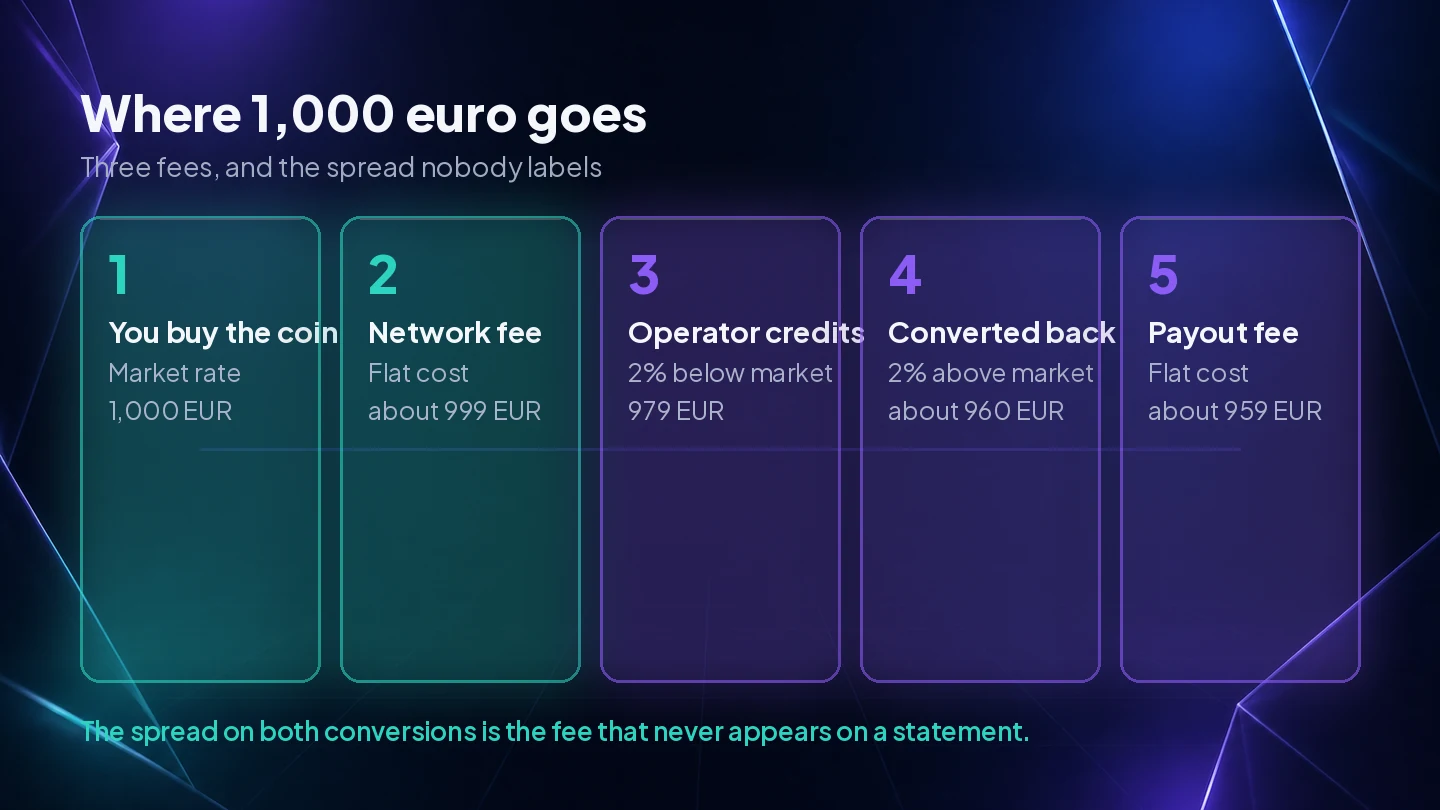
A site can advertise zero fees, charge zero fees, and still be the most expensive way to fund an account. The arithmetic on a 1,000 EUR deposit with a two percent spread each way, no wins and no losses.
| Step | Rate applied | You have |
|---|---|---|
| You buy the asset, market rate | market | 1,000 EUR of coin |
| Network fee to send | flat | about 999 EUR of coin |
| Operator credits your balance | 2 percent below market | 979 EUR balance |
| Operator converts back to coin | 2 percent above market | about 960 EUR of coin |
| Network fee on the payout, if charged | flat | about 959 EUR of coin |
Round trip cost: roughly 41 EUR on 1,000 EUR, a shade over four percent. Most licensed European casinos charge nothing on a card deposit; where a fee exists it is typically one to two and a half percent, and payouts are usually free. At 1.5 percent the same 1,000 EUR costs 15 EUR.
So the “free” method cost 41 EUR and the one with a visible fee cost 15 EUR. Spread never shows on a statement, and it is charged twice. This is why we price payment routes ourselves, as described in how we review and applied on the crypto payments page.
To see it, compare the cashier’s implied rate against any public market rate, on deposit and again on withdrawal. Under half a percent each way is competitive. Two percent each way is a card fee in a costume. Model B sites, where you never convert, avoid this entirely.
Volatility, or the win that shrank before it arrived
This applies only to model B. It is the risk players understand least, because it has nothing to do with gambling.
You deposit the equivalent of 500 EUR when the coin trades at 25,000 EUR, so your balance is 0.02 coin. You have a good session and finish with 0.05 coin. That balance is worth 1,250 EUR, and you request a withdrawal.
Now the ordinary delay applies. A 24 hour reversal window, a verification request because this is your first payout, then a weekend. Four days later the payout goes out. The coin has fallen 12 percent to 22,000 EUR. Your 0.05 coin is intact, every unit of it, and now worth 1,100 EUR.
You lost 150 EUR to something that was not a bet. The casino did not take it, no term was breached, the ledger is exactly right. The denomination moved.
The honest other half: the coin could have risen 12 percent and paid 1,400 EUR. Volatility is symmetrical in principle. Your position is not. You were exposed for four days by a delay you did not choose, on an asset you held as a payment instrument, not an investment.
Stablecoins change this. A token pegged to the dollar holds a roughly fixed value against that dollar, so 1,250 units is what you withdraw. Three real caveats. If your home currency is not the dollar you still carry the pair. A peg is a policy maintained by an issuer, not a law of nature, and pegs have slipped historically. And a stablecoin is only as sound as the reserves behind it, a credit question with no deposit guarantee scheme underneath it.
If your balance sits in the asset and you are not deliberately taking a market position, use a stablecoin.
Speed, or why a fast rail is not a fast cashier
Crypto is fast, and that part of the marketing is accurate. Once an operator signs and broadcasts a payout it settles in minutes on most chains. Against a card refund posting on the issuer’s schedule over one to five business days, that is a serious improvement and the strongest thing crypto has going for it.
The rail is the last stage, not the journey. A withdrawal has four and the payment method touches only the last. First the pending or reversal window, an operator policy, commonly zero to 72 hours, during which nothing happens except that you can cancel and put the money back into play. Second internal approval, where verification, bonus compliance and manual review live. Third the processor or the operator’s hot wallet. Fourth the network.
Change the fourth and you have improved what was rarely the bottleneck. A site with a 48 hour reversal window and a three day document queue pays out in roughly three and a half days on crypto and four on a card. We set out where the time goes in why casino withdrawals are delayed, and that answer barely changes when the rail does.
This is why payout time on this site is read from the request to the moment funds are usable, not from the moment the operator marks it approved. Approval to arrival is the operator’s favourite metric and close to meaningless. On the measure that matters, which includes the pending window and the weekend, some crypto cashiers are among the fastest in the market and others are indistinguishable from a bank transfer. That is an operator property, not a coin property.
One place crypto wins outright: no cut-off. Bank rails have batch times, business days and public holidays. A payout approved at 22:00 on a Sunday settles on a Sunday.
KYC does not disappear because you paid in crypto
The persistent myth is that crypto means no identity checks. At a licensed operator the opposite is closer to true.
A licence obliges the operator to know its customers, run anti-money-laundering checks and apply responsible gambling duties, and none of those obligations mention payment method. You upload the same photo ID and proof of address and answer the same questions, so our walkthrough of KYC checks explained applies unchanged.
Where crypto genuinely differs is source of funds, in the unhelpful direction. A card deposit arrives with a name, a bank and an identity check somebody else already performed. A crypto deposit arrives from a string of characters. So a card player produces a payslip; a crypto player is asked for exchange account records, transaction histories and sometimes an explanation of the wallet’s earlier activity. Deposits from mixers, privacy tooling or addresses flagged by a chain analytics provider draw a hold on their own, with no wrongdoing on your part. Heavier, not lighter.
That leaves the sites advertising no verification at all. The honest description is simple: an operator can only skip KYC by sitting outside a regime that requires it. That price is not paid at deposit, it is paid the day something goes wrong. No regulator with jurisdiction, usually no named dispute provider, no obligation to segregate player funds, no self-exclusion scheme it must honour. Winnings paid promptly for months prove nothing about the case where the operator disagrees with you, because a dispute route is only worth anything when it does not depend on the operator’s goodwill.
We cover the category rather than pretend it away, on no-KYC casinos and the market pages for the UK and Ireland, with the trade-off stated each time. Deciding it is worth it is your call. Deciding without knowing the trade-off is not.
Irreversibility, and how the rails really compare
A crypto transaction cannot be reversed. Not by the operator, not by you, not by a regulator holding a court order. Wrong address, wrong network, wrong amount: once confirmed it is final. No chargeback, no recall, no fraud team to call.
This cuts both ways. Card chargebacks are a genuine consumer protection and also routinely misused, including by players trying to reverse gambling losses, which is a fast route to a closed account and a blocked payout. Bank recalls on a mistyped transfer sometimes work and sometimes take months. Card and bank rails give a slow, imperfect undo. Crypto gives none, and gives settlement in minutes instead.
| Crypto | Card | Local bank rail, iDEAL or Trustly style | |
|---|---|---|---|
| Speed in | Minutes, after confirmations | Instant | Instant |
| Speed out, real world | Operator stages plus minutes | Operator stages plus days | Operator stages plus a day |
| Visible fee | Network fee, often no operator fee | Usually none, sometimes 1 to 2.5 percent | Usually none |
| Hidden cost | Conversion spread, often 1 to 3 percent each way | Only currency conversion | Only currency conversion |
| Reversibility | None, ever | Chargeback, weeks | Recall, sometimes, slow |
| KYC weight at a licensed site | Same, heavier on source of funds | Standard | Standard, often lightest |
| Dispute route | Operator, then ADR and regulator if licensed | Operator, ADR, regulator, plus card scheme | Operator, ADR, regulator, plus bank |
Read the dispute route row alongside the reversibility row. On a card you have two independent avenues, the gambling complaint and the payment complaint, and the second has teeth the first does not. On a bank rail you have the gambling complaint and a bank that will at least investigate. On crypto you have the gambling complaint and nothing else. When the operator is well licensed that is a modest loss. When it is not, it is the whole game. Local rails such as iDEAL stay the cheapest and most traceable option where they exist.
What provably fair proves, and what it does not
Provably fair is real, and routinely oversold. Here is what it does.
Before a bet, the operator generates a server seed and publishes its hash, a fingerprint that cannot be worked backwards into the seed. You supply or are assigned a client seed, and a nonce counts your bets. The result comes from the combination. Afterwards the operator reveals the server seed, you hash it yourself, check it matches the fingerprint published beforehand, and recompute the result. If both check out, the seed was fixed before you bet and the outcome was not altered afterwards.
Valuable, and narrow: it proves one property of one result, no post-hoc tampering.
It does not prove the house edge, because the formula turning seeds into an outcome is the operator’s and an honest process can implement any payout structure, including a bad one. It does not prove solvency, so a provably fair operator with no player fund segregation can still be unable to pay you. It does not prove it will pay a verified win. It does not audit the bonus terms, the max bet rule or the withdrawal caps, where most real disputes start. And it covers only in-house games that implement it, typically dice and crash. Third party slots run on tested RNGs certified by independent laboratories instead.
Provably fair and a licence answer different questions. One says this spin was not rigged after I clicked. The other says an organisation exists that can compel this operator to pay me. Given one, take the second.
Before you deposit, the ten minute checklist
Do this once per site, before the first deposit, not on the day you win.
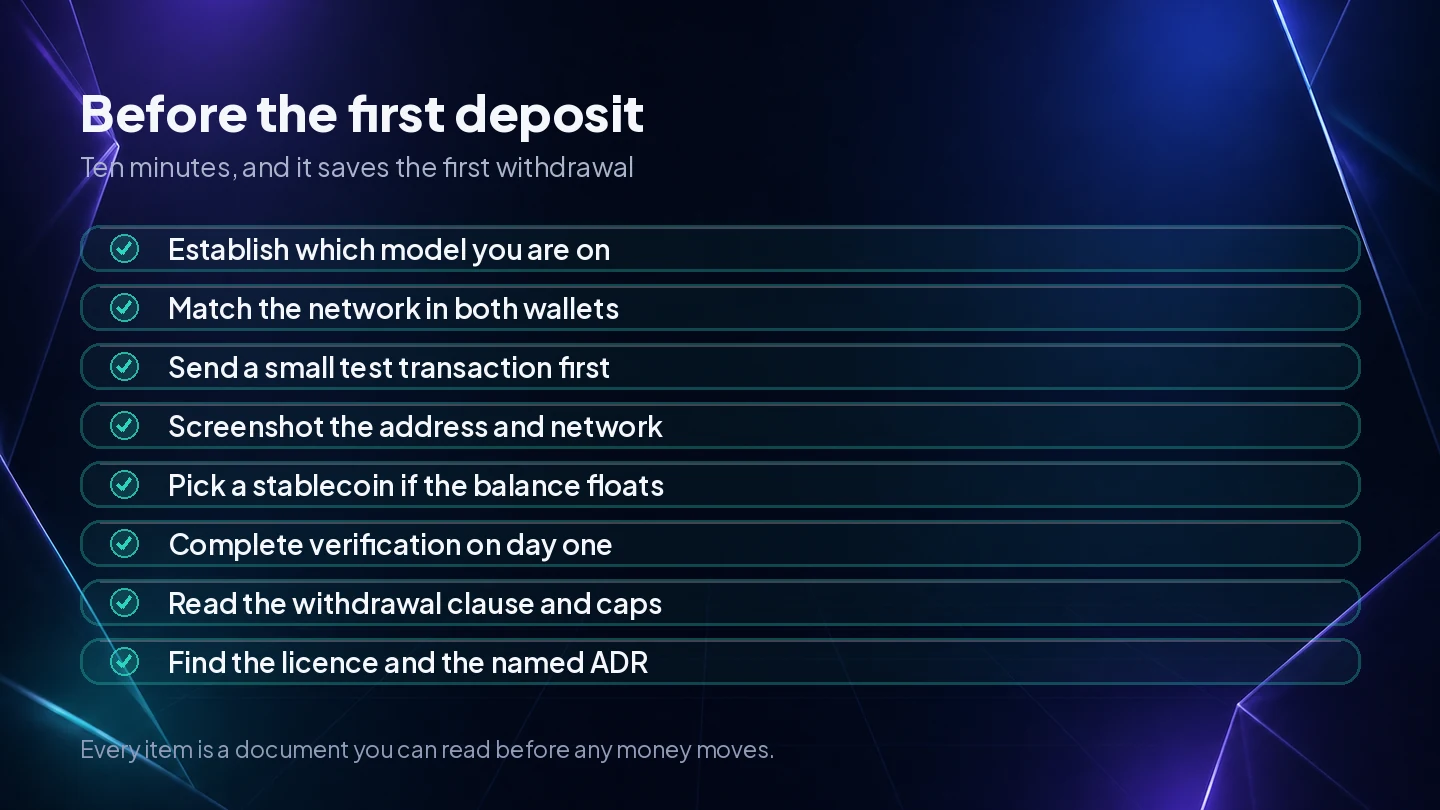
- Establish which model you are on. Does the balance convert to a currency or stay in the asset? Everything follows from that. If it converts, compare the cashier’s rate against a public market rate and treat any gap past one percent as a fee.
- Match the network exactly. Read it in the cashier and in your sending wallet side by side. ERC-20 and TRC-20 are not interchangeable and the ticker tells you nothing.
- Send a test transaction. A small amount first, on a new address, every time.
- Screenshot the deposit address and the network. Addresses are often regenerated per deposit. If a transfer goes missing, a timestamped screenshot of what the cashier displayed is the difference between a support ticket and an argument.
- Choose a stablecoin if the balance stays in the asset. Unless you want the market exposure while you play.
- Complete KYC on day one, before depositing if the cashier allows it. The biggest single saving on your first withdrawal, larger than anything the payment method contributes.
- Read the withdrawal clause and confirm the payout route. Minimum, caps, reversal window, and whether the site pays out only to the address you deposited from. Crypto minimums are sometimes higher than card minimums at the same site.
- Check the licence and the named dispute provider. If neither is stated, price that in as the cost it is.
What to do next
Decide what you want from crypto. If it is speed, you are buying a few hours at the end of a process measured in days, and early verification plus a short reversal window buys more. If it is avoiding conversion cost, hold the balance in a stablecoin on a site that does not convert. If it is avoiding identity checks, you are paying for that by giving up your only enforcement mechanism.
Then three concrete things. Read the confirmation threshold and withdrawal terms before depositing. Send a test transaction on the correct network. Finish KYC while nothing is at stake.
The framing to keep: crypto is a payment method. Not a licence, not an audit, not a guarantee, not a consumer protection. A well licensed casino with a card cashier will treat you better in a dispute than an unlicensed one with instant Bitcoin payouts, and the second only looks better until the day you need someone on your side. Judge an operator on its licence, its terms and its repeated payouts, then pick the rail.
Keep the money in proportion. Gambling is entertainment with a real cost attached and never a source of income, which is easier to forget when the balance is denominated in something that moves on its own. If the amount you are sending matters to you, stop and read responsible gambling first.
In one paragraph
Crypto at a casino is a payment rail, not a licence. How deposits confirm, what the spread really costs, and where crypto helps or hurts a player.
Read next
Markets
Frequently asked questions
Is a crypto casino faster than a card casino for withdrawals?
On the network, yes. Once the operator releases a payout it lands in minutes rather than days. But the release itself still sits behind the pending window, verification and any manual review, and those stages are unchanged by the payment method. A slow cashier with a crypto option is still a slow cashier.
What happens if I send a deposit on the wrong network?
Usually the money is gone. If the operator controls the receiving address on the chain you used, support can sometimes recover it manually, often for a fee and after weeks. If it does not, nobody can move those coins. Always match the network shown in the cashier exactly, not just the ticker symbol.
Do crypto casinos really have no fees?
The claim normally means no operator fee, which is true and not the whole picture. You still pay the network fee, and if the site converts your deposit into fiat you pay a spread against the market rate. A two percent spread each way is a real cost that no cashier screen ever labels as a fee.
Can I gamble in crypto without any identity verification?
Not at a licensed operator. Licensed sites run the same KYC regardless of how you paid, and source-of-funds checks on crypto deposits are often heavier because the money has no bank statement behind it. Sites advertising no verification are generally unlicensed, which removes your dispute route entirely.
Does provably fair mean the casino cannot cheat me?
It means one specific thing: that a result was not altered after your bet was placed, which you can verify yourself from the seeds and hash. It says nothing about the house edge, whether the operator is solvent, or whether it will pay your withdrawal. Those are licensing and audit questions, not cryptography.
More from the blog
-
 safety How to Verify a Casino Licence in Five Minutes A licence badge is an image file. The only thing that counts is the entry on the regulator's public register, and checking it takes about five minutes.
 -
 safety KYC Checks at Online Casinos, Explained Verification is a licence condition, not an operator invention. But the moment an operator chooses to run it is a business decision, and that choice is what turns a ten minute upload into a fortnight of chasing support.
 -
 bonuses Max Bet Rules and How One Spin Voids a Win The max bet clause is the shortest sentence in most bonus terms and the one that costs players the most money. This is what it covers, how a single spin breaches it, and what an operator is allowed to do next.

Niels Zijp
Payments & Withdrawals Tester since 2024
Niels Zijp tests the cashier. At LSM99 he is the Payments and Withdrawals Tester, a role he has held since 2024, which means he runs money through an operator and times what happens: how long a deposit takes to credit, how long a verified withdrawal actually takes to land. He owns the payments sections of our reviews and the comparison pages that sit alongside them. When this site quotes a payout window, that figure came off his stopwatch. It is a measured number, not a promise repeated from a help page.



Play responsibly
Gambling is entertainment, not income. Set a deposit limit before you play, never chase a loss, and stop when it stops being fun. If it has become a problem, these services are free and confidential.
Our responsible gambling guide carries no affiliate links and no casino list.