
Guide
Why Your Casino Withdrawal Is Delayed
A withdrawal that takes six days is not usually six days of work. It is a pending window, a verification request nobody warned you about, and a weekend. Here is where the time actually goes.
Show moreShow less

A withdrawal is not one process. It is four, run by three organisations, and only the first two belong to the casino. When a payout takes six days it is rarely six days of work. It is a deliberate pending window, a verification request nobody warned you about, a processor batch that missed a cut-off, then a bank posting refunds on its own calendar. Each piece is short. Stacked across a weekend, they add up to a week.
What matters is knowing which stage your money is in, because that decides whether you wait, upload something, chase support or complain. A request stuck in pending on a Saturday night is not the same problem as one marked approved four days ago and still missing. The first is design. The second is a payment failure worth chasing.
None of this makes every delay innocent. An operator running a 72 hour reversal window has decided your money should stay reachable, by you, for three days. That is a product decision, not a technical constraint.
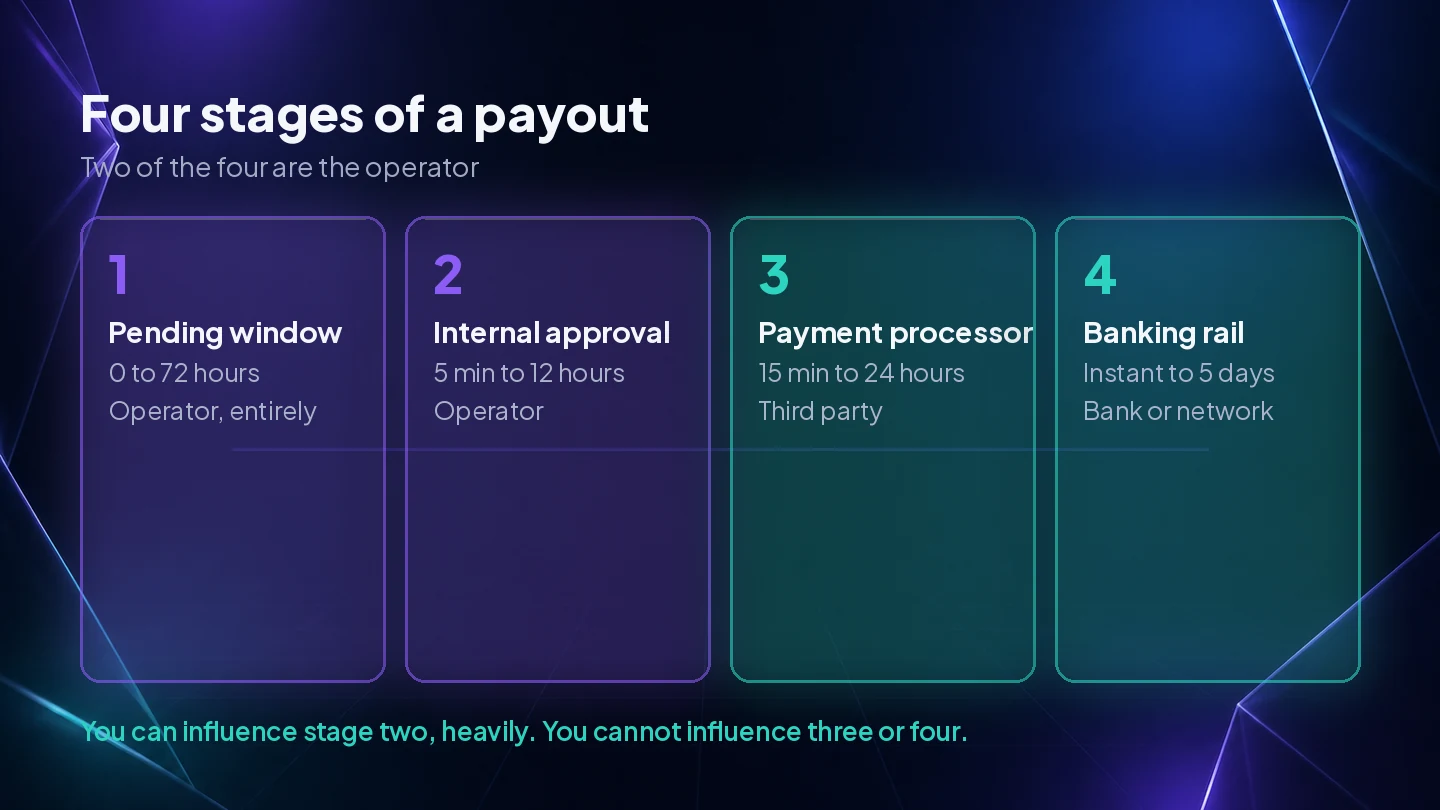
The four stages of a withdrawal, and who controls each
One, the pending or reversal window. Balance drops, status reads pending, nothing else happens. No human sees it. Its only function is that you can cancel and put the money back into play.
Two, internal approval. The payments team or a rules engine checks the account. Verification, bonus compliance and manual review all sit here.
Three, the payment processor. A third party batches the instruction and submits it to the network.
Four, the banking rail. The card scheme, SEPA, the wallet or the blockchain moves the money and your bank posts it.
| Stage | Typical range | Who controls it | Can you influence it |
|---|---|---|---|
| Pending or reversal window | 0 to 72 hours | Operator, entirely | Only by choosing better |
| Internal approval, automated | 5 minutes to 12 hours | Operator | No |
| Verification hold, if triggered | 1 to 5 working days | Operator, but you supply the inputs | Yes, heavily |
| Manual review on large wins | 1 to 10 working days | Operator, under licence obligations | Partly, by answering fully first time |
| Payment processor handling | 15 minutes to 24 hours | Third party | No |
| Card refund or credit transaction | 1 to 5 business days | Scheme and issuing bank | No |
| SEPA or domestic bank transfer | Same day to 2 business days | Bank | No |
| E-wallet credit | Instant to 24 hours | Wallet provider | No |
| Crypto confirmation | Minutes to a few hours | The network | Fee choice only |
Read the “who controls it” column first. Two of the four stages are operator decisions, and that is where almost all avoidable delay lives. The third party stages are boring and mostly fast. When support says the payment is with the provider, that claim is checkable: if true, money lands inside two business days on bank rails and inside an hour on wallets and crypto.
The pending window is a design choice, not a technical limit
There is no engineering reason a request must sit untouched for 48 hours. Payment instructions queue instantly. The reversal window exists because it works, and it works in one direction.
The mechanism, plainly. You request a withdrawal, the amount goes to pending, and for the next one to three days the cashier shows a button that returns the whole sum to your playable balance in one click. Meanwhile you cannot spend the money, cannot see it in your bank, and have nothing to show for the win but a status label. Then a session goes badly, or a free spins email arrives, and the button is right there. It is the only feature in a cashier whose sole function is to make a completed decision reversible. You cannot un-place a bet.
So a short pending window is a genuine quality signal. A cashier that pays on approval, or holds under an hour, has given up the reversal mechanic on purpose. That is worth more than most of what appears in a welcome offer, and it is weighted accordingly in our casino reviews.
Two related things. A window that resets, where part-cancelling a request restarts the clock on the remainder, is a compounding trap. A setting that disables reversals entirely, which a minority of operators offer, is the most useful toggle in the product and usually sits with the responsible gambling controls.
Verification at withdrawal, not at signup, is why you wait days
The most common cause of a multi-day wait is not fraud review, not the bank and not the weekend. It is that identity verification was triggered by the withdrawal request instead of by the deposit.
Signup takes ninety seconds: an email, a date of birth, a password. Nobody asks for a document, because asking then costs the operator conversions. The obligation to verify does not disappear, it gets deferred to the first moment when the operator has leverage and you have patience: the withdrawal.
So on payout day the account raises a flag, an email asks for photo ID and proof of address, and the clock you thought was running on a payment is running on a document queue. That queue behaves badly:
- Documents are reviewed in business hours, in submission order; a first pass takes two hours to two working days.
- Rejections are common and often trivial. A cropped corner, glare on the photo, a utility bill older than three months, a name that reads “Robert” on the passport and “Rob” on the bank statement.
- Every rejection sends you to the back of the queue, not the front.
Two rejections is ordinary and turns a two day check into six. None of it needed to happen after the withdrawal request. Uploading ID and proof of address the day you open the account moves the whole block off your payout timeline and costs ten minutes once. What counts as valid proof of address, and why source of funds requests are separate, is in KYC checks explained.
Verification is not optional and an operator asking for it is not stalling. Under every serious licensing regime, paying out to an unverified account is the failure. The criticism is about timing. An operator that verifies at signup is not stricter, it is honest earlier.
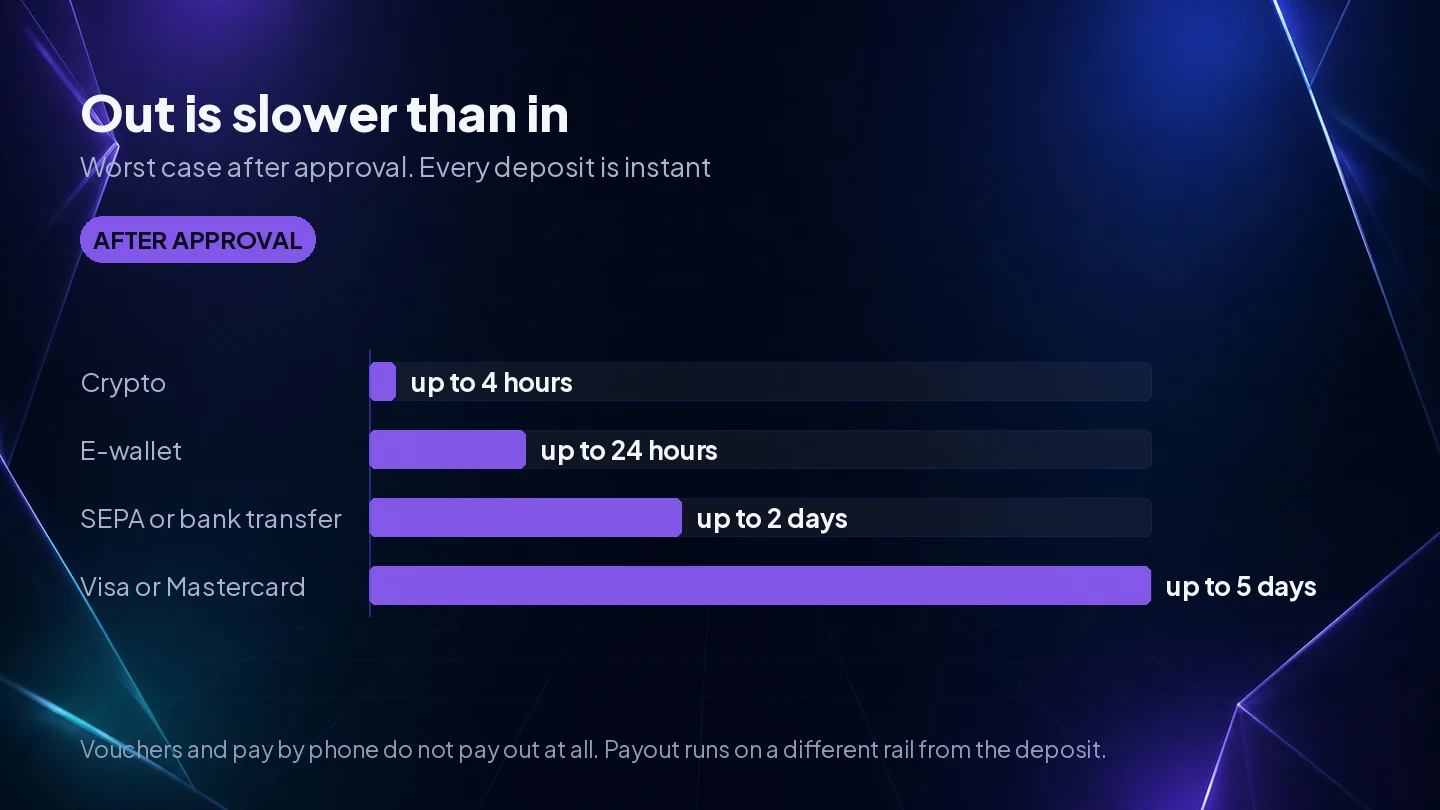
Method asymmetry: instant on the way in, slow on the way out
Deposits are optimised. Withdrawals are not. The gap is structural rather than malicious, but it is large and predictable, and picking your method with the outbound leg in mind is the second biggest saving available.
| Method | Deposit speed | Withdrawal after approval | The catch |
|---|---|---|---|
| Visa or Mastercard | Instant | 1 to 5 business days | Payout runs on a different rail from the purchase |
| iDEAL | Instant | Usually not supported outbound | Returns as a SEPA transfer, 1 to 2 business days |
| SEPA or bank transfer | Instant to 1 day | Same day to 2 business days | Bound by banking hours and cut-offs |
| E-wallet | Instant | Minutes to 24 hours | Wallet may charge to move funds onward |
| Crypto | Minutes | Minutes to a few hours | Network fee, confirmation depth, operator batching |
| Voucher or pay by phone | Instant | Not supported outbound | Needs a second method, with its own verification |
Three mechanics explain most of it.
A card payout is not a reversed card payment. Your deposit was an authorisation and capture. The payout returns as a refund against the original transaction or as an original credit transaction, and both run on the issuer’s timetable, not the casino’s. The processor may have released funds within an hour while your banking app shows nothing for three days. This is the most common false alarm we see: the money was sent, and the delay sits inside your own bank.
One-way methods have no return path. iDEAL, most pay by phone services and prepaid vouchers push money to a merchant and cannot push it back. The operator pays you another way: a second method on file, another verification step, the document queue again. We keep the limits on payment methods and on iDEAL current because this is where players most often get caught.
Closed loop rules split the payment. Anti money laundering practice, and most operators’ terms, require a withdrawal to return to the deposit method up to the amount deposited. Deposit 200 by card, win 3,000, and the payout splits: 200 to the card, 2,800 by bank transfer. Two rails, two timelines, one withdrawal as far as support is concerned.
Crypto is the honest outlier: settlement in minutes, no banking calendar. But the pending window and approval queue still sit in front of it, so a crypto cashier with a 48 hour reversal window is a slow product with a fast last mile. Fees and confirmation depth are in crypto casino payments explained and on the crypto payments page.
Weekends, cut-off times, and why a single measurement is worthless
Three of the four stages run on business hours. The approval team works office hours in the payments office’s timezone, the processor submits batches to a cut-off, and the banking rails settle on business days. The distortion that produces is repeatable: the same operator, same staff, same processor, can pay in forty minutes on a Tuesday morning and three days on a Saturday night. Nothing changed except that the request arrived after the last useful cut-off of the week.
Cut-offs cause the largest single jumps. A processor with a 15:00 deadline treats a payment released at 14:55 and one released at 15:05 completely differently: the first settles that day, the second joins tomorrow’s batch. On a Friday, the second waits until Monday. Ten minutes becomes seventy-two hours, invisibly.
So a single withdrawal timing tells you nothing. A forum post saying “paid in 20 minutes” is one sample, probably taken at the best moment by a verified account with a wallet on file. A post saying “five days, avoid” may be an unverified card withdrawal placed on a bank holiday. Both are true and neither is information.
Our approach is deliberately boring. We run repeated timed withdrawals per method per operator rather than one test. Each run records two timestamps, the moment the request is submitted and the moment the money is confirmed in the receiving account, and pending is logged separately from processing so a reversal window cannot hide inside a headline number. Requests go in at different points in the week on purpose, including after a Friday cut-off, because an average that only samples Tuesday mornings is a marketing number. The full method is on how we review.
Judge a cashier on its worst plausible case. If an operator does 20 minutes on a Tuesday and 4 days on a Saturday, you own the 4 days too.
Manual review, and why a large win gets looked at
Sooner or later a withdrawal is pulled out of the automated flow and put in front of a person. Players find this stage the most suspicious, and it is where suspicion is most often misplaced. Three things commonly trigger it.
Source of funds. Deposits that are large relative to the account history, or a sharp escalation in stake size, create an obligation to ask where the money came from. That is anti money laundering law rather than casino policy, and the operator cannot skip it. Expect requests for payslips or bank statements. Intrusive, and not optional.
Bonus compliance. If any part of the balance came from a promotion, the review checks the terms: wagering completed, no excluded games, no max bet breach, no irregular play pattern. Max bet clauses are enforced here rather than at the moment of the bet, which is why a player can breach one all evening without a warning on screen. If your win came off a bonus, read how wagering requirements work before arguing with support, because the clause is usually there and usually clear.
Responsible gambling flags. Rapid deposit escalation, chasing behaviour, or an account that has previously hit limits can route a withdrawal to a review about your welfare rather than your paperwork. Under several licences the operator must intervene rather than pay and continue.
An operator that never manually reviewed a large win would be failing its obligations, and regulators fine for exactly that. What separates a good operator from a bad one is whether it says a review is happening, names every document it needs in one message rather than five, and keeps to a timeline. Silence is the problem, not the review. The defence has a limit: a review running past ten working days with nothing outstanding from you and no stated reason has stopped being one.
Fees, minimums and monthly caps that turn one payout into five
The clauses that quietly cost the most are not about speed. They are about how much you may take out at a time.
Minimum withdrawal. Commonly 10 to 20 units. Harmless until your balance falls below it and the money is stranded unless you play it off.
Per transaction fee. Many cashiers advertise free withdrawals then charge for the second or third in a month, or for one method. On a small withdrawal a flat fee is a large percentage.
Monthly or weekly caps. The serious one. A cap of a few thousand a month is one line of the terms and unremarkable until the day it applies to you.
Work it through. You win 40,000. The terms cap withdrawals at 5,000 a month, with a 25 unit fee on any withdrawal after the first each month.
| Value | |
|---|---|
| Balance to withdraw | 40,000 |
| Monthly cap | 5,000 |
| Withdrawals needed | 8, one per month |
| Fees, one per month | 0 |
| Fees, split into two per month | 200 |
| Time to final payment | About eight months |
Eight months, during which the remaining balance sits in your account, visible, spendable, one click from a slot. The cap takes no money from you. It arranges for 35,000 of your winnings to stay inside a gambling product for most of a year, and it does not take a cynic to notice which way that points. Progressive jackpots have their own version, with large prizes paid in annual instalments under the game supplier’s rules. That is standard and disclosed, but know it before you chase one.
Read the withdrawal limits clause before you deposit. It sits under a heading like “Payments” or “Withdrawal policy” and takes ninety seconds to find. A low cap deserves more attention than any welcome bonus on the same account, which is why our guide to choosing an online casino treats it as a first-tier check.
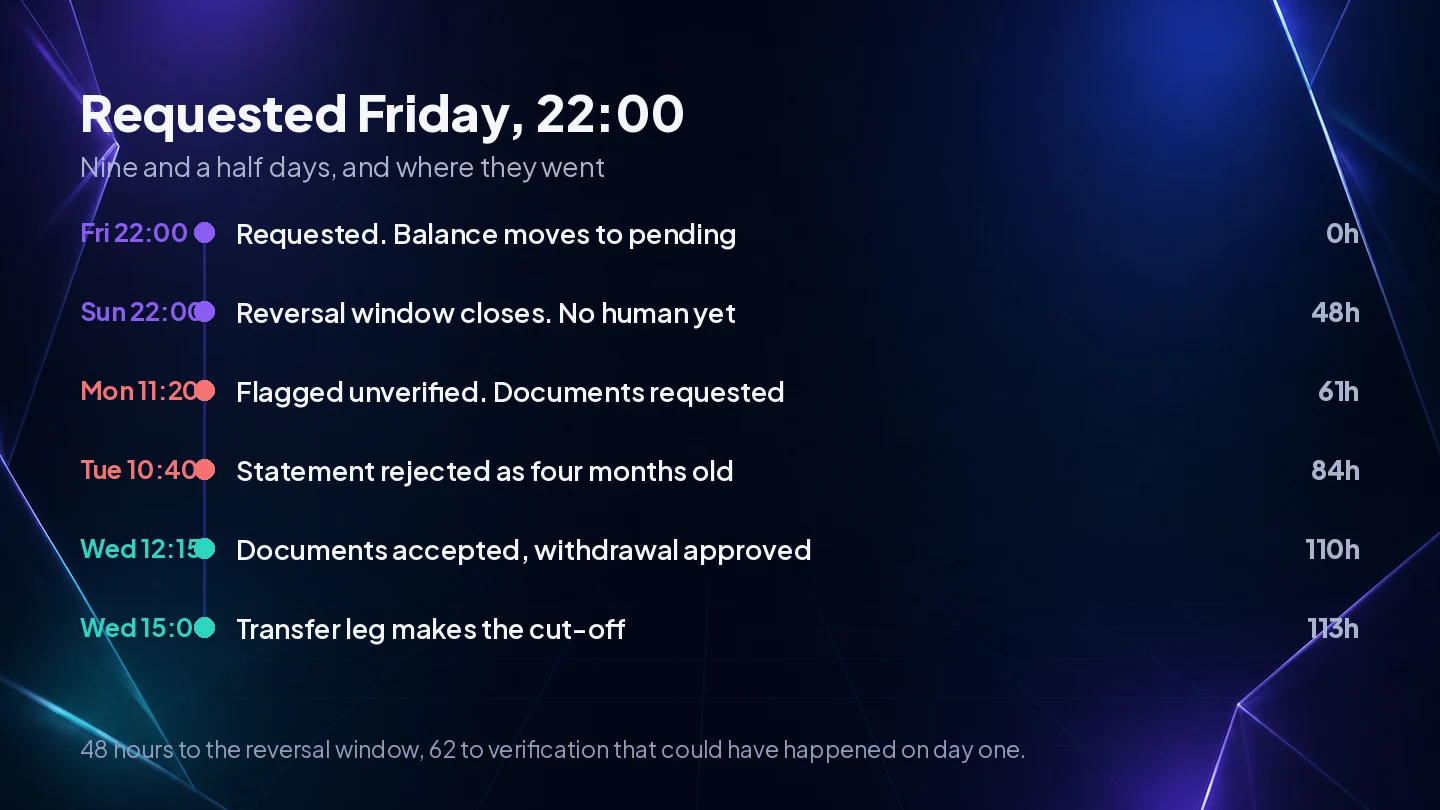
A worked timeline: request placed Friday at 22:00
One ordinary withdrawal, hour by hour. The player deposited 200 by card a fortnight ago, has never withdrawn, and requests 1,800. The operator runs a 48 hour reversal window, a payments team on 09:00 to 18:00 weekdays, and a processor with a 15:00 cut-off.
| When | What happens | Stage | Elapsed |
|---|---|---|---|
| Fri 22:00 | Requested, balance moves to pending | Reversal window opens | 0h |
| Sat, Sun | Nothing. No human sees it. Cancel button live | Reversal window | 0 to 48h |
| Sun 22:00 | Window closes, request joins the approval queue | Handover | 48h |
| Mon 09:00 | Team starts on the weekend backlog | Internal approval | 59h |
| Mon 11:20 | Flagged unverified. Email asks for ID and address | Verification triggered | 61h |
| Mon 19:00 | Player uploads passport and bank statement | Waiting on player | 69h |
| Tue 10:40 | Passport accepted, statement rejected as four months old | Document review | 84h |
| Tue 20:00 | Player uploads a current utility bill | Waiting on player | 94h |
| Wed 12:15 | Documents accepted, withdrawal approved | Approval complete | 110h |
| Wed 12:15 | Split: 200 to the card, 1,600 by bank transfer | Closed loop rule | 110h |
| Wed 15:00 | Transfer leg makes the cut-off | Processor | 113h |
| Thu 09:30 | 1,600 credited to the bank account | Banking rail | 131h |
| Thu to Mon | Card leg sits with the issuer as a refund | Banking rail | - |
| Mon 08:00 | 200 posts to the card | Complete | 226h |
Nine and a half days from request to the last cent arriving, against roughly forty minutes of anyone’s actual work. Everything else was a window, a queue, a weekend or a bank.
Note where the damage concentrates. Forty-eight hours went to the reversal window before a human was involved, and another sixty-two to verification that could have happened the day the account was opened. That is four and a half days of a nine and a half day wait, both avoidable. The same withdrawal, verified account, wallet on file, requested at 10:00 on a Tuesday at an operator with a one hour pending window, completes before lunch.
What to check in your own account, and what to ask support
Ten minutes before your first withdrawal, the best ten minutes in a casino account.
- Verify now. Photo ID and a proof of address dated within three months, before you deposit if the cashier allows it.
- Check the name match. Account, ID and payment method must read identically. Middle names, married names and shortened first names all cause rejections.
- Confirm the payout route exists. If you deposited by iDEAL or a voucher, find out how money comes back and whether it needs its own check.
- Read the withdrawal limits clause. Minimum, per transaction fee, weekly and monthly caps. Screenshot it.
- Find the pending window and the published processing time. Usually written as a “reversal period”. If neither is stated anywhere, that is itself informative, and a complaint is far stronger when it points at the operator’s own figure.
If a withdrawal is late, ask support these in order, in writing, and keep the transcript.
- “Which stage is this in: pending, awaiting approval, or sent to the processor?” This separates a design delay from a payment problem.
- “If it is pending, when does the reversal window close?” A date and time, not “shortly”.
- “Is any document or information outstanding from me?” A complete list, in one answer.
- “Has the payment been released to the provider, on what date and time?”
- “What is your maximum stated processing time for this method?” You are pinning down a deadline.
- “If it passes that, what is your complaints procedure and who is your dispute resolution provider?”
Never accept “it is with the bank” without a release date. That claim is either true and checkable or it is a stall, and one question tells you which.
When a delay stops being normal, and what to do next
Rough thresholds, judgement calls rather than rules.
| Situation | Still normal | Worth chasing | Worth escalating |
|---|---|---|---|
| Pending, window published | Within the stated window | Past it by a day | Past it, no explanation |
| Verification requested | 1 to 3 working days per submission | Day 4, or a third rejection | No response in 5 working days |
| Manual review, nothing outstanding | Up to 5 working days | Day 6 to 10 | Past 10, no stated reason |
| Approved, e-wallet or crypto | Up to 24 hours | Day 2 | Day 3 |
| Approved, card | 1 to 5 business days | Day 6 | Day 10 |
| Repeat rejections of one document | Twice | Three times | Four, no specific reason |
The escalation route, in order. First, the operator’s formal complaints procedure, in writing, quoting the timeline it published. Second, if that fails inside the stated complaints window, the alternative dispute resolution provider named in its terms. Every serious licence requires one to be named and it is free to use. Third, the regulator that issued the licence: the UK Gambling Commission, Spelinspektionen, the Kansspelautoriteit, Spillemyndigheden or the Malta Gaming Authority.
Two honest caveats. Regulators do not generally act as a debt collector for one payout, and a dispute resolution decision takes weeks. What both do reliably is create a record, and operators behave differently once a file exists. Check which regulator covers your account first, because complaining to the wrong one costs a fortnight.
What to do next, plainly. Verify today rather than on the day you win. Pick a payout method with a real return path, ideally one that does not depend on a card issuer’s calendar. Read the withdrawal limits clause before the welcome offer. Treat a long reversal window as a cost of playing there and a short one as the feature it is. Judge an operator on repeated payouts across different days of the week, not on the one that landed fast.
Most delays are process, not theft, and that is worth saying because the internet says otherwise. But process is designed, and slow design is a decision somebody made. Price that decision into where you play. Gambling is entertainment with a real cost attached, never a source of income.
In one paragraph
Most withdrawal delays are process, not theft. Here is what each stage of the wait really is, who controls it, and the point where it becomes a complaint.
Read next
Markets
Frequently asked questions
Why is my casino withdrawal still pending after two days?
Almost always because the operator has set a reversal window, usually 24 to 72 hours, during which your request sits untouched and you are allowed to cancel it. Nobody is reviewing anything in that period. Processing only starts when the window closes, so a two day pending status is the design working as intended.
Can a casino refuse to pay a verified winning withdrawal?
It can withhold one while it checks bonus terms, source of funds or responsible gambling flags, and under most licences it is obliged to do some of that. It cannot refuse indefinitely without a stated reason. If a licensed operator gives no reason and no timeline after a week, that is the point to escalate to its dispute service.
Does completing KYC before depositing make withdrawals faster?
Yes, and it is the single largest saving available to you. Verification triggered at withdrawal typically adds two to five days, because documents queue behind other documents and one rejected file restarts the loop. Uploading ID and proof of address on day one moves that work off your withdrawal timeline entirely.
Why did my card withdrawal take five days when the deposit was instant?
A card deposit and a card payout run on different rails. The payout goes back as a refund or original credit transaction, which the processor batches and the card issuer posts on its own schedule, commonly one to five business days. The casino may have released the money on day one and your bank still shows nothing.
Is there a monthly limit on how much I can withdraw?
Often yes, and it is one of the most expensive terms in a cashier. Caps of a few thousand a month are common, and progressive jackpot wins are sometimes paid in instalments. On a large win a cap can stretch payment across months. Check the withdrawal limits clause before you deposit, not after you win.
More from the blog
-
 safety How to Verify a Casino Licence in Five Minutes A licence badge is an image file. The only thing that counts is the entry on the regulator's public register, and checking it takes about five minutes.
 -
 safety KYC Checks at Online Casinos, Explained Verification is a licence condition, not an operator invention. But the moment an operator chooses to run it is a business decision, and that choice is what turns a ten minute upload into a fortnight of chasing support.
 -
 bonuses Max Bet Rules and How One Spin Voids a Win The max bet clause is the shortest sentence in most bonus terms and the one that costs players the most money. This is what it covers, how a single spin breaches it, and what an operator is allowed to do next.

Niels Zijp
Payments & Withdrawals Tester since 2024
Niels Zijp tests the cashier. At LSM99 he is the Payments and Withdrawals Tester, a role he has held since 2024, which means he runs money through an operator and times what happens: how long a deposit takes to credit, how long a verified withdrawal actually takes to land. He owns the payments sections of our reviews and the comparison pages that sit alongside them. When this site quotes a payout window, that figure came off his stopwatch. It is a measured number, not a promise repeated from a help page.



Play responsibly
Gambling is entertainment, not income. Set a deposit limit before you play, never chase a loss, and stop when it stops being fun. If it has become a problem, these services are free and confidential.
Our responsible gambling guide carries no affiliate links and no casino list.