
Guide
How to Verify a Casino Licence in Five Minutes
A licence badge is an image file. The only thing that counts is the entry on the regulator's public register, and checking it takes about five minutes.
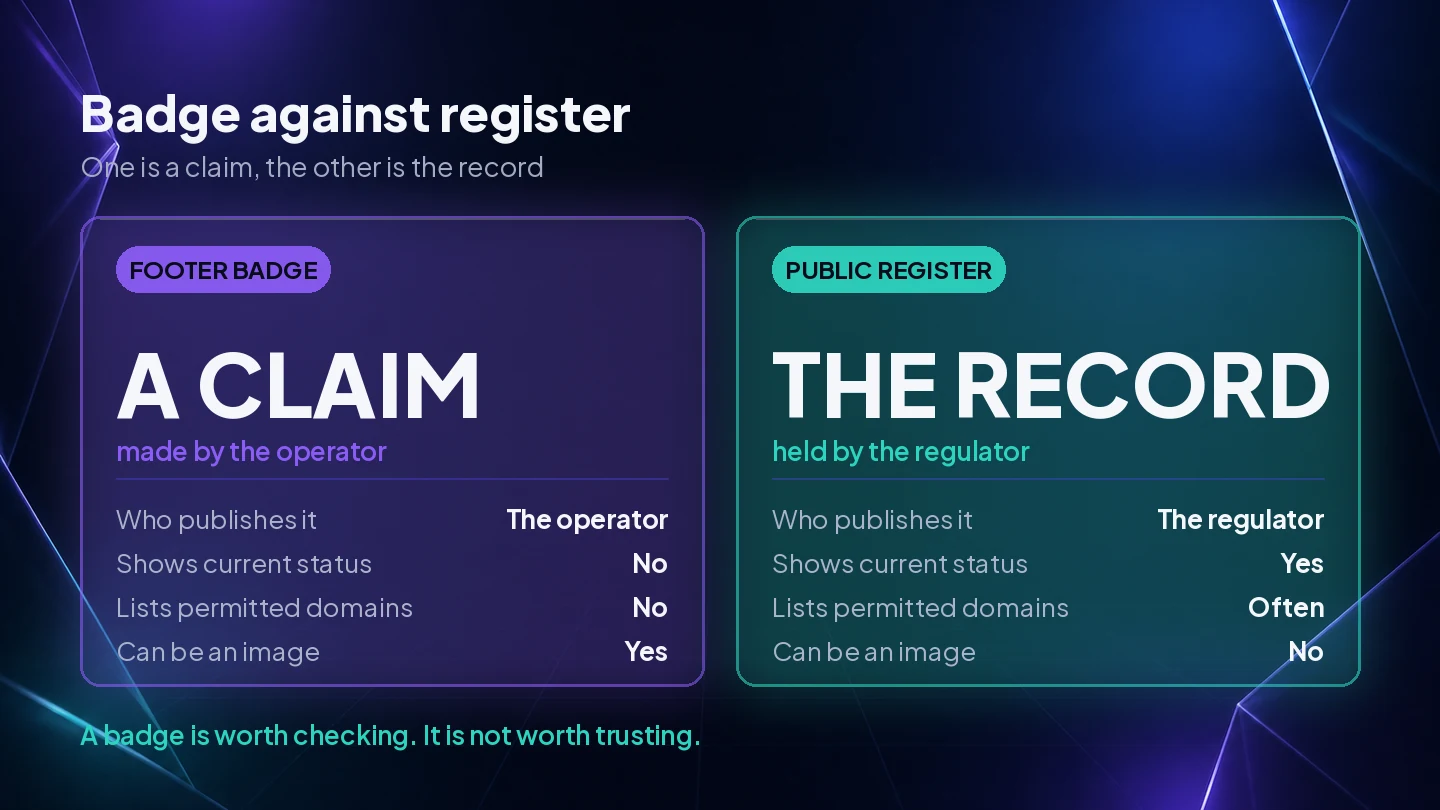
The badge at the bottom of a casino site is a picture. It is an image file served from that site’s own server, and copying one takes about as long as a right click. Nothing about it is verified by anyone at the point where you see it. The only thing that proves a casino is licensed is an entry on the regulator’s own public register, under the exact legal entity that runs the site, showing an active licence for the activity you are about to play.
The check takes about five minutes the first time and under two once you have done it twice. You need three things off the casino site: the legal name of the operating company, the licence or account number, and the domain you are standing on. Then you open the register, search, and compare all three.
This guide covers the seven regulators that matter most for the markets we write about, where each register lives, and what a complaint route actually gets you. It also covers the two failure modes people miss: a real licence held by a different company than the one taking your money, and a real licence that does not cover the country you are sitting in. Both look like a pass at a glance. Neither is one.
Why the footer badge means nothing on its own
Three things make the badge worthless as evidence.
It is an image. There is no cryptographic link between a PNG on a website and a licence held by a company. Some regulators issue a dynamic seal that calls back to their own server, and those are better, but most of what you see in footers is a static graphic that renders identically whether or not the licence behind it exists.
It can be copied. The badges on unlicensed sites are usually not forgeries at all. They are the genuine article, lifted from a licensed operator’s footer, with the number left in place or a plausible-looking one substituted. A number belonging to somebody else looks exactly as convincing as a number belonging to nobody.
It says nothing about scope. Even a real, correctly attributed badge tells you only that a company holds some licence. Not that it is current, that it covers casino games rather than only sports betting, that it covers the domain you are on, or that it has not been suspended since the image was uploaded.
The register solves all three problems at once, because it is the regulator’s own record rather than the operator’s claim about it: status, permitted activities and, in several jurisdictions, the specific web addresses that operator may run. Our review methodology puts this check first for a reason. Everything else about a casino, from bonus terms to withdrawal speed, is meaningless if the licence does not hold up.
The check, step by step
Step one: get the operating entity and the number
Scroll to the very bottom of the homepage. You are looking for a sentence, not a graphic. In most licensed markets that sentence is mandatory and follows a fixed shape: a company name, a statement that it is licensed and regulated by a named authority, and a number.
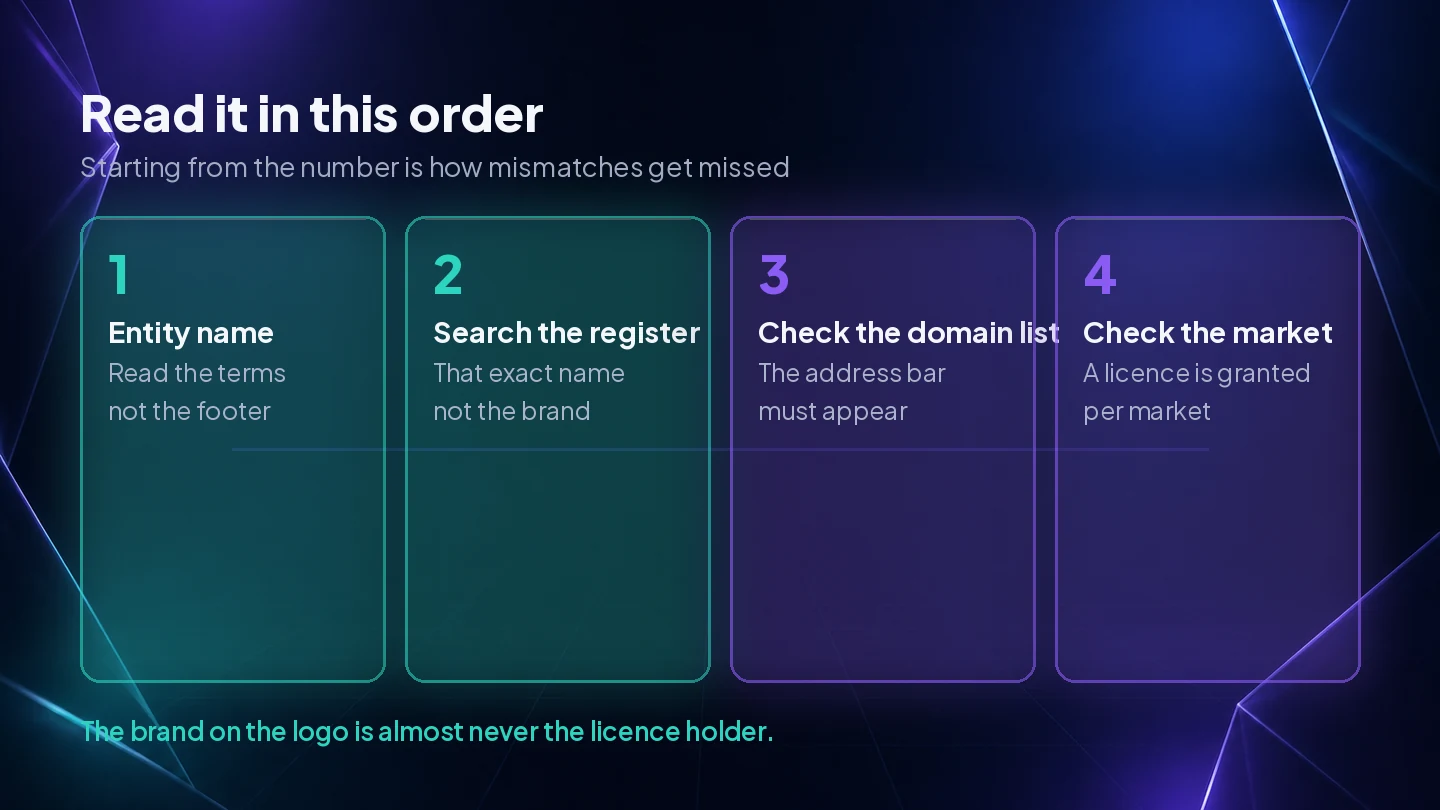
If the footer gives you a badge but no text, go to the terms. The operating entity is almost always named in the first clause, or under Definitions, About Us or The Company. You want the full legal name including the suffix (Ltd, Limited, N.V., B.V., plc, SAS), the registration number if given, and the registered address. Write them down before you open the register, because the most common failure is a reader who searches the brand name, finds a similar-looking company, and calls it a match.
Step two: open the register, not a search engine
Type the regulator’s domain directly, or use the links in the table below. Do not search the regulator’s name and click the first result: affiliate and lookalike domains rank for those queries, and some host their own copy of a “register” that is really a marketing list. If you cannot reach the register from the homepage in two clicks, look for a menu aimed at players rather than businesses. The lists sit under a player, consumer or licensing section, never under news.
Step three: search on the strongest field available
Search by whatever the register indexes most reliably, in this order:
- Domain. The strongest field where it is offered, because it links the licence directly to the site you are on. The British and Maltese registers both allow it, and the Swedish register publishes the web addresses of online and betting licensees.
- Licence or account number. Precise, but only useful if the operator quoted it correctly. A number that returns nothing is a finding in itself.
- Legal entity name. Reliable, but match the full name, not the brand. Brand name alone is the weakest option and the likeliest to produce a false pass.
Step four: compare, field by field
A match is not “I found something with a similar name”. It has to satisfy all four of these at once:
The entity name is identical to the one in the terms and conditions, including the corporate suffix. Casino Group Ltd and Casino Group N.V. are different companies.
The licence status is active. Registers do not delete lapsed entries, they mark them. The British register shows statuses including Active, Expired, Revoked and Suspended. Finding a revoked licence is worse than finding nothing, because the operator is displaying a badge for a permission it no longer holds.
The permitted activities cover what you intend to play. A remote betting licence does not authorise slots. A B2B licence authorises supplying games to other operators, not taking your deposit. This is where a real number attached to the wrong scope slips past people.
The domain you are on is listed, in jurisdictions where the regulator lists domains. If the approved web addresses are published and yours is not among them, that is a fail regardless of how healthy the rest of the entry looks.
One British detail: the Gambling Commission’s register flags each domain as Active, Inactive or White label. The third one matters, and the next section explains why.
Worked example: turning a licence number into the number you search
British operators do not usually print their full licence number. They print an account number derived from it, and the derivation is published by the Gambling Commission in its guidance on displaying licensed status. Take a licence number in the standard format:
000-012345-N-987654-001
The steps:
- Take the first six digits of the licence number. Here that is
000012. - Remove the leading zeros. The Commission’s guidance is explicit that leading zeros must be omitted.
- What remains is
12345. That is the account number. - That five-digit number is what the operator must display in its footer, inside the required sentence: “(licensee’s name) is licensed and regulated in Great Britain by the Gambling Commission under account number 12345”.
- It must be a hyperlink pointing to that licensee’s specific record on the public register, not to the register homepage and not to the Commission’s front page.
Point five gives you a free test. Click the account number in a British site’s footer. If it lands on the operator’s own record, showing the same company name you read in the terms, you have done most of the check in one click. If it lands on a generic page or on nothing at all, do the search manually and treat the failure as a mark against the site.
The entity trap: the brand is not the licence holder
This is the failure mode that catches careful readers, because everything about it looks legitimate. A casino brand is a marketing asset; a licence is held by a company. The two are often the same, and often not. Three variants show up repeatedly.
The licence is real and belongs to someone else entirely. The number in the footer resolves to an active licence held by a company with no stated connection to the site you are on. Nothing is forged; the number was taken from a licensed operator. If the terms name one company and the register entry names a different one, the check has failed, no matter how healthy that other company’s entry looks.
The licence is real, held by the right company, and covers a different brand. Group structures are messy. One company can run several casino brands and, where domains are registered, will have each approved site listed. If the register lists four domains and yours is not one of them, the company is licensed but this site is not covered by that permission.
The white label arrangement. The site operates under a licence, but the licence belongs to a platform provider rather than to the brand’s own company, and the British register flags those domains as White label. Player funds, complaints handling and account closure decisions may sit with a company you have never heard of, whose name appears only in clause 1 of the terms. What it changes is who you complain about and who your money is actually with.
A player spots all three in one move: read the terms for the entity name first, search the register for that exact name second, check the domain list third. In that order the mismatch is obvious. Starting from the number instead makes it easy to see an active licence and stop reading.
Scope and market: a valid licence that does not cover you
You can pass every check above and still be outside the licence, because a licence is granted for a market.
A Malta licence authorises remote gaming under Maltese law. A British operating licence authorises gambling to consumers in Great Britain. A Swedish licence authorises gambling in Sweden. They are not interchangeable, and an operator’s obligations are written in terms of the market its regulator supervises. Three practical consequences follow.
Dispute routes. Regulators supervise operators; they do not act as your lawyer, and an escalation route is built for that jurisdiction’s consumers. If you are in Sweden playing at a Malta-licensed operator, the Swedish consumer complaints route is a poor fit and Swedish gambling law does not bind that operator. That is the concrete cost of choosing an MGA casino over a locally licensed one.
Self-exclusion. National registers only bind operators licensed in that country. Spelpaus binds Swedish licence holders, GAMSTOP British ones, CRUKS Dutch ones. An operator licensed elsewhere is connected to none of them, which is precisely why some sites are marketed on that basis. We cover the mechanics in self-exclusion schemes explained. If you are self-excluded and reading this looking for the gap, close the tab and read our responsible gambling page instead.
Local funding and limit rules. Market-specific protections travel with the licence, not with you. Sweden’s ban on gambling funded by credit binds Swedish licence holders, as we set out in the Swedish credit ban and Spelpaus changes. Deposit limit regimes work the same way. A site outside that licence is not breaking those rules by ignoring them, because they were never addressed to it.
None of this makes an offshore licence worthless. It makes the trade explicit: fewer mandatory protections and a weaker complaints route, usually in exchange for looser verification or wider payment options. Players looking for a casino uden Rofus or an online casino buitenland are making that trade whether or not anybody has spelled it out.
The regulators we cover, and what each licence actually buys you
| Regulator | Where the register is | What the licence covers | Player complaints route | Protection in practice |
|---|---|---|---|---|
| UK Gambling Commission | Register of gambling businesses, searchable by business name, trading name, domain name or account number | Gambling to consumers in Great Britain, split by activity, with trading names and domains listed per licensee | Operator first, then an approved ADR provider after 8 weeks or a deadlock letter. The Commission does not settle individual disputes | Strongest of the set. Domains and white label status are published, statuses and regulatory actions are visible, ADR is free |
| Spelinspektionen (Sweden) | Licensregister, listing valid licence holders and the web addresses of online and betting licensees | Gambling offered in Sweden, by licence type, with site addresses published for online and betting | Operator first, then Allmanna reklamationsnamnden. Marketing and terms complaints go to Konsumentverket | Strong. The regulator says plainly it cannot pursue a dispute between you and a licence holder, so the consumer board is the real route |
| Kansspelautoriteit (Netherlands) | Kansspelwijzer, searchable by name | Gambling offered in the Netherlands, online and land-based | Operator first. The Ksa states it cannot solve your problem and cannot mediate personally, and points players to legal advice services | Strong on prevention, weak as an adjudicator. CRUKS and deposit limit rules are the substance, not case-by-case redress |
| ANJ (France) | Operateurs agrees, giving legal entity, site names and category | Online betting and card games. The published categories are paris sportifs, paris hippiques and jeux de cercle | Operator first, then the mediateur des jeux after a 20 day wait. The mediator’s proposal is not binding | Good, with a narrow scope. If a site offers slots to French players, its absence from the list is the answer |
| Spillemyndigheden (Denmark) | Licensed gambling operators, excluding slot machine licences and game suppliers | Gambling offered in Denmark under Danish licence | Operator first, which must resolve promptly or give a status within 14 days, then Center for Klageloesning | Strong. The authority states it cannot settle disputes, so the consumer complaint centre carries the load |
| Malta Gaming Authority | Licensee register, searchable by licensee name, authorisation status, URL or gaming service | Remote gaming under Maltese law, by licence type, with approved URLs listed | Operator first, then the MGA’s Player Support Unit or another ADR entity | Middling to good. A real complaints channel exists and outcomes vary. Not a substitute for a licence in your own market |
| Curacao Gaming Authority | Licence register, published as document overviews covering online gaming licences, land-based casinos, certificate holders and enforcement | Online gaming under Curacao law, now issued directly rather than through master licence holders | The CGA states it does not handle individual complaints against gaming providers and that resolving player disputes is not within its mandate | Weakest of the set for redress. The reform improved the licensing structure without giving players an adjudicator |
What the Curacao LOK reform did and did not change
Curacao is the jurisdiction most often misread, in both directions, so be precise about what is verifiable.
The Curacao Gaming Authority states that it began a phased reform of the online gaming regime in November 2023, and that the Landsverordening op de kansspelen, the National Ordinance on Games of Chance known as the LOK, came into effect on 24 December 2024. Under the LOK the body previously known as the Gaming Control Board is referred to as the Curacao Gaming Authority.
What changed: licences are issued directly by the authority rather than through the old master licence structure, in which a handful of master licensees issued sublicences to operators the regulator had little direct relationship with. LOK licences are non-transferable and cannot be used by other parties to operate under. The authority publishes register overviews, including an enforcement register, on its own site.
What did not change: the authority is explicit that it does not handle individual complaints against gaming providers, and that resolving player disputes is not within its mandate. It has said it intends to introduce a standardised claim form. Until an independent adjudicator exists and is used, a Curacao licence is a statement about regulatory status, not a promise that somebody will hear your case if a withdrawal is refused.
Red flags, in rough order of seriousness
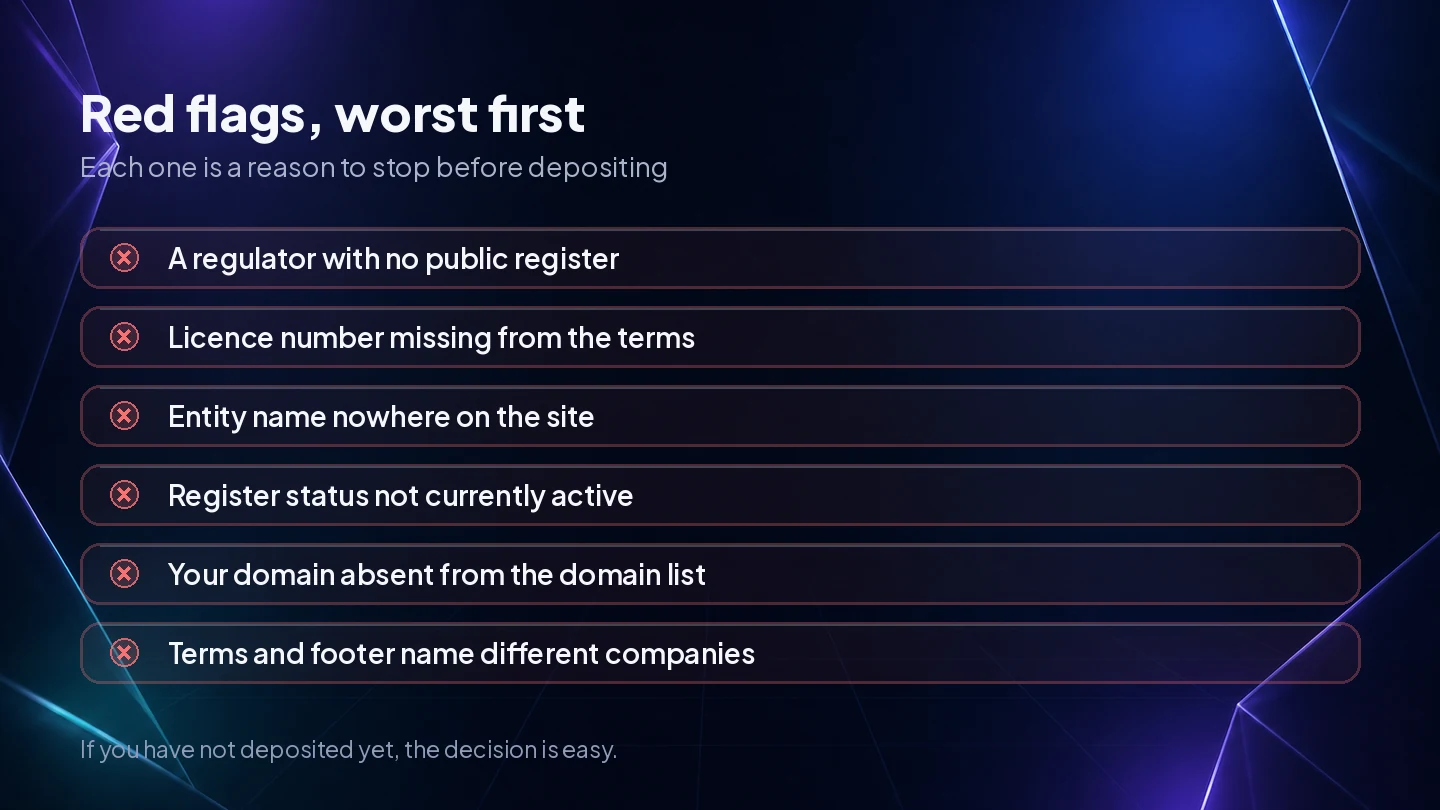
A badge with no number. The logo is there, the number is not. Nothing to verify, which is usually the point.
A number that returns nothing. Try once more without spaces or punctuation, then stop. Regulators do not hide active licensees from their own registers.
An entity that does not match. The number resolves, but to a company that is not the one named in the terms. The classic copied badge, and a fail even though the licence you found is genuine.
A register entry that is revoked, expired or suspended. Worse than an absent entry, because the operator knows and is displaying the badge anyway.
A licence that covers a different vertical. Entry active, entity matching, but the permitted activities cover betting when you are about to play slots, or it is a supplier licence rather than an operator licence. Read the activity list, not just the status.
A domain that is not listed, in registers that publish approved web addresses.
A regulator you cannot find a register for. No public register means nothing to verify, and a badge that is decorative by design.
What to do if the check fails
If you have not deposited, the decision is easy: do not. Our casino reviews and our guide to choosing an online casino both start from the licence, so if a site is not in there, that is often why. If you have already deposited, work in this order.
Withdraw the full balance now, before you raise anything with support. A withdrawal request made while an account is in good standing behaves differently from one made after you have accused the operator of running without a licence. Expect KYC checks here, because the withdrawal is usually the trigger for them.
Stop depositing and remove stored payment methods. Delete saved cards, and cancel recurring or pre-authorised payments at your bank rather than only at the site.
Screenshot everything. The footer, the terms clause naming the entity, your balance, your transaction history, and the failed register search with the URL visible. If the site later changes its footer, your screenshot is the only record that it once made that claim.
Go to the payment provider, not the regulator. People get this backwards. If the site is not licensed anywhere useful, no regulator has jurisdiction to help you. Your leverage sits with whoever moved the money.
Now the uncomfortable part: what you can realistically recover.
Card payments are your best case. Chargeback rights exist through the card schemes and, in some markets, extra statutory protection applies to credit card purchases. Timeliness matters enormously; a dispute raised within weeks is a different conversation from one raised after months.
E-wallets and payment initiation services sit in the middle. Some run their own dispute processes and will act on evidence that a merchant misrepresented its regulatory status. Others will tell you the transaction was authorised by you and close the case.
Bank transfers are hard. You authorised a push payment to a named beneficiary, so recovery depends on your bank’s goodwill, on scam reimbursement rules where they exist, and on whether the receiving account still holds funds.
Crypto payments are effectively final. No scheme, no issuer, no reversal. Treat the money as gone and act to stop further loss. That asymmetry is the strongest argument for checking before you fund an account rather than after.
What you generally cannot recover: losses from play itself, on the theory that the games were unfair. Proving that needs evidence you do not have and a forum willing to hear it. The realistic goal is deposits back, not litigating outcomes.
Your five minute checklist before you deposit anywhere
Run this once per new site. It gets faster every time.
Minute one. Scroll to the footer. Find the licensing sentence, not the badge. Copy the entity name and the number into a note.
Minute two. Open the terms and confirm the same entity name appears there, with a registration number and address. If the two disagree, stop and find out why.
Minute three. Open the register from the regulator’s own domain. Search by domain if supported, otherwise by number, otherwise by full entity name.
Minute four. Check four fields: entity name identical, status active, permitted activities cover casino games, your domain listed where domains are published.
Minute five. Check market fit. If the licence is not for the country you are in, accept consciously that you get a weaker complaints route and no national self-exclusion coverage, and set your own deposit limit before the first deposit rather than after the third.
Keep a short note of which register you used for which site and the date. Licences lapse, get suspended and get surrendered, so a check from eighteen months ago is not a check. Our UK casino pages list the account number alongside each operator so you can run step three without hunting for it.
What to do next
Pick the site you played at most recently and run the checklist before you next log in. Most readers find a clean pass, and the value is entirely in the cases that do not.
Three habits are worth keeping. Verify before the first deposit, never after a problem starts. Verify the entity rather than the brand, because the entity is what the register knows about and what your money is legally with. Verify the market rather than just the licence, because a licence for somebody else’s country gives you a badge you can check and a complaints route you cannot use.
If the check fails, that is the whole answer. No mismatched register entry gets better once your balance is larger. And if you are looking outside your own market because your own market has locked you out, the licence is not the problem to solve. Start at our responsible gambling page instead.
In one paragraph
The badge in the footer proves nothing. Here is how to find the licence number, search the regulator's own register, and spot an entity that does not match.
Read next
Markets
Frequently asked questions
Is the licence badge in the footer proof that a casino is licensed?
No. A badge is an image file, and an image file can be copied from any licensed site in about two seconds. The only proof is a matching entry on the regulator's own public register, under the exact legal entity named in the site's terms. Treat the badge as a claim to be tested, never as evidence.
How do I find the operating company behind a casino brand?
Look at the very bottom of the homepage, then at the terms and conditions, usually in the first clause or in a section headed About Us or Definitions. You want a full legal name, a company or registration number, and a registered address. If the site never names a company anywhere, stop there.
The licence is real but my country is not covered. Does that matter?
Yes, practically. A licence binds an operator to one regulator's rules for one market. If you are outside that market, that regulator's complaints route, deposit limits and national self-exclusion register are not built for you, and the operator can argue you were never its regulated customer.
What does the Curacao LOK reform actually change for players?
The Curacao Gaming Authority says the LOK came into effect on 24 December 2024 and replaces the old master licence structure with direct, non-transferable licences. It does not give you an adjudicator. The authority states plainly that it does not handle individual complaints against gaming providers.
What can I recover if the licence check fails after I have deposited?
Realistically, less than you would hope. Withdraw the balance immediately and stop depositing. Card chargebacks and payment provider disputes are your strongest remaining tools, and they work far better within weeks than months. Bank transfers and crypto payments are usually gone for good.
More from the blog
-
 safety KYC Checks at Online Casinos, Explained Verification is a licence condition, not an operator invention. But the moment an operator chooses to run it is a business decision, and that choice is what turns a ten minute upload into a fortnight of chasing support.
 -
 bonuses Max Bet Rules and How One Spin Voids a Win The max bet clause is the shortest sentence in most bonus terms and the one that costs players the most money. This is what it covers, how a single spin breaches it, and what an operator is allowed to do next.
 -
 bonuses How Wagering Requirements Actually Work A wagering requirement is not a scam and it is not a formality. It is the price you pay for a bonus, and it is written in a way that makes that price hard to read. This is how to read it.

Aristotelis Kourtelis
Licensing & Player Protection Analyst since 2024
Aristotelis Kourtelis is the Licensing and Player Protection Analyst at LSM99, and the reason a brand does not reach the top of a list on its bonus alone. He joined in 2024 and works at the front of the review process, before any scoring happens. LSM99 rates every casino across six weighted sections, licensing and safety, payouts, bonus fairness, game range, support and mobile, and Aristotelis owns the first of those. If the licensing work fails, the other five sections do not rescue the brand. He reads bonus terms, KYC triggers and self-exclusion rules closely, because those are the clauses that decide whether a win is really a win.



Play responsibly
Gambling is entertainment, not income. Set a deposit limit before you play, never chase a loss, and stop when it stops being fun. If it has become a problem, these services are free and confidential.
Our responsible gambling guide carries no affiliate links and no casino list.