
News
Sweden Bans Gambling on Credit and Rebuilds Spelpaus
Two Swedish rule changes landed months apart and both hit the player, not the boardroom: a full ban on funding gambling with borrowed money, and a rebuilt technical standard for how operators query the Spelpaus self-exclusion register.
Show moreShow less
Two things changed for Swedish players this year, and both of them show up in places you actually touch: the deposit screen and the login screen. On 1 May 2026 a full ban on gambling financed by credit came into force, replacing a narrower rule that had been in the Swedish Gambling Act since 2019. On 1 August 2026 a new binding regulation from Spelinspektionen set out exactly how licensed operators must query the Spelpaus.se self-exclusion register, down to the credentials they use and the interface they call.
The short version at the cashier: a deposit that cleared in April on a credit card, an overdraft or an invoice-later product should be declined in May at any site holding a Swedish licence. The short version at login: the check against Spelpaus is no longer something an operator can wave through, and the same tightening applies before they send you an addressed email or text.
Neither change touches sites outside the Swedish licence, and that gap is the whole reason this article is longer than a news brief. If you go looking for a casino utan Spelpaus or an utlandska casino, you are stepping outside both of these protections at once, and you should know exactly what you are giving up before you do it. If you are currently self-excluded and reading this to find a workaround, close the tab and read our responsible gambling page instead. That is the honest answer, not a disclaimer.
What the credit ban actually says
The change is SFS 2026:90, an amendment to the Swedish Gambling Act (2018:1138) passed by the Riksdag and in force from 1 May 2026. It rewrites Chapter 14, Section 8 and adds a new Section 8 a.
The new wording is short and blunt. Licence holders and gambling agents may not allow or assist gambling being financed with credit, and they must take appropriate measures to counteract it. That is two duties, not one: a prohibition on letting it happen, and a positive obligation to build systems that make it harder.
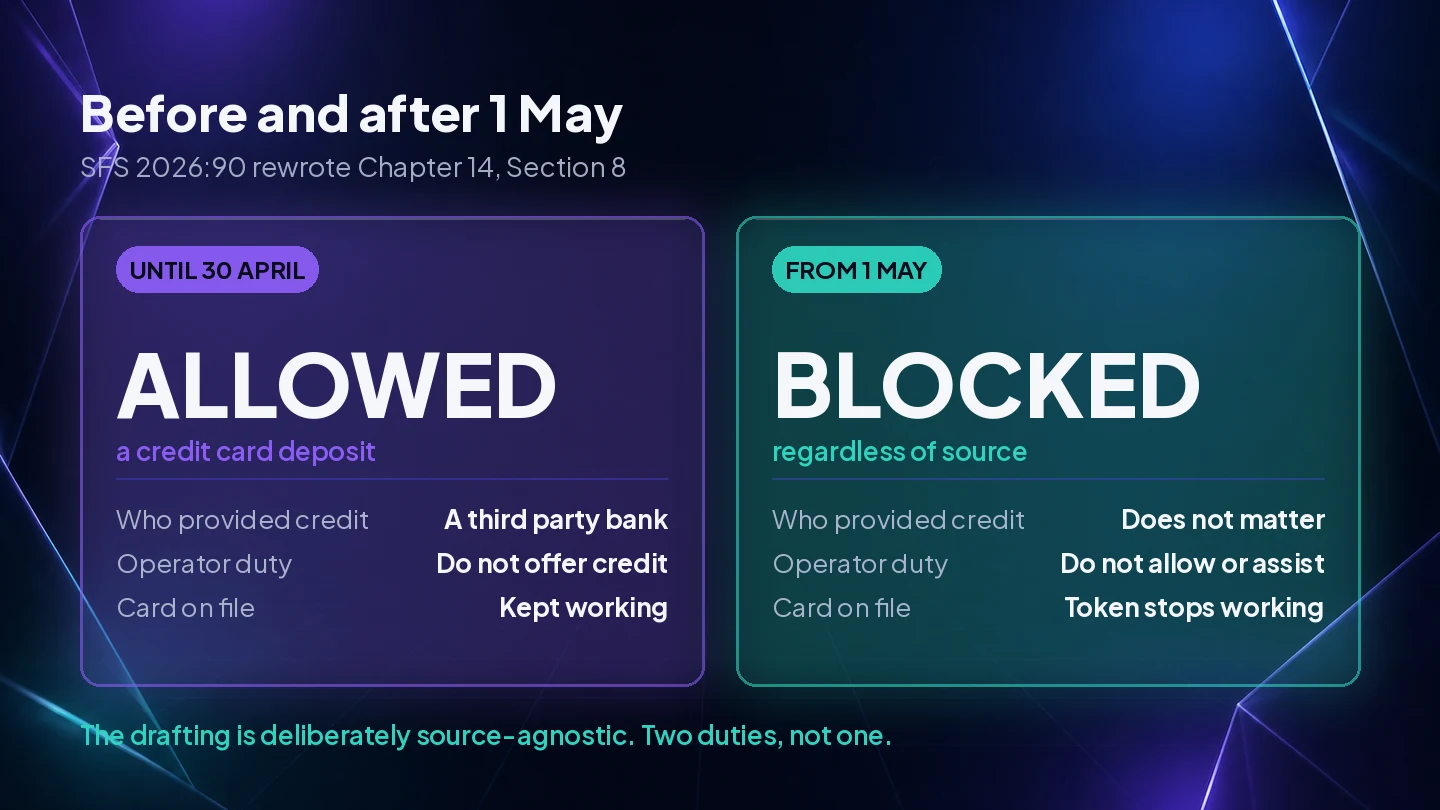
The old rule it replaced was narrower. It said only that a licence holder or agent could not offer or provide credit for stakes in the game. In other words, the operator could not be your lender. It said nothing about the operator accepting money you had borrowed from somebody else. The government’s own preparatory work described this as an obvious deficiency: an operator could link out to a credit provider, accept a card that was a credit product in everything but name, or take payment via a mobile phone invoice, and stay technically compliant the whole time.
The stated principle behind the change is that people should not bet with borrowed money. That is a policy sentence, not a legal test, but it explains why the drafting is deliberately source-agnostic. The prohibition applies regardless of who provided the credit and regardless of what the loan was originally for. A consumer loan taken out for a kitchen renovation and then spent on slots is credit-financed gambling under this rule.
Where the ban stops
Two limits matter for reading this correctly.
First, the duty falls on operators, not on payment companies and not on you. Card issuers and payment service providers were not given new obligations by this amendment. Neither were players. There is no penalty for a Swedish citizen who funds a bet with a credit card. You simply carry the whole financial risk, and the operator is the one facing regulatory consequences for letting it through.
Second, operators are not required to run forensic accounting on every deposit. The preparatory work is explicit that licence holders do not have to conduct extensive investigations of where each krona came from, and are not expected to impose blanket blocks that would also stop unrelated purchases. What they must do is refuse a transaction when they know credit is involved, remove credit as a payment option where it is technically possible, and inform customers.
That second limit is why the ban is real at the cashier and fuzzy in the bank account. Blocking a credit card at checkout is a technical control the operator can actually implement. Detecting that the 5,000 kr sitting in your bank account arrived there yesterday from a consumer loan is not something an operator can see, and the law does not pretend otherwise.
What changes on the deposit screen
Here is how the payment landscape at a Swedish-licensed site looks after 1 May, based on the rule’s own logic rather than on any single operator’s cashier.
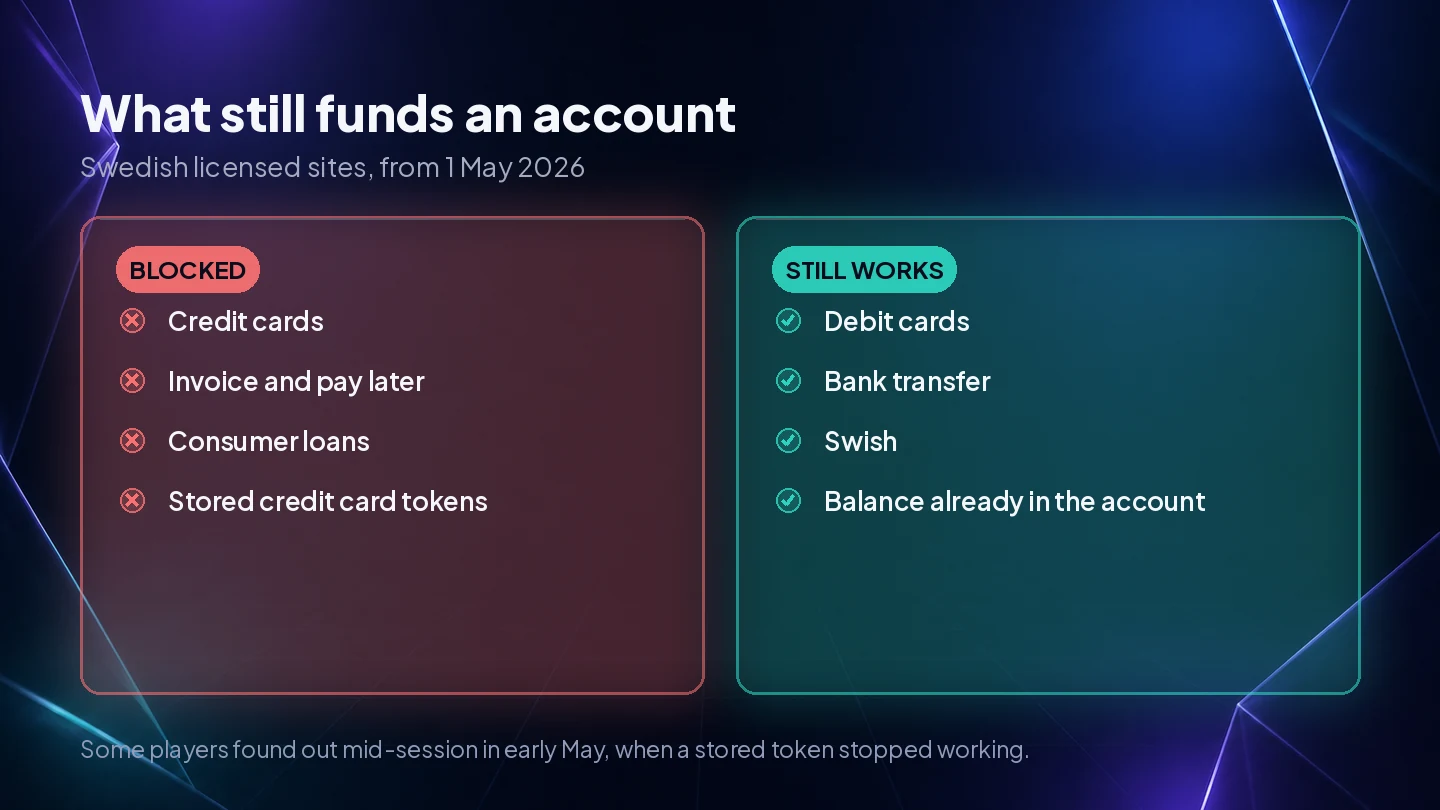
| Funding method | Status at a Swedish licensed site | Why |
|---|---|---|
| Debit card | Allowed | Your own money, no deferral |
| Credit card | Blocked | Credit product, technically blockable |
| Swish or transfer from a positive balance | Allowed | Own available funds |
| Transfer drawing on an approved overdraft | Prohibited but hard to detect | Credit the operator cannot see |
| Invoice or pay-later checkout | Blocked | Deferred payment is credit |
| Consumer loan money sitting in your account | Prohibited but invisible | Traceability breaks in the bank account |
| Money borrowed from a friend | Prohibited but undetectable | Covered in wording, not at the cashier |
| E-wallet topped up from a credit line | Blocked where visible | Depends how the wallet is funded |
The column that matters is not “allowed” versus “blocked”. It is the gap between what the law prohibits and what an operator can see. The ban closes the visible channels and leaves the invisible ones covered on paper only. If you are reading that gap as a loophole, that thought is the reason the law exists.
Our payments hub covers the mechanics of individual methods in more detail, including which ones settle instantly and which add a business day.
The worked example: 1,480 kr and why that number exists
The new Section 8 a is the only place the law lets credit near a stake, and it is worth walking through because it shows how small the tolerance is.
Spelinspektionen may grant an exception from the credit ban for licensed lotteries, excluding party political lotteries, where special circumstances exist and the licence holder ensures the total credit amount per person does not exceed one fortieth of the price base amount.
The arithmetic, step by step:
- Start with the price base amount for 2026, set by the government at 59,200 kr.
- Divide by 40. That gives 1,480 kr.
- That is the maximum aggregate credit a single subscriber to an exempted charity lottery may run up.
- The exemption is discretionary, not automatic. An operator must apply and show special circumstances.
- Even with an exemption, the duty to take appropriate measures against credit-financed gambling still applies.
Because the cap tracks the price base amount rather than a fixed sum, it moves every year with the index. This is the only credit that survives inside the Swedish licence, it applies to subscription-style charity lotteries rather than casino play, and 1,480 kr a year is roughly what one unchecked evening of slot play can cost. That contrast is the point.
Why your April deposit worked and your May deposit did not
Walk through a concrete sequence. Nothing here names a real operator; treat it as the shape of the thing.
On 20 April, a player deposits 2,000 kr at a Swedish-licensed casino using a card. The card is a credit card. The cashier accepts it, the funds appear instantly, the player plays. Under the old Chapter 14, Section 8, the operator had not offered or provided credit; a third-party bank had. Nothing in the wording required the operator to care.
On 4 May, the same player, the same account, the same card, the same 2,000 kr. This time the deposit fails. The error message is likely to be generic: “this payment method is not available” or “card not supported”. It will probably not say “credit ban”. Support may or may not explain it accurately on first contact.
What happened in between is that the operator’s payment layer started reading the card’s bank identification number and rejecting anything flagged as a credit product. That is the “remove credit as a payment option where technically possible” duty in practice. Same card, same network logo, different outcome, because the block keys off the account type behind the card rather than the brand printed on it.
Three follow-on effects are worth knowing about.
Your debit card may be caught by mistake. Bank identification number databases are imperfect, and prepaid and business cards in particular get misclassified. If your card is genuinely a debit card and it is refused, tell support exactly that. It is a fixable data problem, not a policy decision about you.
A declined deposit is not a withdrawal problem. Money already in your account balance is unaffected by the ban. Withdrawals still run on the normal rails and the normal KYC checks.
Card-on-file setups may have broken silently. If your stored card was a credit card, the token stops working, and some players found that out mid-session in early May.
The Spelpaus overhaul: SIFS 2026:3
The second change is quieter, more technical, and arguably more consequential for anyone who has used Spelpaus.
Spelinspektionen decided the regulation on 23 April 2026, published it on 29 April 2026, and it entered into force on 1 August 2026. It carries the reference SIFS 2026:3 and governs the national self-exclusion register. It applies to licence holders required to register players under Chapter 12, Section 1 of the Gambling Act.
The requirements are narrow and specific, which is exactly what makes them useful.
Each licence holder is assigned unique connection credentials by Spelinspektionen: an identifier called an Actor ID and a password called an API key. Those credentials are the operator’s own, and they must be used for every query.
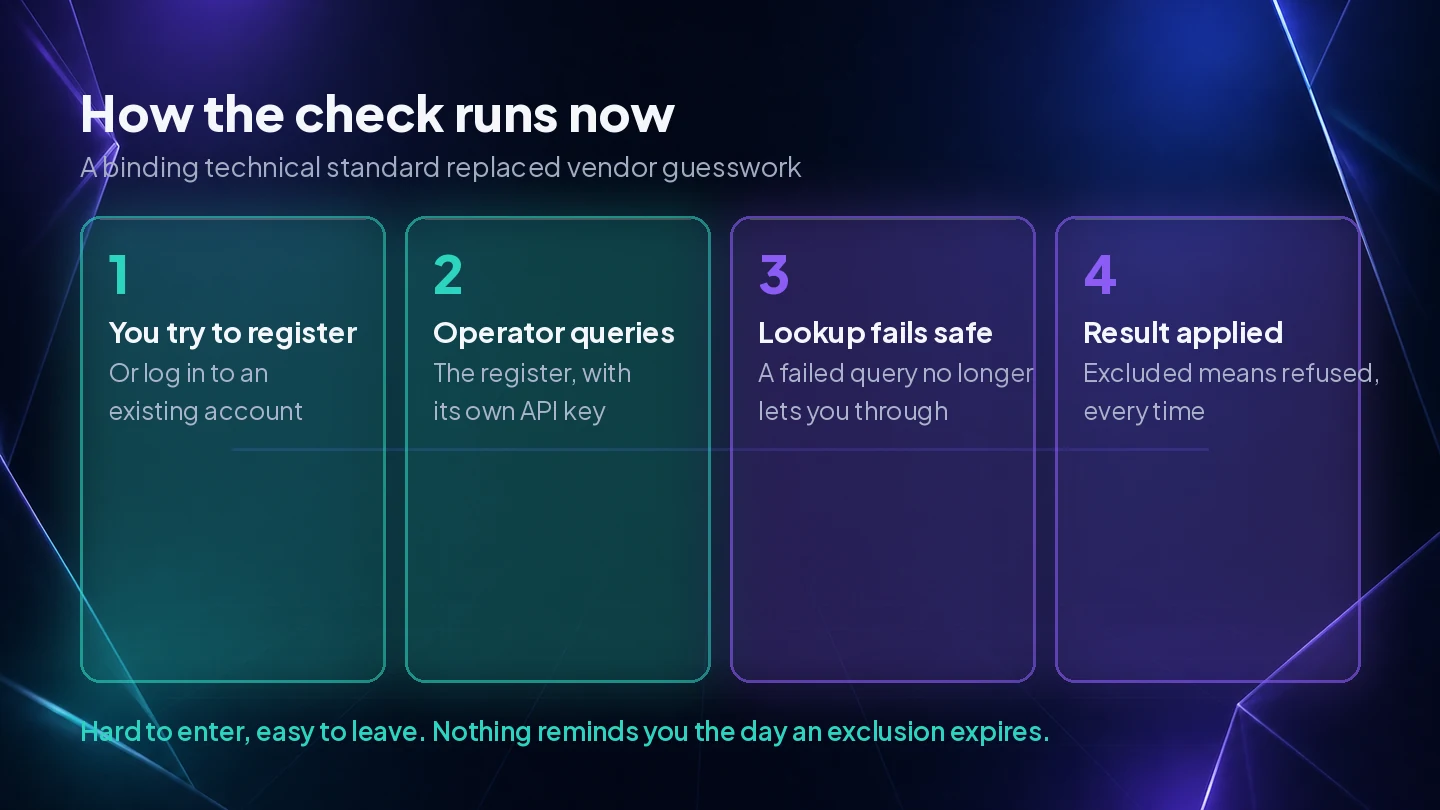
Checks must go through the application programming interface that corresponds to the purpose of the check. A check made before registering or logging in a player goes through the interface for that purpose. A check made before sending direct marketing goes through the marketing interface. Using the wrong one is not a technicality; it is non-compliance.
A check counts as complete only when it has established whether the person is excluded from gambling or not. A call that times out, errors, or returns anything short of a clear yes or no is not a completed check.
Where a licence holder outsources the check to a third party, the commissioning licence holder’s own credentials must be used. Responsibility does not travel with the outsourcing contract. If your platform provider, your affiliate marketing vendor or your customer relationship management supplier runs the query, it runs on your Actor ID, and you answer for it.
| Moment | Which interface | Complete check means |
|---|---|---|
| New account registration | Registration and login | Clear result before the account opens |
| Login to an existing account | Registration and login | Clear result before session access |
| Addressed email, SMS, post or phone marketing | Marketing | Clear result before the message queues |
What the API rules mean for you in practice
Strip out the compliance language and three player-facing consequences fall out.
Fewer gaps in the net. Before a binding technical standard, operators integrated against the register in whatever way their vendor had built. Different vendors, different retry logic, different handling of a failed lookup. If a query failed and the system defaulted to letting the player through, an excluded person could get a session. Requiring that a check is only complete when it returns a definitive answer removes the fail-open option. In plain terms: if the register cannot be reached, the correct behaviour is to not let the person play, not to shrug and continue.
Marketing that should stop arriving. Spelpaus has always been supposed to switch off direct marketing from licensed operators, and direct marketing here means personally addressed material: post, email, SMS and phone calls. Enforcement was the weak point. Requiring a separate marketing interface and the operator’s own credentials makes each marketing check individually attributable. If a self-excluded person still receives an addressed offer from a licensed operator, there is now a specific rule that was broken and a specific credential trail that shows who ran, or did not run, the check.
Accountability that survives outsourcing. Most operators do not build their own Spelpaus integration. They buy a platform. Under the old arrangement, a shared or vendor-level credential made it genuinely difficult to say which brand had failed to check. Now the licence holder’s own Actor ID sits on every query made on its behalf. That is a small piece of plumbing with a large evidentiary effect.
What has not changed is Spelpaus itself. You register with an electronic identity, typically Mobilt BankID, and you can choose 10 days, one month, three months, six months, or until further notice, which runs for a minimum of twelve months. The exclusion covers all gambling that requires registration in Sweden: online, in shops, at the racetrack, and Vegas terminals. It cannot be cancelled or shortened early, and if you register a second exclusion while one is running, the new one cannot be shorter than the time remaining. We break down how this compares with other national schemes in our guide to self-exclusion schemes.
A second worked example, this time on dates
Say you register a six-month exclusion on 1 August. It runs to 1 February.
On 1 October, four months still to run, you decide six months was too long and try to set a one-month exclusion instead. The system refuses, because a new registration cannot be shorter than the remainder of the active one. Your only options are a period ending on or after 1 February.
On 1 October you also try to open an account at a Swedish-licensed casino you have never used. The registration interface check runs before the account is created, returns “excluded”, and registration is denied. Nothing about being a new customer at a new brand changes this. The register is national and central, not per-operator.
On 15 October a marketing email from a licensed brand you used last year would, under SIFS 2026:3, require a completed marketing-interface check on that brand’s own credentials before it goes out. The check returns “excluded”. The email should not be sent.
On 2 February, one day after expiry, you can register and log in normally. No one asks your permission twice and nothing reminds you that yesterday you were excluded. That asymmetry, hard to enter and easy to leave, is worth planning for before the end date arrives rather than on the day.
Outside the Swedish licence, none of this applies
This is the part most Swedish-language pages on this subject soften. We are not going to.
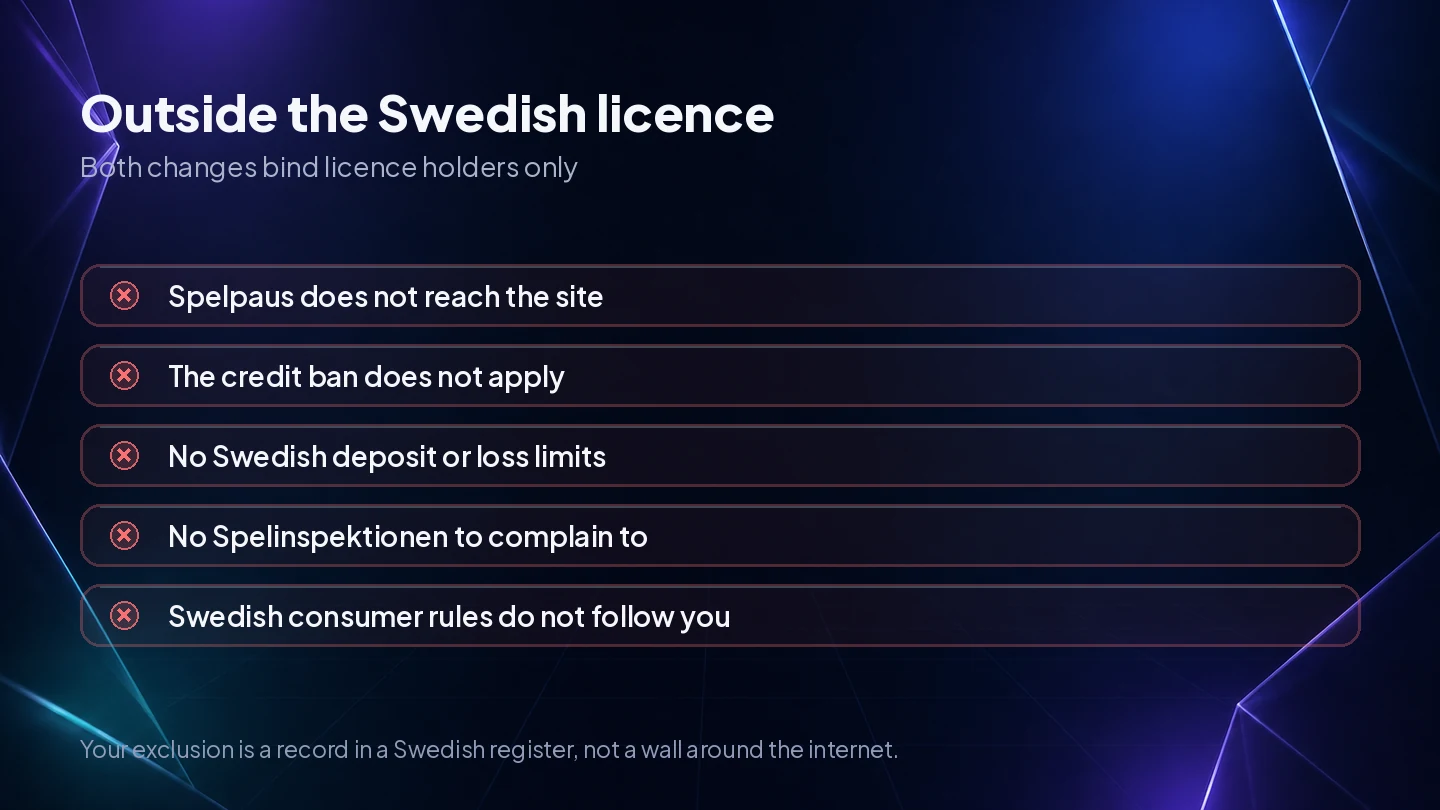
Both changes bind Swedish licence holders. A site operating on a Malta Gaming Authority licence, a Curacao licence, or no meaningful licence at all, and accepting Swedish players, is not a Swedish licence holder. Concretely, that means:
Spelpaus does not reach it. Your exclusion is a record in a Swedish register that only Swedish licence holders are required to query. An offshore operator has no Actor ID, no API key, and no legal duty to look. If you are excluded and you open an account at such a site, you will very likely succeed. That is not the site being generous; it is the site being outside the scope of the protection you asked for.
The credit ban does not reach it either. Credit cards, overdraft-funded transfers and pay-later checkouts may all still work there. Two protections that Swedish law now stacks on top of each other come off at the same moment.
The rest of the Swedish consumer package comes off too. Mandatory deposit limits, mandatory time and loss reminders, the Swedish bonus restriction, and the ability to escalate a dispute to Swedish authorities and the Allmanna reklamationsnamnden are all functions of holding a Swedish licence. They do not follow you.
None of that means every site outside the Swedish licence is a scam. Some hold real regulatory oversight elsewhere. A Malta licence in particular carries actual supervision, complaint handling and player-funds requirements, which is why we maintain a separate page on MGA casinos and treat that licence differently from a Curacao shell. But “regulated somewhere else” is not the same as “regulated for you”, and the difference shows up on the day you have a dispute. Our walkthrough of how to verify a casino licence is the practical version of that check, including how to confirm that a licence number in a footer is live rather than lapsed.
If you are researching sites outside the Swedish system for reasons that have nothing to do with self-exclusion, our pages on utlandska casino and betting utan svensk licens set out what the trade looks like honestly, and our Sweden hub collects everything in one place. If you are researching them because you are on Spelpaus and want to play, the trade is not one you can win. The exclusion you set is doing what you asked it to.
What to check in your own account
Ten minutes, once, and you will know where you stand.
Check what card is actually saved. Open the cashier and look at the stored payment method. If it is a credit card, it has stopped working at Swedish-licensed sites and it is worth removing rather than leaving it to fail mid-session. If it is a debit card and it is being refused, that is likely a card-classification error and support can escalate it.
Check whether your account has an overdraft attached. Many Swedish current accounts carry a small approved overdraft that stays invisible until you cross zero. A transfer from an account in overdraft is credit-financed gambling under the new rule, and nothing at the cashier will flag it. Your own balance is the only control here.
Check your deposit limits. Swedish licence holders must let you set them, and they are the single most effective account-level tool available. Lowering a limit takes effect immediately; raising one is subject to a delay.
Check your marketing preferences separately. Unsubscribing from an operator’s mailing list and being on Spelpaus are two different mechanisms. If you want addressed marketing to stop but do not want to self-exclude, use the operator’s own preference settings and, where offered, the national direct marketing opt-out. Spelpaus is not a mailing list tool.
Check your exclusion status and end date if you have one. Log in to Spelpaus.se with your electronic identity and read the end date. Write it in a calendar. Decide now what you want to do on that date, while you are not in the middle of wanting to play.
Check that the site is genuinely Swedish-licensed. The licence holder’s legal name and licence reference should appear in the footer, and it should be verifiable on the regulator’s own register at spelinspektionen.se. A Swedish-language site with a Swedish domain is not evidence of a Swedish licence. The register is.
New leadership and what to watch next
Spelinspektionen has a new director general. Peter Knutsson took office on 17 August 2026 on a six-year appointment running to 31 August 2032. He came from the role of advertising ombudsman and before that a unit head at the Ministry of Finance, with a background in consumer law and consumer affairs.
That background is worth noting, because both of this year’s changes are consumer-protection instruments with a marketing dimension: one restricts how gambling is funded, the other tightens who may be advertised to. Personnel is not policy. We will not predict enforcement from a curriculum vitae.
Three things are worth watching over the next twelve months.
Whether the credit ban shows up in supervision cases. The visible half of the ban, blocking credit cards and pay-later checkouts, is easy to audit. Expect any enforcement to start there rather than with the invisible half.
Whether SIFS 2026:3 produces marketing sanctions. Direct marketing to self-excluded players has been a recurring compliance failure across Europe. A credential trail per licence holder makes it far easier to prove.
Whether channelisation moves. The share of Swedish play that stays inside the licensed system is the industry’s standing counter-argument to every tightening: restrict the licensed product and some players go elsewhere. That argument is real, and it is also the argument an offshore operator wants you to find persuasive.
What to do next
If you play at Swedish-licensed sites and your card stopped working in May, that is the law functioning as designed, not a fault. Switch to a debit card or a transfer from money you already have. If the alternative is not depositing this month, that is information about your bankroll, and it is worth sitting with rather than routing around.
If you are self-excluded, the 1 August rules make the net tighter inside the Swedish system and change nothing outside it. The gap is not a design flaw you can exploit safely. Add a bank-level gambling block, which most Swedish banks now offer, and speak to Stodlinjen, the national support line, if the pull is strong. Our responsible gambling page lists the tools that work independently of any operator.
If you are comparing sites, check the licence before the bonus, every time. The methodology we apply to that is set out in how we review, and the primary sources for everything above are the regulator’s own site at spelinspektionen.se and the self-exclusion register at spelpaus.se.
Gambling is entertainment that costs money, and both rules above exist because it costs some people far more than they planned. Nothing here is legal or financial advice.
In one paragraph
Sweden's credit ban started on 1 May and tighter Spelpaus check rules on 1 August. What changes at the cashier, at login, and what happens outside the licence.
Read next
Markets
Frequently asked questions
Can I still deposit with a credit card at a Swedish licensed casino?
No. Since 1 May 2026 licence holders may not allow or assist gambling funded by credit, and blocking credit cards where technically possible is one of the measures the law expects. A Visa or Mastercard debit card drawing on your own balance is still fine. The card type, not the card network, decides it.
Does the credit ban apply to sites without a Swedish licence?
No. The ban sits in the Swedish Gambling Act and binds Swedish licence holders and their agents. A site licensed in Malta or Curacao and aimed at Swedish players is outside it, so a credit card, an overdraft or an instalment plan may still go through there. Nothing about that makes the debt easier to repay.
What changed about Spelpaus on 1 August 2026?
The regulator issued a binding technical standard, SIFS 2026:3. Each licence holder gets a unique Actor ID and API key, must query the register through the interface matching the reason for the check, and the check only counts as done once it returns a clear excluded or not excluded answer. Guessing or caching is no longer defensible.
Will Spelpaus stop marketing emails and texts reaching me?
It should, at Swedish licensed operators. Direct marketing checks must now run through the marketing interface with the operator's own credentials, so an operator cannot claim a generic lookup was good enough. Adverts on television, radio and open web pages are not personally addressed, so those are not covered and you will still see them.
I am on Spelpaus and want to play anyway. What should I do?
Treat that urge as the signal it is, not a technical problem to route around. Spelpaus is deliberately impossible to cancel early, and sites outside the Swedish licence exist precisely because they ignore it. Read our responsible gambling page, use a bank level gambling block, and talk to Stodlinjen before you open anything.
More from the blog
-
 safety How to Verify a Casino Licence in Five Minutes A licence badge is an image file. The only thing that counts is the entry on the regulator's public register, and checking it takes about five minutes.
 -
 safety KYC Checks at Online Casinos, Explained Verification is a licence condition, not an operator invention. But the moment an operator chooses to run it is a business decision, and that choice is what turns a ten minute upload into a fortnight of chasing support.
 -
 bonuses Max Bet Rules and How One Spin Voids a Win The max bet clause is the shortest sentence in most bonus terms and the one that costs players the most money. This is what it covers, how a single spin breaches it, and what an operator is allowed to do next.

Aristotelis Kourtelis
Licensing & Player Protection Analyst since 2024
Aristotelis Kourtelis is the Licensing and Player Protection Analyst at LSM99, and the reason a brand does not reach the top of a list on its bonus alone. He joined in 2024 and works at the front of the review process, before any scoring happens. LSM99 rates every casino across six weighted sections, licensing and safety, payouts, bonus fairness, game range, support and mobile, and Aristotelis owns the first of those. If the licensing work fails, the other five sections do not rescue the brand. He reads bonus terms, KYC triggers and self-exclusion rules closely, because those are the clauses that decide whether a win is really a win.



Play responsibly
Gambling is entertainment, not income. Set a deposit limit before you play, never chase a loss, and stop when it stops being fun. If it has become a problem, these services are free and confidential.
Our responsible gambling guide carries no affiliate links and no casino list.