
Guide
KYC Checks at Online Casinos, Explained
Verification is a licence condition, not an operator invention. But the moment an operator chooses to run it is a business decision, and that choice is what turns a ten minute upload into a fortnight of chasing support.
Show moreShow less

Know Your Customer checks are not something an operator invented to sit on your money. They are a licence condition, driven by anti money laundering law and player protection duties, and a licensed casino that skipped them would risk its permission to trade. The reasons are real: confirm you are who you say you are, that you are old enough, and that the money moving through the account is yours.
That is the honest half. The other half is that the law tells operators to verify customers and mostly does not say when. Timing is a business decision. An operator that asks for your passport on day one treats verification as a cost of acquisition. One that waits until you request a four figure withdrawal treats it as a cost of paying you. Same obligation, opposite experience, and the second version is where most complaints about stalling come from.
So the useful question is not whether you can avoid KYC. You cannot, at any operator worth using. It is how to make the check happen when it costs you nothing, and how to send documents that clear first time.
Why KYC exists, and why timing is the real complaint
Two bodies of law land on the same cashier screen. Anti money laundering rules exist because gambling accounts are a convenient way to wash money: deposit dirty funds, play a token amount, withdraw clean funds elsewhere. Customer due diligence is the countermeasure. Player protection is the other strand: know the customer’s age, spot a self-excluded person opening a new account, notice when play stops looking like entertainment.
In the UK, the Gambling Commission’s licence conditions require operators to verify a customer’s name, address and date of birth before allowing them to deposit or gamble at all. That rule has been in force since 2019, and it is why UK-facing sites ask early. Elsewhere the trigger is transactional. European anti money laundering directives set a baseline for gambling services at 2,000 euro in stakes or winnings, counted as a single transaction or as linked transactions, and national regulators build on top. Check it at source: gamblingcommission.gov.uk, kansspelautoriteit.nl, spelinspektionen.se and mga.org.mt publish their rules openly.
Those rules specify who must be checked and to what standard. Beyond a few hard trigger points, scheduling is left to the operator’s risk assessment. That gap is not a scandal on its own, and plenty of operators use it sensibly. It is also the gap that lets a site take deposits for four months without a question, then discover an urgent compliance need the day you try to take out 3,000. How we weigh that when scoring a site is in how we review.
The consequence is simple. Verification you trigger yourself is administration. Verification triggered by a withdrawal request is a queue, and your money is in it.
The three tiers: identity, address, source of funds
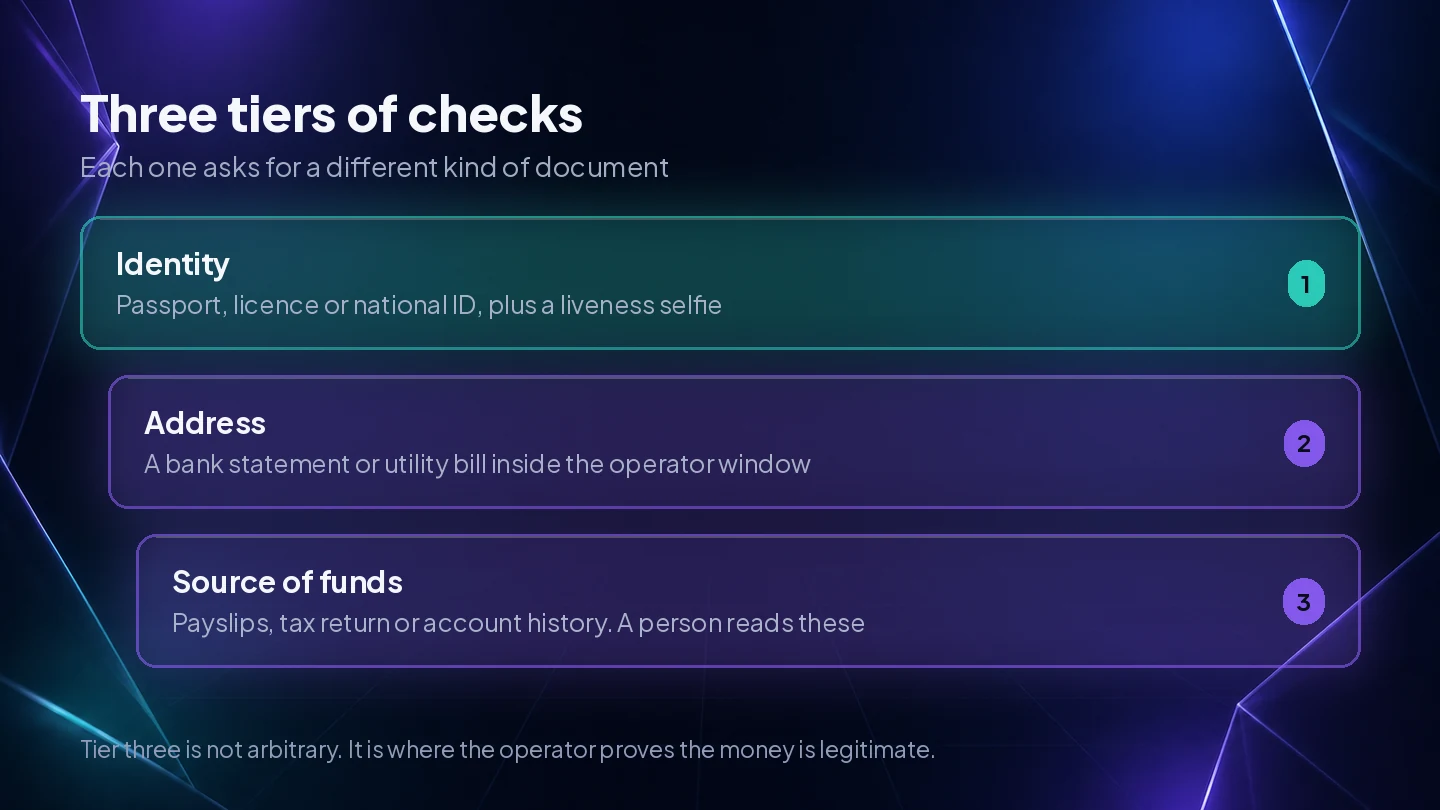
Verification is not one request. It is three, and they escalate. Most players meet the first two and never see the third.
Tier one: identity
A government photo ID: passport, national identity card or photocard driving licence. The operator matches the name and date of birth on the document to those on the account, so they have to be identical, middle names included.
Increasingly this is paired with a liveness check: a selfie or a few seconds of video, sometimes with a prompt to turn your head. That separates a real person holding a real passport from someone who downloaded a photo of one, and it is usually the fastest step, often under a minute.
Tier two: address
A document showing your name and residential address, dated inside an acceptance window, usually three months and sometimes six. Utility bills, bank or card statements, council tax bills and government letters are the standard set. Mobile phone bills are often refused, because a mobile account is easy to open at any address.
Tier three: source of funds and source of wealth
Source of funds asks where the money you are gambling with came from. Source of wealth asks how you came to have money at all. In practice the request is for payslips, bank statements covering several months, a tax return, a P60 or its local equivalent, sale documents, or a letter about an inheritance or redundancy payment.
It feels out of proportion when it lands after a good week on slots. It is not arbitrary: it is the point where the operator has to satisfy itself that funds passing through the account are legitimate. What matters is whether the request is proportionate and explained.
What sets a check off, and when
Some triggers fire the same way for everyone. Others are specific to your account.
Registration. In markets like the UK, verification before first deposit is mandatory. Elsewhere it is optional, and the better operators do it anyway.
First withdrawal. The most common trigger where there is no registration rule, and the most expensive for you, because verification and payout now run in series.
Cumulative deposit thresholds. Counted across a rolling period, not per transaction. Eight deposits of 200 cross a 1,500 threshold as effectively as one of 1,600, and players miss this because no single transaction looked large.
A large win. Not because winning is suspicious, but because a large payout is where the operator’s risk rules and its payment provider’s rules both wake up.
A change of payment method. Adding a card, bank account or wallet restarts the ownership check. Sending a withdrawal to something you never deposited with triggers one almost everywhere.
A mismatch between stated and observed activity. Many operators ask about expected monthly spend at signup. If you said 100 a month and you are depositing 2,000, that gap is one of the fastest routes to a source of funds request.
Responsible gambling signals. Rising deposits, late night play that looks like chasing, cancelled withdrawals followed by immediate replay, failed deposits in sequence. These produce interventions as well as checks. If that sounds like your account, the checks are the least important part of the conversation and responsible gambling tools are the important part.
Enhanced due diligence and politically exposed persons
Enhanced due diligence is standard checking, turned up. It applies where regulations or the operator’s risk assessment identify higher risk: unusually large or complex transactions, higher risk jurisdictions, unclear ownership of funds, activity with no economic rationale. In practice, more documents, more questions and a human reading everything.
A politically exposed person is someone entrusted with a prominent public function: senior politicians, judiciary, military, board members of state owned enterprises. The definition reaches immediate family and known close associates too, which is why people are sometimes flagged for a relative’s job. Being a PEP is not an accusation. It requires enhanced due diligence and senior sign off. Under UK rules, domestic PEPs are generally treated as lower risk than foreign ones absent other risk factors, so a local council connection should not attract the treatment given to a foreign head of state.
The one move that saves you two weeks
Complete verification before you deposit. Not at withdrawal. This is the single most valuable thing in this article, and it costs ten minutes.
Here is how it works at a typical cashier. After registering, open account settings and find the section named Verification, My Documents or Profile. Most licensed operators expose the upload form there whether or not you have funded the account. Upload photo ID first, then proof of address, then the payment method if asked, and wait for each to reach Approved before you deposit. If the site hides the form until a first deposit exists, email support with the files attached, ask for them to be added to your account, and keep that email.
Now the arithmetic, using a payout of 1,200 requested on a Friday evening at an operator with a 24 hour pending window.
Player A deposits first and verifies later.
- Friday 20:00, withdrawal requested. Pending window opens.
- Saturday 20:00, window closes. Automated review flags the account as unverified and issues a document request.
- Monday morning, the player uploads a passport photo and a utility bill.
- Tuesday, the passport clears. The bill is rejected: dated four months ago, window is three.
- Tuesday evening, a current bank statement goes up instead.
- Thursday, approved. Payout released to the processor.
- Friday or the following Monday, money posts to the card, on the issuer’s schedule.
Elapsed: seven to ten calendar days, of which perhaps forty minutes was work.
Player B verified on day one, before depositing.
- Registration day, ten minutes, ID and address uploaded and approved.
- Friday 20:00, withdrawal requested. Pending window opens.
- Saturday 20:00, window closes. Automated review finds a verified account and releases the payout.
- Monday or Tuesday, money posts to the card.
Elapsed: three to four calendar days, no rejected document, no weekend waiting on support.
The gap between those two timelines is not luck. It is one decision taken on registration day. The same logic runs through why casino withdrawals are delayed: most of the wait is queueing rather than work, and pre-verification removes a whole queue from your path.
Why documents get rejected, and the fix for each
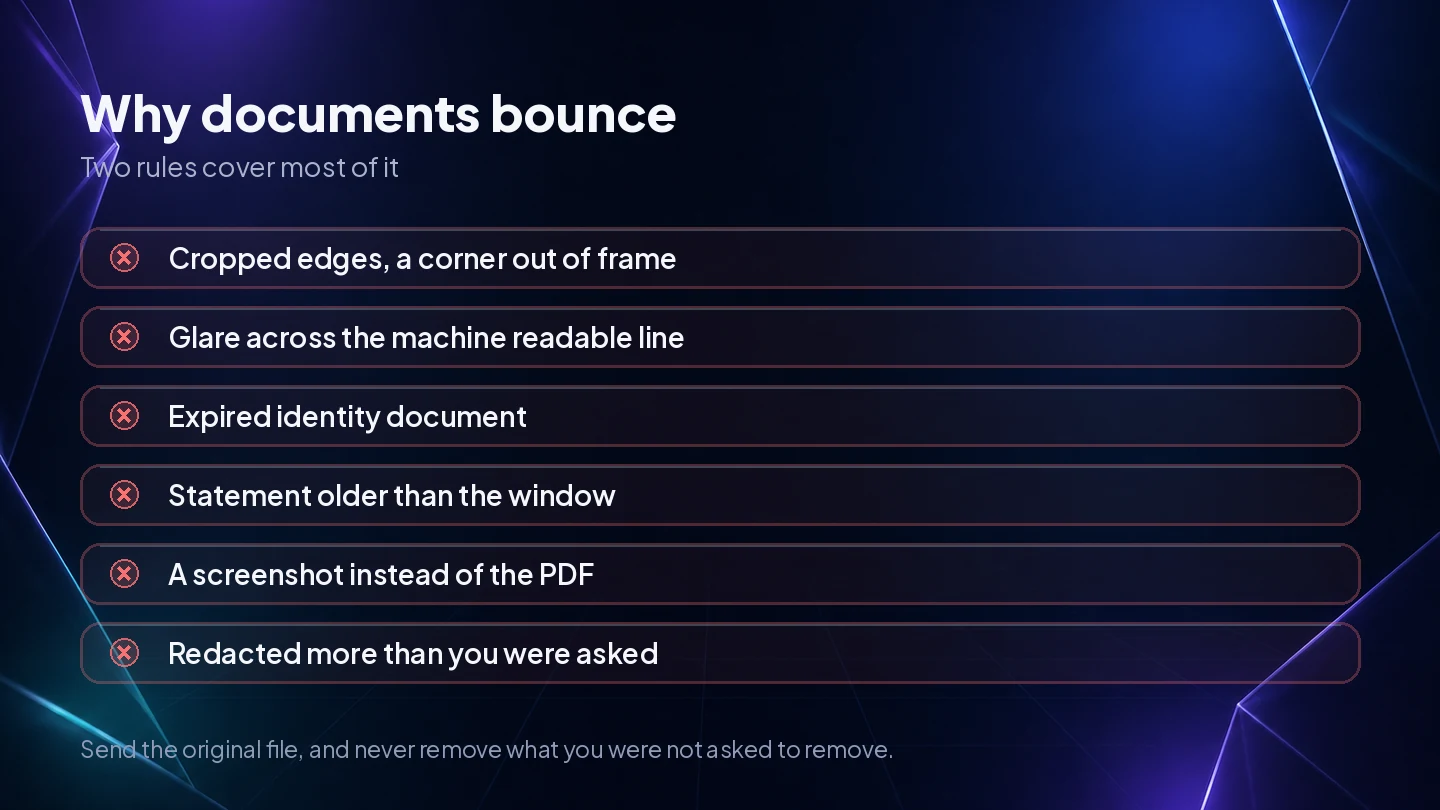
Rejections are mechanical. The reviewer is checking a list, not judging you, and a handful of failures account for most of it. Each rejection costs about a working day, because the resubmission goes to the back of the queue.
| Rejection reason | Why it fails | The fix |
|---|---|---|
| Cropped edges | A corner outside the frame means the reviewer cannot confirm the document is whole | Photograph it flat on a dark surface with visible background on all four sides |
| Glare across the photo or data line | Reflection hides the machine readable zone, so nothing matches | Flash off, indirect daylight, move the document rather than the camera until the shine goes |
| Expired ID | An expired document proves nothing current, however good the photo | Check the expiry date first, and switch document type rather than hoping |
| Bill older than the window | Address proof must sit inside three or six months, depending on the operator | Download a fresh statement from your banking app. Statements issue monthly |
| Name mismatch after marriage or a legal change | Account name and document name differ, so the automated match fails | Upload the marriage certificate or deed poll alongside, and email support first so a human expects the pairing |
| Bank statement that is only a card image | A photo of the plastic proves possession of a card, not ownership of an account | Send the statement, showing name, address, bank and date on one page |
| Screenshot instead of a PDF | Screenshots lose the header, the date and often the name, and edited images are trivial to make | Use the Download PDF option in your banking or utility portal |
| Redacted too heavily | Masking the whole statement leaves nothing verifiable | Mask only what you were asked to. Card digits can go, name, address and date never |
Two rules cover most of it. Send the original file, not a picture of a screen, and never remove information you were not asked to remove.
Where the money came from: third-party payments and source of funds
Third-party money is the one rule with no flexibility
You cannot fund a gambling account with someone else’s card, bank account or wallet. Not your partner’s, not your parent’s, not a friend who owed you money. Every licensed operator’s terms prohibit it, and the reason is structural: third party funding is the classic laundering pattern, and it destroys the audit trail responsible gambling rules depend on. A self-excluded person gambling through a relative’s card is exactly what the rule exists to catch.
The consequences beat a rejected deposit. Depending on the terms, third party funds may be frozen, returned to the original payer rather than to you, and winnings from them voided. That is a lost balance.
Joint accounts are the grey area. A joint account or supplementary card carries more than one name, and an automated ownership check that meets a name it does not recognise treats it as a third party. That places a hold until a human resolves it, usually with a statement showing both names and yours clearly present, but it costs days. If you have an account in your sole name, use it, and keep one instrument for deposits and withdrawals. Payment mechanics, including why crypto rails do not exempt you from any of this, are in crypto casino payments explained and on our payments pages.
What a reasonable source of funds request looks like
A fair request has four features. It names the documents it wants. It states the period they should cover. It explains in a line why it is asking now, whether that is a deposit threshold, a withdrawal size or a change in activity. And it gives you a route to ask questions, with a named team or a reference number.
An unreasonable request is open-ended. “Send proof of your wealth”, with no document list and no period, is not a request, it is a delaying tactic. So is demanding a full unredacted year of statements when your total deposits were a few hundred, or naming a new document category each time you satisfy the last one. Three sequential single-document requests that could have been one usually means the account is being slowed rather than reviewed.
Here is the line. A licensed operator must be able to justify the request: proportionate to the risk identified, grounded in its documented risk assessment, defensible if a regulator asks. You are entitled to ask what triggered it and what will close it. A compliance team that answers both in a sentence is doing the job. One that will not is telling you something.
What happens to your documents afterwards
Your passport scan does not vanish once the tick appears. It is retained, because anti money laundering rules require the operator to keep records of the checks it ran and the evidence it relied on. That sits alongside data protection law, which says personal data must not be kept longer than necessary for the purpose it was collected for. Both apply at once, which is why retention is measured in years rather than weeks.
Do not trust a number you read on a forum. Retention periods differ by regime and document type, and they run from the end of the customer relationship rather than from the day you uploaded the file. The operator’s privacy notice must state its actual period, and if it does not, that absence is itself informative. Ours is at legal privacy, and any operator you use should have an equivalent that is just as findable.
Under UK and EU data protection law you have rights you can exercise in writing, free in normal cases: ask what they hold and why, ask for factual errors to be corrected, ask who they shared it with, object to processing that is not required by law. The last has a limit worth understanding, since documents held to satisfy an anti money laundering duty cannot simply be deleted on request. Requests are usually answered within a month.
Two habits help. Check the upload form runs on the operator’s own domain over HTTPS, not an unbranded page reached from an email link, and prefer the in-account upload tool to email, since emailed copies sit in backups indefinitely.
Timelines: normal, yellow flag, complaint
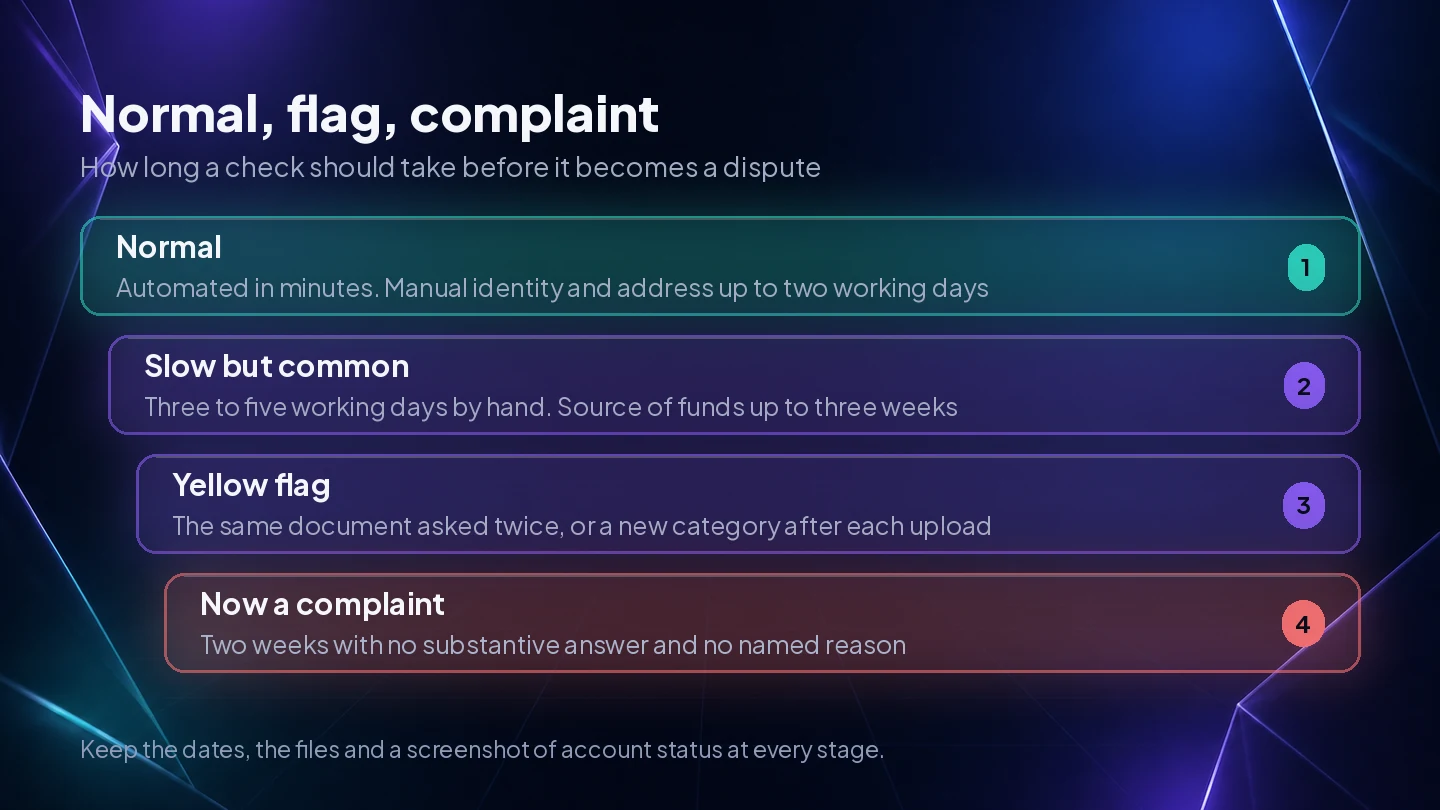
Verification has a rhythm, and departures from it are the signal.
| Situation | What it usually means | What to do |
|---|---|---|
| Automated ID and liveness, minutes to a few hours | Working as designed | Nothing |
| Manual ID and address review, up to 2 working days | Normal at most operators | Wait |
| 3 to 5 working days on a simple check | Slow, common where one small team reviews by hand | Ask for a status and a reference number |
| Source of funds review, days to about three weeks | Expected. A person is reading financial documents | Send everything at once and keep copies |
| Same document requested twice, no reason given | Yellow flag: broken process or deliberate friction | Ask in writing what failed and what would satisfy it |
| A new document category after each submission | Yellow flag, escalating | Ask for the full list of outstanding items in one message |
| Two weeks with no substantive response or named reason | This is now a complaint | Escalate formally |
Escalation follows a fixed order, and skipping steps slows you down. First, exhaust the operator’s complaints procedure in writing and note the date. Licensed operators must publish one and respond inside a stated period. Second, take it to the alternative dispute resolution provider named in the terms. ADR is free to the player, and the operator has agreed in advance to take part. Third, inform the regulator. Bodies such as the Gambling Commission and the Malta Gaming Authority do not usually adjudicate individual money disputes for you. They act on licence compliance, so your report is evidence about the operator even when it does not recover your balance.
Keep three things and the complaint writes itself: the date and content of every request, the files you sent and when, and a screenshot of the account status at each stage. Which regulator and ADR body applies depends on the licence, and establishing that takes two minutes if you follow how to verify a casino licence.
The no-KYC question, answered honestly
Searches for no-verification casinos are popular for an obvious reason: the checks are tedious and the horror stories are real. The honest answer has three parts.
First, a site that does not verify customers is almost certainly not licensed in your market, because verification is a licence condition everywhere gambling is licensed. You are not choosing a casino without paperwork. You are choosing a casino without a regulator: no ADR service, no complaints route with teeth, no external body with any power over whether you get paid.
Second, the verification usually does not disappear, it moves. Plenty of sites advertising instant anonymous signup have terms permitting them to demand full documentation before any significant withdrawal. The check arrives anyway, at the worst moment, run by a compliance function nobody supervises, with no appeal.
Third, “no KYC” and “low KYC” are often marketing for a thin check rather than none, particularly on crypto-funded sites where the deposit rail is pseudonymous but the withdrawal policy is not.
We keep pages on this category because people search for it and deserve a straight account rather than a sales pitch: no-KYC casinos in English and casino sans verification for French-speaking readers. Both set out what these sites are, what you give up, and why our licensed casino list is the safer default. If you are weighing one up, the criteria in how to choose an online casino matter more than usual, because you are removing the safety net that normally catches your mistakes.
Your document pack, and what to do next
Build the pack once and every future verification is a ten minute job. Keep these in one named folder on a device you control.
- Photo ID, whole document in frame, four corners visible, no glare, unexpired. A passport beats a driving licence, since it proves nationality as well as identity.
- Proof of address, an original PDF from your bank or utility portal, dated inside the last month. Save each statement as it arrives and the pack refreshes itself.
- A second proof of address of a different type, because some operators refuse two documents from the same source.
- Payment method proof: a statement header with your name and account, or a card image with the middle digits and security code masked.
- A name change document if applicable, stored with the ID so you never send one without the other.
- Source of funds documents, if your play is at a level where a request is realistic: three months of payslips and three to six months of statements, as originals.
Then check your accounts tonight. Open the cashier at every casino you use and answer five questions. Is my status Approved, or Pending since a date I have forgotten? Does the account name match my ID exactly, middle names included? Is the payment method mine alone, or joint? Is the profile address the one on my statements? And is there an unread verification email in spam, quietly holding a withdrawal I assumed was processing?
What to do next is short. Verify before you deposit, at every operator, on registration day. Send original PDFs, whole documents, nothing over-redacted. Use one instrument in your own name for deposits and withdrawals. If a source of funds request arrives, answer it fully in one go and ask what triggered it and what will close it. If the same document is requested twice with no reason, put it in writing, and if two weeks pass with no substantive answer, escalate through the complaints procedure, then ADR, then the regulator.
Keep the frame straight too. Gambling is entertainment that costs money, never income, and if verification friction is what is keeping you awake about an account, the limits and self-exclusion tools on our responsible gambling page matter more than any of this. Nothing here is legal or financial advice.
In one paragraph
What casinos ask for, why the law makes them ask, what actually triggers a check, and how to clear verification in ten minutes instead of two weeks.
Read next
Markets
Frequently asked questions
Can I complete casino KYC before I deposit any money?
At most licensed operators, yes. Look in account settings for a section called Verification, Documents or My Profile, and upload photo ID and proof of address from there. Some cashiers only expose the upload form after a first deposit. If that is the case, send the documents to support by email and ask them to attach the files to your account.
Why does the casino want my bank statement and payslips?
That is a source of funds request, and it sits above basic identity checks. Anti money laundering rules require an operator to understand where a customer's money comes from once activity crosses a risk threshold. It is intrusive by design. A licensed operator has to be able to explain why it asked you and why it asked now.
How long should casino verification take?
Hours to two working days is normal for identity and address checks at a well run operator. Three to five working days is common where a human reviews everything. Source of funds reviews take longer because a person reads the documents. Repeated requests for a document you already sent, with no reason given, is the signal that something has gone wrong.
Can a casino refuse to pay me because verification failed?
It can hold a payout while checks run, and it can refuse if it concludes the account breaks its terms, for example a third party funding it or a false name. What it cannot do is hold money indefinitely with no stated reason. If a licensed operator gives no reason and no timeline after a week, escalate to its dispute service and then the regulator.
Are no-KYC casinos safe to use?
They are almost always unlicensed in your market, which means no dispute service, no regulator to escalate to, and no enforceable obligation to pay you. The verification that never happened at signup often reappears the moment you request a large withdrawal, except now there is nobody to complain to when it stalls.
More from the blog
-
 safety How to Verify a Casino Licence in Five Minutes A licence badge is an image file. The only thing that counts is the entry on the regulator's public register, and checking it takes about five minutes.
 -
 bonuses Max Bet Rules and How One Spin Voids a Win The max bet clause is the shortest sentence in most bonus terms and the one that costs players the most money. This is what it covers, how a single spin breaches it, and what an operator is allowed to do next.
 -
 bonuses How Wagering Requirements Actually Work A wagering requirement is not a scam and it is not a formality. It is the price you pay for a bonus, and it is written in a way that makes that price hard to read. This is how to read it.

Aristotelis Kourtelis
Licensing & Player Protection Analyst since 2024
Aristotelis Kourtelis is the Licensing and Player Protection Analyst at LSM99, and the reason a brand does not reach the top of a list on its bonus alone. He joined in 2024 and works at the front of the review process, before any scoring happens. LSM99 rates every casino across six weighted sections, licensing and safety, payouts, bonus fairness, game range, support and mobile, and Aristotelis owns the first of those. If the licensing work fails, the other five sections do not rescue the brand. He reads bonus terms, KYC triggers and self-exclusion rules closely, because those are the clauses that decide whether a win is really a win.



Play responsibly
Gambling is entertainment, not income. Set a deposit limit before you play, never chase a loss, and stop when it stops being fun. If it has become a problem, these services are free and confidential.
Our responsible gambling guide carries no affiliate links and no casino list.