
Guide
How Wagering Requirements Actually Work
A wagering requirement is not a scam and it is not a formality. It is the price you pay for a bonus, and it is written in a way that makes that price hard to read. This is how to read it.
Show moreShow less

A wagering requirement is the amount you have to stake before bonus money, and usually anything you win with it, turns into cash you can withdraw. It is quoted as a multiplier: 20x, 35x, 40x, 60x. On its own that multiplier tells you almost nothing useful. What decides whether an offer is worth taking is what the multiplier is applied to, which games count towards it and at what rate, how long you have, and whether there is a ceiling on the amount you are allowed to take out at the end.
Those variables move the real cost of a bonus by a factor of ten or more between offers that look identical in a banner. Two casinos can both advertise “100% up to 100, 35x wagering” and the honest price of one can be double the other. None of it is hidden in a legal sense. It is all written down, just written across three pages, in an order that puts the flattering number before the expensive one.
What follows is the arithmetic, slowly, with numbers you can check on paper, and then the place each clause hides in a real cashier. The framing is simple: a wagering requirement is the price of the offer. Some offers are priced fairly and some are not, and your job is to work out which before you click accept.
The formula, and the two bases operators apply it to
The formula has exactly two inputs.
Required turnover = multiplier x base amount
Turnover means total stakes placed, not money lost. Stake 1 unit a hundred times and finish on the same balance, and you have generated 100 in turnover. The distinction matters: the requirement measures how long you must keep playing, not how much you must lose.
The multiplier is the number in the headline. The base is the part that gets skipped over, and it comes in two shapes.
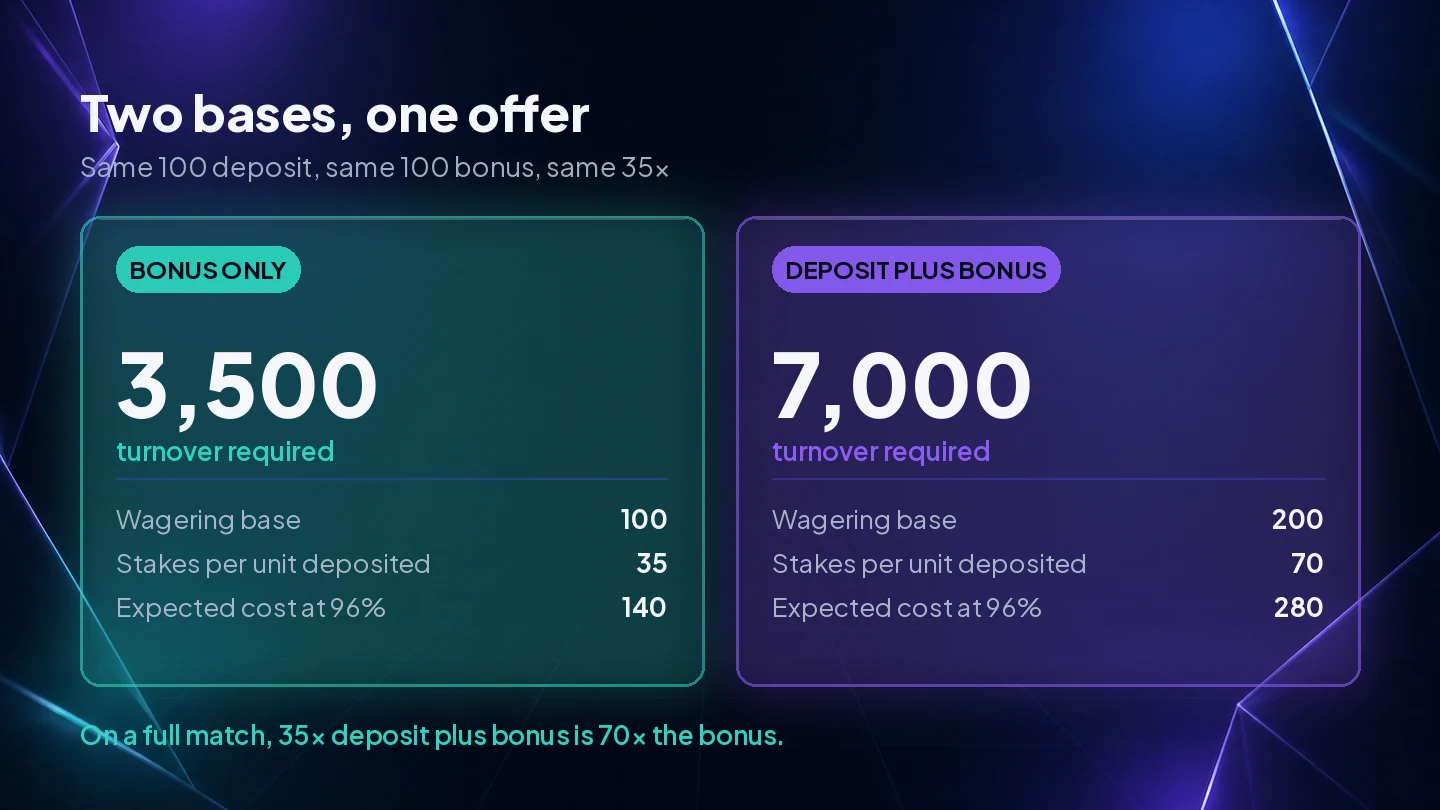
Bonus-only wagering applies the multiplier to the bonus credit alone. Deposit-plus-bonus wagering, often written as 35x (D+B), applies it to your deposit and the bonus added together. Here is the same offer, the same deposit, the same multiplier, under both bases.
| 35x bonus only | 35x (deposit + bonus) | |
|---|---|---|
| Deposit | 100 | 100 |
| Bonus credited (100% match) | 100 | 100 |
| Wagering base | 100 | 200 |
| Multiplier | 35 | 35 |
| Turnover required | 3,500 | 7,000 |
| Stakes per unit deposited | 35 | 70 |
Same headline. Same money on the table. One version asks you to place 3,500 in stakes and the other asks for 7,000. On a full match offer, a deposit-plus-bonus condition is arithmetically identical to double the bonus-only multiplier: 35x (D+B) on a 100 percent match is 70x the bonus. If you take one habit from this article, take that conversion. Before comparing any two offers, restate both as a bonus-only multiplier, because otherwise you are comparing numbers that are not measuring the same thing.
The gap has a cash cost you can estimate. If you clear the requirement on slots returning 96 percent, you expect to lose about 4 percent of everything you stake. On 3,500 that is 140 units. On 7,000 it is 280. The bonus is worth 100. Under either base, the expected arithmetic is against you before a single clause is applied, and the deposit-plus-bonus version is against you by nearly twice as much. Return to player is a long-run average and not a promise about your session, which we cover in what RTP really means, but it is the right tool for pricing a grind of several thousand spins.
A third variant is worth naming. Some operators apply the multiplier to the bonus only, but hold your withdrawal until the deposit has also been turned over once or twice. It usually sits in a clause about “deposit playthrough” rather than in the wagering clause, so it is easy to read the offer and never see it.
Game weighting turns your number into a different number
The wagering requirement is stated in currency. What you actually place in stakes to satisfy it depends on a contribution table, and that table is where most of the real cost sits.
Typical shape, though every operator writes its own:
| Game type | Common contribution | 3,500 requirement becomes |
|---|---|---|
| Slots (most) | 100% | 3,500 in stakes |
| Slots (high RTP or feature buy titles) | 0% to 50% | 7,000 or excluded |
| Roulette | 10% to 20% | 17,500 to 35,000 |
| Blackjack | 5% to 10% | 35,000 to 70,000 |
| Baccarat | 5% to 10% | 35,000 to 70,000 |
| Video poker | 0% to 20% | 17,500 or excluded |
| Live dealer tables | 0% to 10% | 35,000 or excluded |
| Progressive jackpot slots | Usually 0% | Never clears |
Read the blackjack row again. A 10 percent weighting does not shave the requirement. It multiplies your stakes by ten. To satisfy a 3,500 requirement at 10 percent contribution you must place 35,000 in bets. Combine that with a deposit-plus-bonus base and the picture is genuinely absurd: 35x (D+B) on a 100 unit deposit, cleared at the blackjack table, needs 70,000 in stakes. That is 700 times the deposit.
The logic is not arbitrary. Blackjack played reasonably runs a house edge well under 1 percent, so an operator letting it clear at 100 percent would be handing money to anyone who read a basic strategy chart. Slots carry an edge of 2 to 6 percent, so the same turnover costs the player more and the promotion pays for itself. Knowing why weighting exists does not make it cheaper, but it explains why the table is never negotiable and why the offer assumes you will play online slots and nothing else.
Two traps follow. A 0 percent row sits in the same table as the 10 percent rows and looks like a rounding detail when it means the game never counts. And some operators punish rather than ignore: play an excluded game with a bonus active and the terms may void the bonus outright. Check which of the two your terms describe.
Maximum bet, and how one oversized spin voids everything
Almost every bonus carries a maximum stake while the bonus is active. Common shapes are a flat cap of around 5 units per spin or hand, or a percentage of the bonus such as 10 percent, whichever the operator prefers. Some terms extend it to features: a bought free spins round, a doubled bet feature, a side bet on a live table.
The consequence of breaching it is out of proportion to the mistake. Typical wording lets the operator void winnings from the breach onward, remove the remaining bonus, and in the harshest versions return only your deposit. It is enforced at withdrawal, by a review of your bet history, not by the game client at the moment you bet. That is the part players find hardest to accept: nothing stops you, nothing warns you, and the balance keeps climbing.
The failure mode is almost never deliberate. It is autoplay left running after a stake change, a bet slider that resets between sessions, or a game that scales the stake on a feature round without asking. We treat enforcement as its own subject in max bet rules and voided wins, because it is the clause that most often turns a real win into nothing.
Set the stake once, before your first spin, at a figure comfortably under the cap. If the cap is 5, play at 4. The difference in how fast you clear is trivial. The difference in exposure is total.
Expiry, and why a short window can make an offer undeclinable in practice
Every bonus carries a clock. Seven days and thirty days are both common, and the difference between them is not a detail, it is the difference between a workable offer and a decline dressed up as an acceptance.
Take the 7,000 turnover from the worked example and put it inside a seven day window. That is 1,000 in stakes a day, every day, for a week. At 1 unit a spin that is 1,000 spins daily, and at a realistic pace of five to six seconds a spin, two to three hours of play per day for seven consecutive days. Raise the stake to 4 a spin and it drops to 250 spins daily, but variance bites faster and the expected loss is unchanged at around 280 units.
Put the same 7,000 in a thirty day window and it becomes roughly 230 a day. Same requirement, same expected cost, completely different proposition for anyone who plays a few evenings a week.
Three details in the expiry clause are worth finding. When the clock starts: at deposit, at bonus credit, or at first qualifying wager. Whether unfinished wagering forfeits only the bonus and its winnings, or the whole balance including funds you would consider yours. And whether attached free spins carry a separate, shorter window, which they very often do.
Treat a short window on a large requirement as a refusal. If the offer needs more play than you would honestly do in the time allowed, it was not designed for you, and the move is to decline it and deposit without it. Our review methodology scores expiry against the size of the requirement rather than reporting the day count on its own.
Maximum cashout, the clause that shrinks the headline
A cashout cap limits the amount of bonus-derived winnings you are permitted to withdraw. It is expressed either as an absolute figure or as a multiple of the bonus or deposit, commonly 3x to 10x.
Here is what a cap does to a good outcome. You take a 200 percent match, deposit 100, receive 200 in bonus, complete a 40x bonus requirement of 8,000 in stakes and finish with 900 in the account. The terms cap bonus winnings at 100. You withdraw 100 of deposit plus 100 of winnings, and the remaining 700 is removed. You did everything the offer asked, and it paid a hundred units for a grind whose expected cost was 320.
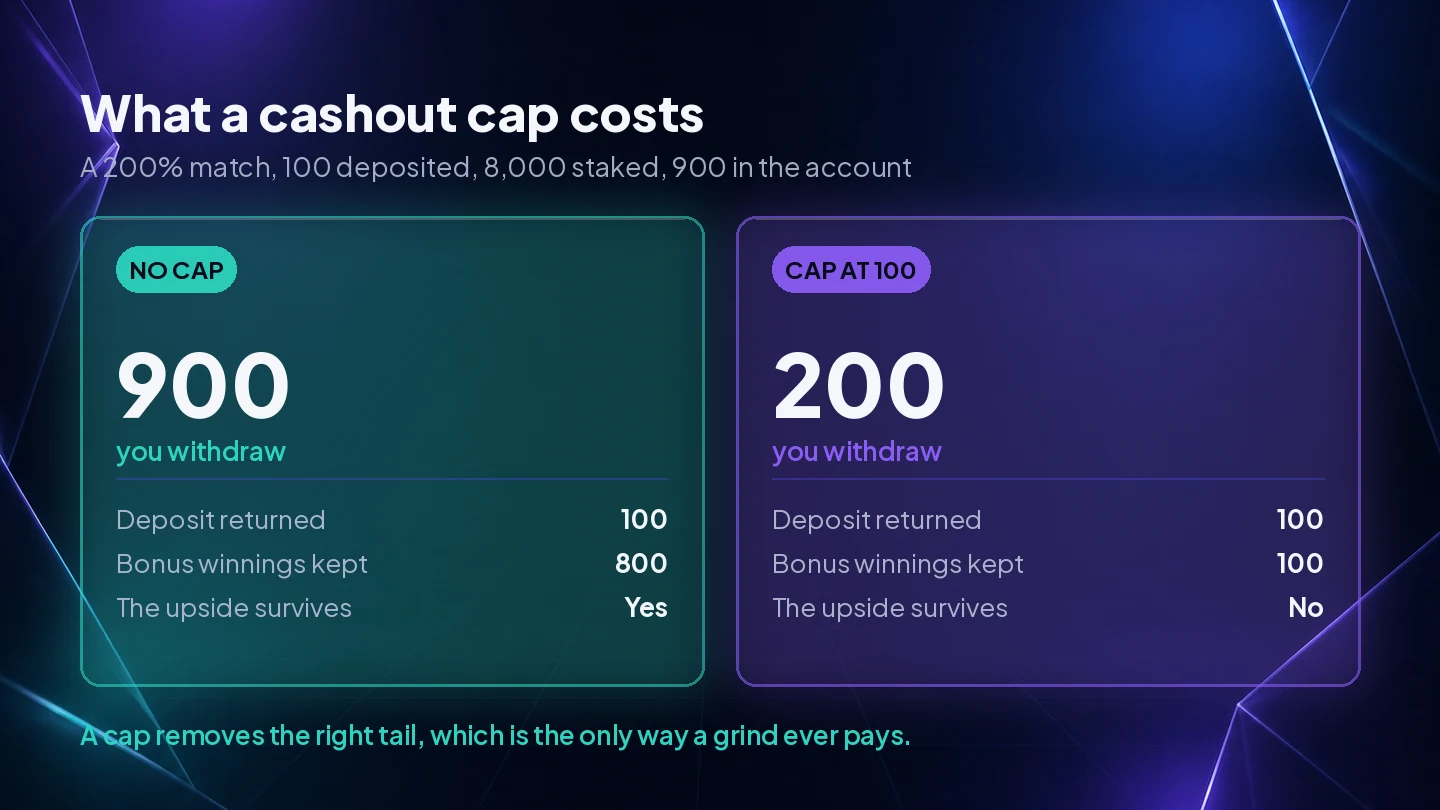
The reason a cap is so damaging is structural. The only way a bonus grind ever pays is through the right tail: the session where a feature round lands well and the balance jumps. Everything else is expected to grind slowly downward. A cap removes the tail and leaves the grind. It converts a bet with a small chance of a large win into a bet with a small chance of a capped win, at the same cost.
Caps are most aggressive on no-deposit offers and free spins, where a free promotion is routinely capped well below what the spins can produce. That is the mechanism that makes a free offer affordable to run, but it means “up to 500 free spins” describes the spin count and says nothing about the maximum you can take home. Read the cap before the multiplier. It is the fastest single filter for discarding offers.
Sticky and non-sticky, the distinction that matters most
A sticky bonus is never withdrawable. The credit sits in your balance, you play with it, and when you withdraw, the bonus amount is deducted. Usually the whole balance is locked until wagering completes, so you cannot take out even your own deposit without forfeiting.
A non-sticky bonus, sometimes called a parachute bonus, keeps deposit and bonus in separate wallets. Your own money is played first. While you are still on real funds, no wagering requirement applies and you can withdraw at any moment, forfeiting the unused bonus. The bonus only activates, with its conditions, once your real balance is exhausted.
Why the difference is material, with the same numbers:
You deposit 100 and take a 100 percent match, 35x (D+B), 7,000 in required turnover. Ninety minutes in, your balance is 400.
Under the sticky version, that 400 is locked. To withdraw it you must complete 7,000 in stakes, and the expected cost of that grind is roughly 280. Most of the 400 is expected to go back. Under the non-sticky version, if you are still playing your own funds, you press withdraw, give up an unused bonus you never needed, and take out 400.
Non-sticky gives you the option sticky removes: the option to stop while ahead. Options have value, which is why non-sticky offers carry smaller headline percentages and why a 50 percent non-sticky match is often a better product than a 200 percent sticky one. Across reviewed casinos, that flag moves the bonus score more than the advertised percentage does.
Contribution edge cases, and why the abuse clauses exist
Beyond the headline clauses sits a layer of rules aimed at people trying to clear wagering without taking risk. They catch ordinary players too.
Cancelled and voided bets never count. A bet voided by the operator, a live table round declared void, a sports bet on a postponed fixture: all contribute nothing, and any progress already credited is normally reversed.
Both-sides betting is prohibited. Staking equal amounts on red and black, or on player and banker at baccarat, generates turnover with a near-zero edge. Terms describe this as low-risk, equal or zero-risk betting, and prohibit it. The wording is usually broad enough to cover covering most of a roulette layout, hedging across two accounts, or betting both outcomes of a sports market. Detection is automated and the standard penalty is forfeiture of bonus and winnings.
Feature buys are commonly excluded or restricted. Many operators bar buying a bonus round while a wagering requirement is open, because it compresses variance into a small number of high-value spins.
Bonus abuse clauses are deliberately broad. Multiple accounts, shared households, shared IP addresses, shared payment instruments, coordinated play across a group, and systematic hopping between welcome offers all appear. The wording usually reserves discretion to the operator, and that discretion is the point.
Operators write these clauses because a welcome bonus is a marketing cost priced against expected turnover from a normal player. A small group of players extracts value systematically, and separating them from ordinary customers is expensive and slow. The cheap solution is a broad clause enforced selectively. It works commercially and it produces the well-known failure mode where a legitimate player with a large win gets their account reviewed under a rule written for someone else. That review is one of the main reasons withdrawals get delayed.
What you can do about it is limited but real. One account per person, your own name on the payment method, no shared devices, and no play from an address that already holds another account. Then read whether the abuse clause lets the operator void your deposit as well as your winnings. Some do, and that is a materially worse contract.
Three realistic offers, priced
The point of all of this is comparison. Below are three offer shapes that all exist in the market, priced on the same 100 unit deposit, all cleared on slots returning 96 percent.
| Offer A | Offer B | Offer C | |
|---|---|---|---|
| Headline | 100% up to 100 | 50% up to 50 | 200% up to 200 |
| Bonus credited | 100 | 50 | 200 |
| Wagering basis | 35x (D+B) | 20x bonus | 40x bonus |
| Required turnover | 7,000 | 1,000 | 8,000 |
| Slot weighting | 100% | 100% | 100% |
| Max bet | 5 | 5 | 5 |
| Expiry | 7 days | 30 days | 14 days |
| Max cashout | None | None | 100 |
| Expected grind cost at 96% RTP | 280 | 40 | 320 |
| Rough net position | about -180 | about +10 | worse than -220 |
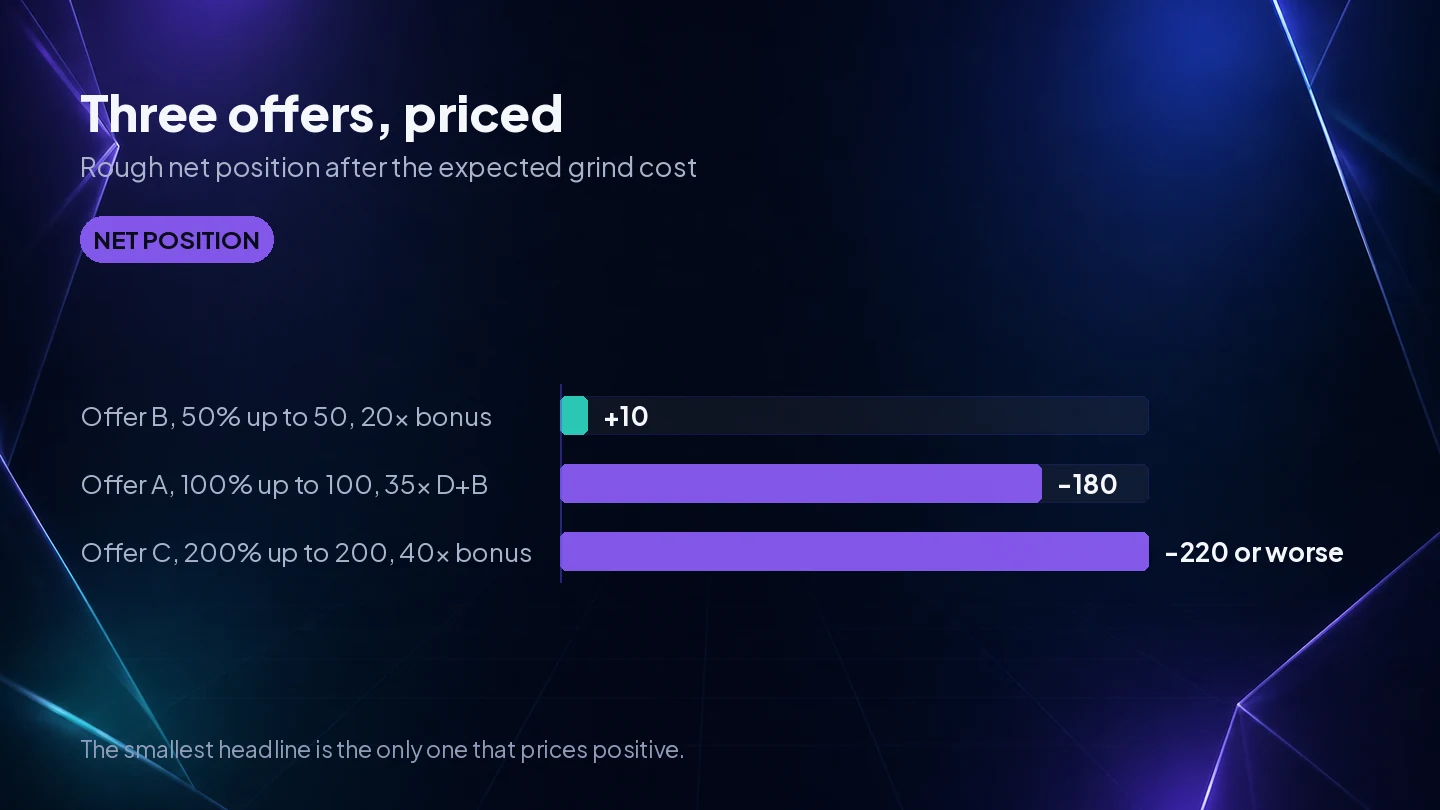
Offer B has the smallest headline of the three and is the only one whose arithmetic is not clearly against you. Twenty times a 50 unit bonus is 1,000 in turnover, an expected cost of about 40 against a 50 unit credit, inside a month-long window. Offer C has the largest headline and is the worst product on the table: the cap removes the only outcome that could have justified the grind.
Two honest caveats. The expected cost figure is a long-run average that no individual player experiences: most people who take Offer A will bust early or finish somewhere either side, and variance is far wider than the numbers suggest. The model also assumes you complete the wagering, which most players do not. Treat the net position column as a way of ranking offers against each other, not as a forecast. If you are treating any of these numbers as income rather than as the price of entertainment, stop and read responsible gambling.
The five things to read before you accept, and where they hide
Five clauses decide the price. Everything else is detail. Here is each one and the usual hiding place.
1. The wagering basis. Look for the sentence naming what the multiplier applies to. Location: the offer-specific terms behind a small “T&Cs apply” link under the cashier tick box, not the general bonus policy. Warning sign: a page saying “35x wagering applies” that never names the base. If you cannot find it, ask live chat and keep the transcript.
2. The game contribution table. Location: almost always the general terms page rather than the offer terms, under a heading like “Game Contribution” or “Eligible Games”, sometimes on a page of its own. Check for 0 percent rows as well as low ones.
3. The maximum bet. Location: general bonus terms, phrased as “maximum stake”, “maximum bet per round” or “maximum wager”. Check whether it applies per spin, per hand, or per bonus feature, and whether the number is flat or a percentage of the bonus.
4. The expiry and when the clock starts. Location: offer-specific terms. Find the trigger event, not just the day count, and check whether attached free spins expire sooner.
5. The maximum cashout. Location: often the last clause in the offer terms, worded as “maximum conversion”, “winnings are capped at” or “the maximum amount withdrawable from this promotion”. On free spins and no-deposit offers, look for it first.
If any of the five is genuinely absent from the published terms, that is information in itself, and it is one of the things our guide to choosing an online casino tells you to weigh before depositing.
What to check inside your own account
Once a bonus is live, your account interface becomes the record.
Open the cashier or balance panel and see whether real balance and bonus balance are shown separately. If they are, you probably hold a non-sticky bonus and can withdraw real funds. A single combined figure with a lock icon means sticky, and everything is locked.
Find the wagering progress meter and work out what it counts. Remaining turnover in currency is the most useful display, turnover completed against turnover required is fine, and a bare percentage hides the figure you need. Check it after a few spins on the game you intend to grind. If you stake 10 and the meter moves 1, you are on a 10 percent game whatever the table said.
Check your bet history for the largest stake placed since the bonus was credited and compare it against the cap. Do that before you request a withdrawal, not after.
Then ask support, in writing, for the exact remaining turnover and the exact maximum cashout on your bonus. A transcript naming a number beats a screenshot of a general terms page and costs two minutes. In UK-licensed casinos the standards on clear and timely information are firmer than in some markets, and bonus terms there are under commercial pressure, which we covered in the UK gambling tax rise and your bonuses.
What to do with all this
A wagering requirement is not a trick played on you. It is the price of the offer, set so the promotion costs the operator less than it brings in. That is an ordinary commercial arrangement, stated in writing. The problem is not that a price exists. It is that the price is presented as one multiplier when it is really five variables, and the four that matter most arrive last.
So price it before you accept. Convert the multiplier to a bonus-only equivalent. Multiply by the weighting of the game you will actually play. Divide the required turnover by the days available and ask honestly whether you would play that much. Look for the cap. Establish whether the bonus is sticky. Five minutes of arithmetic and you know whether the offer is Offer B or Offer C.
And be willing to decline. Every cashier lets you deposit without the bonus, usually behind a small link or an unticked box, and for a large share of offers that is the better play. Declining costs you a credit that was expected to cost more than it was worth, and it leaves your balance unlocked, your stake size unrestricted and your withdrawal free of a review that exists only because a bonus was attached.
If a bonus is the reason you are depositing at all, or the reason you are depositing more than you planned, the offer has already done its job and none of the arithmetic above is the issue any more. Set a deposit limit first and use the tools on our responsible gambling page. We publish how we are paid on how we make money, because a site that prices bonus offers should be legible about why.
In one paragraph
Wagering requirements decide whether a bonus is worth taking. Here is the arithmetic, the clauses that change it, and the numbers to check before you deposit.
Read next
Markets
Frequently asked questions
What does 35x wagering actually mean?
It means you must stake 35 times a base amount before bonus funds convert to withdrawable cash. The base is the trap. If the base is the bonus alone, a 100 unit bonus needs 3,500 in stakes. If the base is deposit plus bonus, the same offer needs 7,000. Always find the sentence that names the base.
Is 35x the bonus better than 35x deposit plus bonus?
Much better, on a full match offer it is exactly half the work. A 35x deposit-plus-bonus condition on a 100 percent match is arithmetically the same as 70x the bonus. When you compare two offers, convert both to a bonus-only multiplier first, otherwise you are comparing numbers that measure different things.
Why do table games only count 10 percent towards wagering?
Because blackjack, baccarat and most roulette bets carry a lower house edge than slots, so the operator loses less to a bonus hunter grinding them. Weighting equalises the cost. The effect on you is brutal: at 10 percent weighting, a 3,500 requirement needs 35,000 in actual stakes to clear.
What happens if I bet over the max bet with a bonus active?
In most terms the operator can void the winnings from that point, remove the bonus, and in some cases return only your original deposit. It is usually enforced automatically at withdrawal, not blocked at the moment you place the bet, so you can breach it for hours without any warning on screen.
Should I ever take a bonus?
Sometimes. A low multiplier on the bonus alone, 100 percent slot weighting, a workable expiry window and no cashout cap can be worth taking if you were going to deposit anyway. A high multiplier on deposit plus bonus with a tight cap almost never is. Price it first, then decide.
More from the blog
-
 safety How to Verify a Casino Licence in Five Minutes A licence badge is an image file. The only thing that counts is the entry on the regulator's public register, and checking it takes about five minutes.
 -
 safety KYC Checks at Online Casinos, Explained Verification is a licence condition, not an operator invention. But the moment an operator chooses to run it is a business decision, and that choice is what turns a ten minute upload into a fortnight of chasing support.
 -
 bonuses Max Bet Rules and How One Spin Voids a Win The max bet clause is the shortest sentence in most bonus terms and the one that costs players the most money. This is what it covers, how a single spin breaches it, and what an operator is allowed to do next.

Marie-Louise Aubert
Head of Casino Research since 2024
Marie-Louise Aubert has led casino research at LSM99 since 2024, and she is the one who actually opens the accounts. Where most review sites summarise an operator from its own marketing, Marie-Louise registers, deposits, plays and requests a withdrawal, then records what really happened rather than what was advertised. The account is real, opened in her own name and funded with the site's own money, never a demo balance and never a media account handed over by an operator. She reads terms line by line so readers do not have to, and she owns the toplists, the market rankings and the country pages that come out of that work.



Play responsibly
Gambling is entertainment, not income. Set a deposit limit before you play, never chase a loss, and stop when it stops being fun. If it has become a problem, these services are free and confidential.
Our responsible gambling guide carries no affiliate links and no casino list.