
News
The UK Gambling Tax Rise and What It Did to Bonuses
The duty on online casino revenue nearly doubled on 1 April 2026. Operators cannot pass a tax bill to you directly, so they moved the parts of an offer that are not fixed by regulation. This is the chain, step by step.
Show moreShow less

Remote Gaming Duty, the tax on profits from online games of chance offered to British customers, rose from 21 percent to 40 percent on 1 April 2026. That is the headline, and it is confirmed in the government’s own gambling duty changes policy paper. Bingo Duty was abolished on the same date. A separate 25 percent remote rate of General Betting Duty follows on 1 April 2027, with remote bets on UK horseracing staying at 15 percent.
None of that is charged to you. Duty is levied on the operator, on its gaming profits, and there is no mechanism by which a casino can add a line to your deposit and call it tax. What happened instead is that the money an operator has available to spend on acquiring and keeping customers got smaller, and promotions are the largest and most flexible item in that budget. So the welcome offer moved. Then a second thing happened, which almost every account-opening guide published this year gets wrong: a set of Gambling Commission rules on incentives came into force on 19 January 2026 and put a hard ceiling on one of the levers operators would normally have pulled.
The result is an offer that looks thinner but is, in one specific respect, better constructed than what it replaced. This piece separates the two forces: what the tax did, what the regulator did, which of the changes is a legal requirement and which is a commercial choice, and what to read before you accept an offer. It is reporting, not a verdict on whether the tax is sound policy.
What changed on 1 April, in numbers
Three duty changes were confirmed at the Autumn Budget 2025 and legislated for. Only the first two land in 2026.
| Duty | Old position | New position | Effective |
|---|---|---|---|
| Remote Gaming Duty | 21% of gaming profits | 40% of gaming profits | 1 April 2026 |
| Bingo Duty | 10% of bingo promotion profits | Abolished | 1 April 2026 |
| General Betting Duty, remote | 15% | 25%, except remote UK horseracing at 15% | 1 April 2027 |
| Casino Duty, land-based | Banded rates | Frozen for 2026/27 | n/a |
Remote Gaming Duty covers online casino, slots and online bingo. That last one surprises people, because Bingo Duty was abolished on exactly the same day. Excise Notice 455a is explicit that remote gaming includes bingo played by internet, telephone or television, with one narrow exception for remote bingo played at licensed bingo club premises under an ancillary remote licence. If you play bingo on your phone, your operator did not get a tax cut on 1 April. It got the same near-doubling as the slots business next door.
The scale of the cost is not a secret. One London-listed operator group told investors it expected between 125 million and 135 million GBP in additional annual duty, with roughly 80 million landing in the current financial year. A major supplier warned of a high-teens millions of euros hit to earnings before mitigation. That is two companies out of hundreds holding a British licence, but the direction is the same across the market.
Why a tax on the operator reaches a player promotion
The connection is not just “less money, smaller bonus”. There is a specific mechanism in how duty is calculated, and it works directly against generous bonus structures.
Gaming profits, the thing duty is charged on, are gaming payments received minus prizes paid out. Two rules in Excise Notice 455a decide how a promotion enters that sum.
The first is that a free play counts as a stake. In the notice’s words, duty “is due on a freeplay as if it were a (non-discounted) fully paid up stake”, and the notional value is “the full amount the player would have paid but for the offer”. So a hundred free spins at 10p a spin add 10 GBP to the operator’s gaming payments the moment you use them, even though you paid nothing.
The second is that a prize is only deductible if you can actually have it. The operator may deduct money credited to a customer account, but only where it has told the customer the money is there and the customer “can withdraw it at any time”. The notice adds that you cannot deduct a prize “if the customer has to re-wager them or there are any other conditions attached”.
Put those together and the shape of the problem appears. A promotion that hands out locked bonus credit generates dutiable stakes on the way in and nothing deductible on the way out. Winnings from a free play that can only be re-staked are treated as excluded winnings and sit outside the calculation entirely. The duty cost of a bonus is therefore driven less by how much you eventually withdraw and more by how much notional turnover the promotion creates and how much of the resulting value never becomes withdrawable cash.
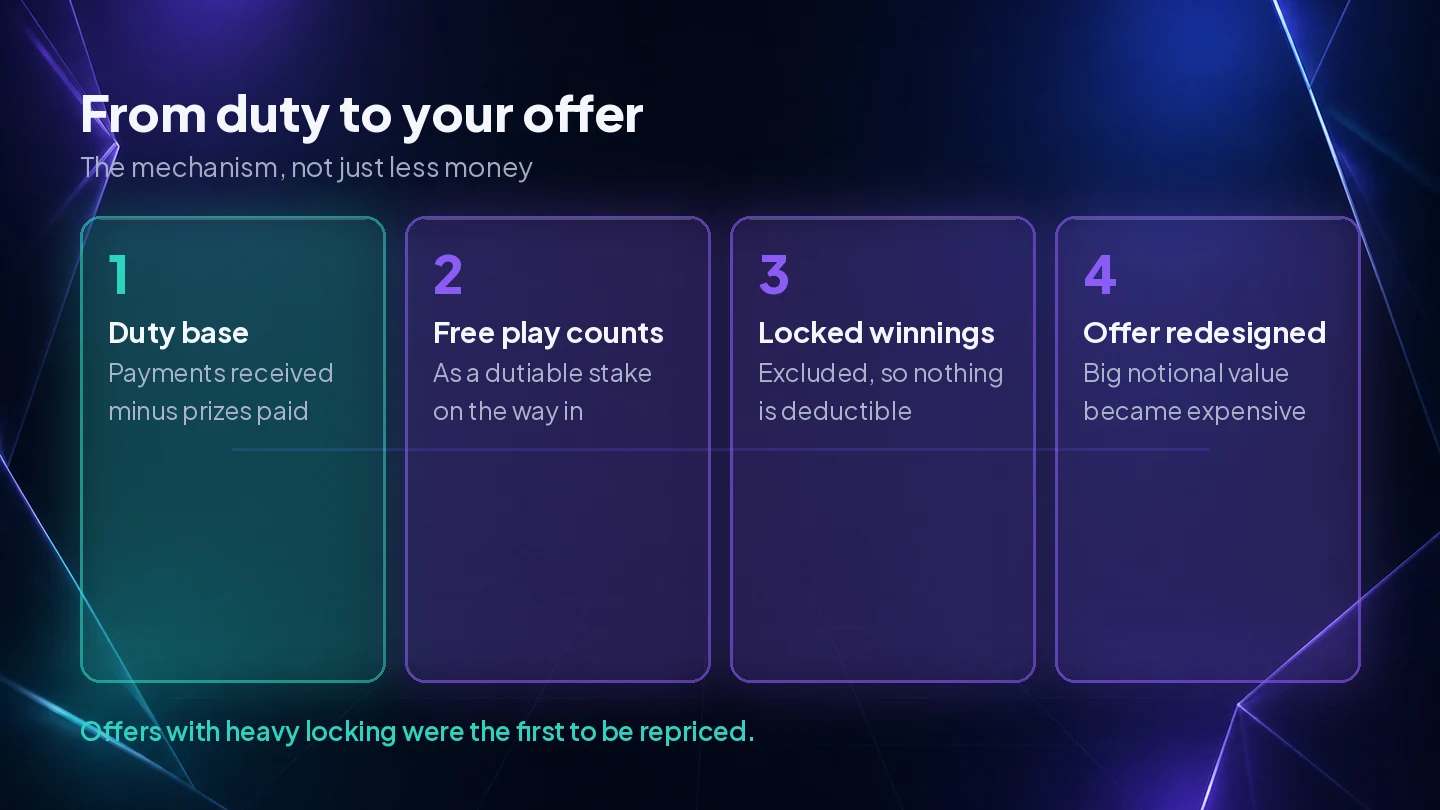
That is why the response was not “keep the same offer and eat the cost”. Offers with a large notional value and heavy locking became disproportionately expensive to run at 40 percent, so those were the first to be redesigned.
A worked example you can follow
Take a common promotion shape and price it under both duty rates. The numbers below are illustrative arithmetic, not any operator’s published figures, but every step follows the rules in Notice 455a.
An operator gives a new customer 100 free spins with a notional value of 0.10 GBP per spin. Winnings from the spins are credited as bonus funds carrying a wagering requirement.
Step 1. The spins are used. Notional value enters gaming payments: 100 x 0.10 = 10.00 GBP.
Step 2. The spins return, say, 9.60 GBP at a 96 percent return to player. That 9.60 is credited as locked bonus funds, so it cannot be withdrawn at any time and cannot be deducted as a prize.
Step 3. Gaming profit from this promotion is 10.00 minus nothing, so 10.00 GBP.
Step 4. Duty at the old rate: 10.00 x 21 percent = 2.10 GBP. Duty at the new rate: 10.00 x 40 percent = 4.00 GBP.
The duty cost per new customer on that single promotional element rose by 1.90 GBP, or about 90 percent. Multiply by a sign-up cohort of 20,000 and the same offer that cost 42,000 GBP in duty now costs 80,000.
Now run the variant where the same spins pay out as immediately withdrawable cash with no wagering attached.
Step 1. Gaming payments: still 10.00 GBP.
Step 2. The 9.60 is withdrawable at any time, so it is a deductible prize.
Step 3. Gaming profit: 10.00 minus 9.60 = 0.40 GBP.
Step 4. Duty at 40 percent: 0.16 GBP.
The duty bill collapses, but the operator has handed over 9.60 in real cash instead of 4.00 in tax on locked credit. Cash spins are not automatically cheaper overall. The honest conclusion is narrower: duty on a promotion scales with the notional turnover it manufactures, and locking value behind wagering makes that value non-deductible. At 21 percent that inefficiency was tolerable. At 40 percent it is a line item somebody has to defend.
The practical consequence for you is that the cheapest thing to cut is the notional value: fewer spins, a lower per-spin value, a smaller matched percentage, a lower cap on the match. That is what most redesigned welcome offers did.
What the regulator stopped operators from doing
Here is where the common account of 2026 goes wrong. The intuitive prediction is that a squeezed operator raises wagering requirements to claw value back. In Great Britain it cannot.
Social responsibility code provision 5.1.1 was rewritten and came into force on 19 January 2026. Two of its requirements matter here. Operators must not apply wagering requirements “over a maximum of 10 times” the bonus funds a customer is required to play through. And they must not “include more than one type of gambling product (betting, casino, bingo, and lottery) within an incentive”.
The wagering cap is the important one for anybody comparing offers year on year. Multipliers of 35x and 40x on bonus funds, which were ordinary in the British market a couple of years ago, are no longer lawful for a Commission licensee. The ceiling is ten. So a 2026 welcome offer with a smaller headline can still be a materially better product than a 2024 offer with a larger one, because the price of clearing it fell by a factor of three or four. If you want the arithmetic of why the base a multiplier is applied to matters as much as the multiplier itself, we set it out in how wagering requirements work.
The mixed-product ban is the other visible change. Offers that credited casino funds on the condition you first placed a qualifying sports bet, and vice versa, are gone. Every incentive now sits inside a single product. Two further provisions in the same code are worth knowing: an operator must not alter the value of a benefit because a customer met the qualifying conditions faster than intended, and free or subsidised travel and accommodation must not be tied to a customer’s prospective level of gambling. High-value and VIP schemes have to be consistent with the licensing objectives, which is why several of them were quietly restructured over the winter rather than in response to the tax at all.
You can read the code provision on the Gambling Commission’s own site under LCCP condition 5.1.1, and the Commission’s summary of the reforms sits under gambling promotions to be safer and simpler.
So where did the value actually go
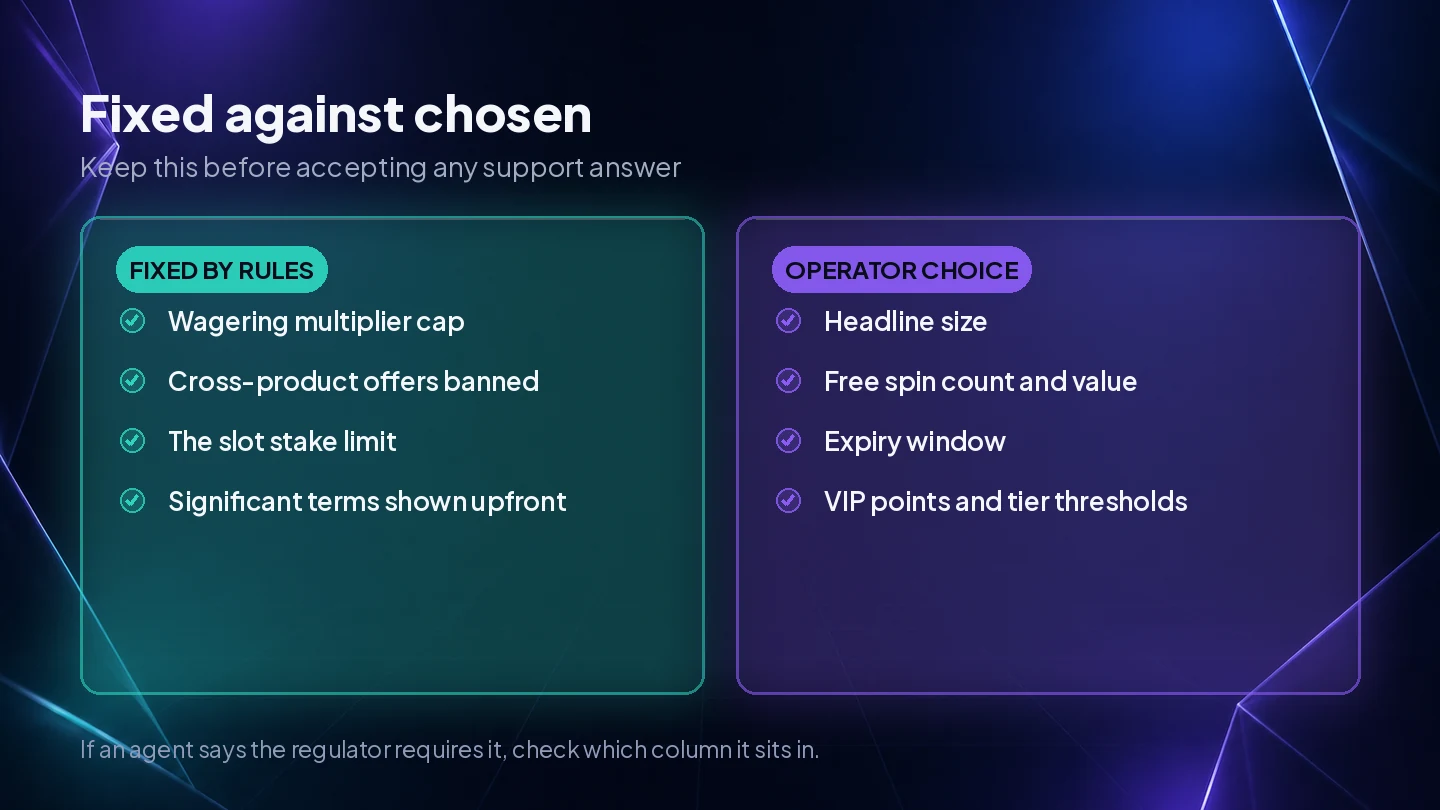
With the wagering multiplier capped and cross-product offers banned, the remaining levers are the ones no rule fixes. In rough order of how often we have seen them move on UK-licensed sites this year:
Headline size. The simplest cut and the most visible. A match capped at 200 becomes a match capped at 100, or the percentage falls.
Free spin count and per-spin value. Both drive notional value directly, which is the number the duty calculation runs on. Two hundred spins at 0.10 became fifty spins at 0.10 in a lot of places, and a few offers moved the per-spin value down to the minimum the game allows.
Maximum win from bonus funds. A cap on the amount of bonus-derived winnings you may withdraw is untouched by the wagering cap and does more damage to the value of an offer than a multiplier does, because it removes the only outcome that ever justified the grind.
Game weighting and eligible titles. A contribution table that excludes more games, or weights them lower, raises the real turnover you must place without touching the advertised multiplier at all.
Expiry windows. A shorter clock on the same requirement lowers the proportion of customers who complete it. This is the least visible change in the list and the one most worth checking.
Return to player. Trade reporting through 2026 quotes games studios saying that standard slot RTPs have drifted from around 96 percent towards 94, with 92 being asked for at the low end. We have not seen a regulator confirm the scale of this, and it varies enormously by title and by operator, so treat it as a claim to verify rather than a fact. What you can do is check it yourself: UK slots publish the theoretical return in the game’s information or help panel, and the same game can be configured differently at different operators. If you play online slots regularly, that panel is now worth opening before you play rather than never.
VIP and loyalty schemes. Points-per-stake rates, tier thresholds and reward conversion rates are commercial settings with no regulatory floor. Several schemes were repriced. Some of that is the tax and some of it is code 5.1.1 forcing changes to how high-value incentives are constructed. From the outside the two are hard to tell apart.
Requirement or choice: a quick reference
This is the table to keep. If a support agent tells you something is “required by the regulator”, check it against this before accepting the answer.
| What you see | Requirement or choice | Detail |
|---|---|---|
| Wagering capped at 10x bonus funds | Requirement | SR code 5.1.1, in force 19 January 2026 |
| No sports bet needed to unlock a casino bonus | Requirement | Same provision, mixed-product ban |
| Max 5 GBP per spin on slots, 2 GBP if aged 18 to 24 | Requirement | In force 9 April and 21 May 2025 |
| Light-touch check after 150 GBP net deposits in 30 days | Requirement | Threshold in force since 28 February 2025 |
| Smaller headline match or fewer free spins | Choice | Commercial response to duty and margin |
| Cap on maximum winnings from a bonus | Choice | Not regulated as a value; must be disclosed |
| Shorter bonus expiry window | Choice | Must be clear, transparent and fair |
| Games excluded from wagering contribution | Choice | Must be published in the terms |
| Lower published RTP on a slot | Choice | Publication required, level is not set |
| VIP tier thresholds raised | Choice, shaped by rules | 5.1.1 constrains construction, not generosity |
The distinction matters because the two categories behave differently when you shop around. A requirement is the same everywhere a British licence applies, so there is no point hunting for a UKGC site with 40x wagering. A choice varies by operator, which is precisely what makes comparing new casino sites worth the twenty minutes.
The other dates in 2026 that change your account
The duty rise arrived in the middle of a much larger regulatory programme, and several of the changes players attribute to the tax are unrelated to it.
Statutory levy, in force 6 April 2025. The Gambling Levy Regulations 2025 replaced voluntary contributions with a mandatory charge of 0.1 to 1.1 percent of the leviable amount, with remote casino, remote bingo, remote betting and gambling software licences at the top rate of 1.1 percent. Government said it expects to raise around 100 million GBP a year, split roughly 50 percent to NHS-led treatment, 30 percent to prevention and 20 percent to research through UK Research and Innovation. It is a cost on the same revenue base as the duty, and it landed a year earlier.
Slot stake limits, in force 9 April and 21 May 2025. Five GBP maximum per game cycle for players aged 25 and over, two GBP for players aged 18 to 24. Online slots only. These did not change in 2026 and are unrelated to the duty.
Deposit limit definition, from 30 September 2026. This is the one to diarise. Under the revised technical standards, only a gross deposit limit, meaning a cap on what you put in regardless of what you take out, may be called a “deposit limit”. A limit that nets off withdrawals must be labelled a net deposit limit and cannot be given the plain name. Gross limits must be offered with at least equal prominence to other financial limit types, and where you set several timeframes the most restrictive applies. The Commission also renamed “spend limits” to “stake limits” to stop the two being confused. The deadline was originally 30 June 2026 and was extended to 30 September after operators asked for more development time, so if your account still shows the old wording, that is why.
Financial risk assessments, staged from 2026. These are distinct from the light-touch financial vulnerability checks, which have applied since 28 February 2025 at a threshold of net deposits above 150 GBP in a rolling 30-day period. In July 2026 the Commission set out a staged introduction of the credit-reference-based assessments, starting with the largest operators.
| Financial risk assessment stage | Aged 25 and over | Aged under 25 |
|---|---|---|
| Stage one | Net deposits above 5,000 GBP in a rolling 24 hours | Above 2,500 GBP in a rolling 24 hours |
| Final stage | Above 1,000 GBP in 24 hours, or above 3,000 GBP in 90 days | Above 750 GBP in 24 hours, or above 2,000 GBP in 90 days |
The Commission’s stated expectation is that around 97 percent of assessments will be frictionless, meaning you would never know one had happened, and that fewer than one account in a thousand would face a non-frictionless assessment. Intermediate stages between the two rows above had not been set at the time of writing. None of this is a bonus rule, but it is the most common reason a large deposit run meets an unexpected request for documents, and it gets blamed on the tax rise in forum threads where it has no bearing at all.
What to check in your own account
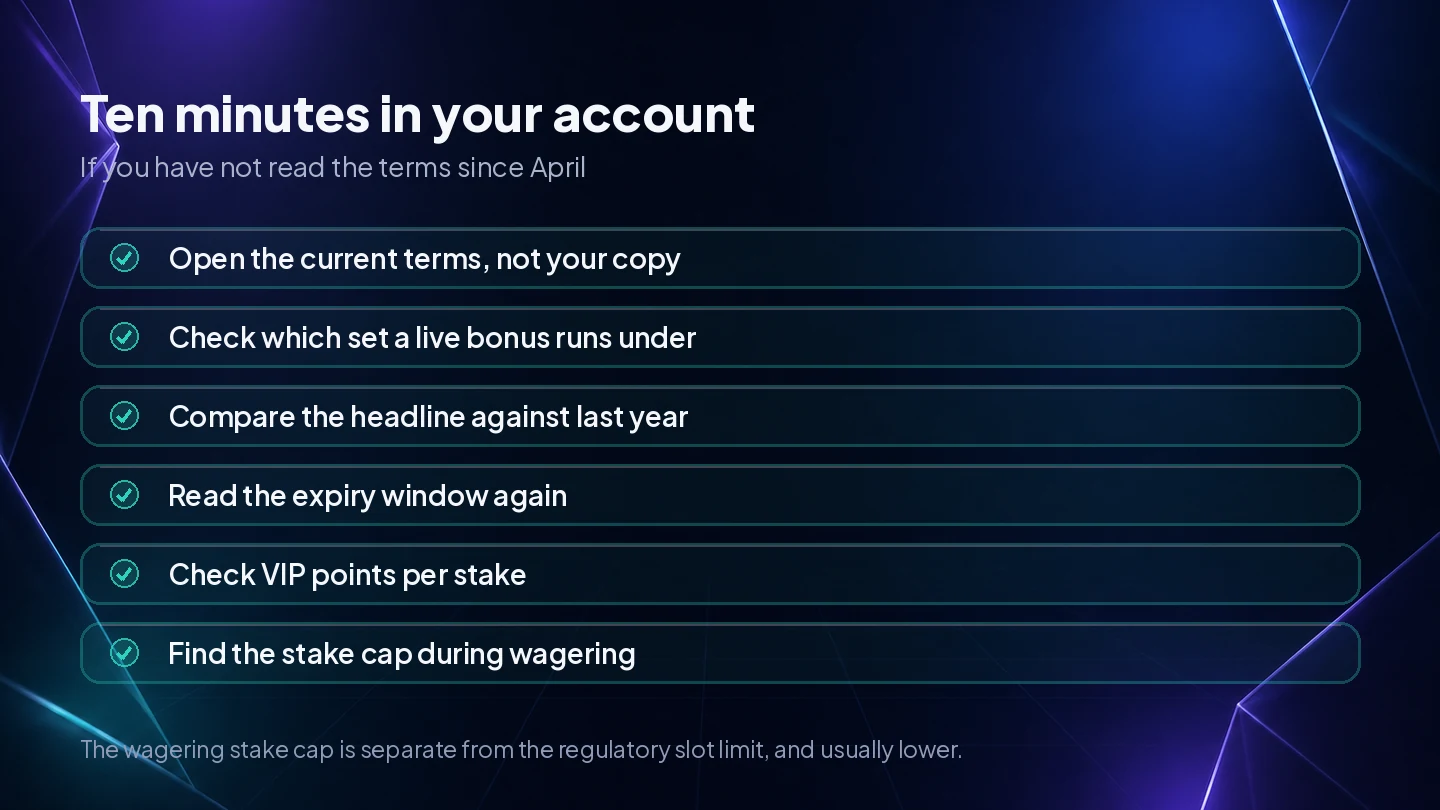
If you opened an account before April and have not looked at the terms since, five checks take about ten minutes.
Open the current promotions terms, not the version you agreed to. A bonus you already accepted normally runs under the terms in force when it was credited. Bonuses you accept from here run under the new ones. If you cannot tell which set applies to a live bonus, ask support in writing and keep the transcript.
Find the maximum win from bonus funds. This is the clause that moved most quietly in 2026 and does the most damage. It is usually the last line of the offer-specific terms, worded as a maximum conversion or a cap on withdrawable winnings. On free spins offers, look for it before you look at anything else.
Recalculate the requirement using the game you will actually play. The 10x cap applies to bonus funds, not to your stakes after weighting. A game contributing 20 percent turns a 10x requirement into 50x of real turnover. The multiplier is capped. The contribution table is not.
Check the expiry trigger, not just the day count. Deposit, credit and first qualifying wager are three different start points, and free spins attached to a match offer very often carry a shorter clock than the match itself.
Look at your deposit limit and read its label. Until 30 September 2026 an operator may still present a net limit under the plain name. If your limit resets or behaves oddly after a withdrawal, you are almost certainly on a net limit. Setting a limit is the most effective control in a licensed account, and the tools are listed on our responsible gambling page.
One more, if you have ever hit a max bet clause: the stake cap during wagering is separate from the 5 GBP regulatory slot limit and is usually lower. Breaching it is still the most common way a legitimate win disappears, which we cover in max bet rules and voided wins.
Bingo Duty was abolished. It was probably not your bingo
The headline reads as good news for bingo players and mostly is not.
Bingo Duty was charged at 10 percent of bingo promotion profits and applied to bingo played in premises. Its abolition on 1 April 2026 is a genuine relief for land-based bingo clubs, which have been closing for two decades. Online bingo is a different tax: it falls under Remote Gaming Duty, which went up. The only overlap is the narrow case of remote bingo played at a licensed bingo club under an ancillary remote licence.
So if your bingo happens in an app, the operator’s duty on it nearly doubled on the same day the word “bingo” appeared in a tax abolition headline. Expect promotions there to follow the slots pattern, not your local club’s.
What to do next
Three things, in order.
First, stop comparing 2026 offers to your memory of 2023 offers. The headline number fell and the wagering ceiling fell further. A 50 percent match at 8x bonus wagering with no win cap is a better instrument than a 200 percent match at 40x with a cap, and the second of those can no longer be offered to you by a British licensee anyway. Convert every offer to the same units before ranking it: required turnover, adjusted for the weighting of the game you will play, against the maximum you are permitted to withdraw.
Second, treat the win cap and the contribution table as the two clauses that decide the price, because they are the two the regulator did not fix. Our review methodology weights both above the advertised percentage for exactly that reason, and the guide to choosing an online casino sets out the order to read a terms page in.
Third, be honest about whether the offer is the reason you are depositing. A thinner welcome bonus is not a reason to look for a site outside the licensed market, where none of the protections described above apply and where a dispute has nowhere to go. Withdrawal friction is the usual first symptom, and we go through the ordinary causes in why casino withdrawals are delayed. Gambling is entertainment with a cost attached and is never a way to make money, and if a promotion is moving how much you deposit rather than where you deposit it, the tools on our responsible gambling page are the right next click rather than a comparison table.
We publish how this site is funded on how we make money. We think a site writing about the commercial pressure on bonus budgets should be legible about its own. Nothing here is legal, tax or financial advice, and the duty and licensing positions described are as they stood at the date on this page.
In one paragraph
Remote Gaming Duty went from 21 to 40 percent. Here is how that reached your welcome offer, which changes are UKGC rules, and what to check before you accept.
Read next
Markets
Frequently asked questions
Did the tax rise make my bonus smaller?
Indirectly, yes. Remote Gaming Duty moved from 21 to 40 percent of gaming profits on 1 April 2026. Promotions are a marketing cost measured against expected revenue, and the revenue side shrank. Nothing in tax law forces an operator to cut an offer, but most trimmed something. The size of the cut varies by operator.
Can a UK casino give me 60x wagering in 2026?
No. Social responsibility code 5.1.1 caps wagering requirements at ten times the bonus funds for every Gambling Commission licensee, in force since 19 January 2026. If you see a higher multiplier advertised to a UK account, either it is not a UKGC-licensed site or the number is being applied to something other than bonus funds. Check which.
Why can I no longer get a casino bonus for placing a bet?
The same code provision bans mixing product types inside one incentive. An offer cannot require you to bet on sport to unlock casino or slots funds, or the reverse. Every promotion must sit inside a single product. That rule is a regulatory requirement, not a commercial decision, and it applies to all licensees.
Is the maximum stake on online slots still 5 GBP?
Yes for players aged 25 and over, and 2 GBP per game cycle for players aged 18 to 24. Those limits came into force on 9 April 2025 and 21 May 2025 and were unaffected by the duty change. They apply to online slots only, not to roulette, blackjack or live dealer tables.
What is the deposit limit change coming in September?
From 30 September 2026 only a gross deposit limit may be called a deposit limit, and it must be offered with at least equal prominence to any other financial limit. A limit counting deposits minus withdrawals has to be labelled a net deposit limit. The deadline moved from 30 June after operators asked for more build time.
More from the blog
-
 safety How to Verify a Casino Licence in Five Minutes A licence badge is an image file. The only thing that counts is the entry on the regulator's public register, and checking it takes about five minutes.
 -
 safety KYC Checks at Online Casinos, Explained Verification is a licence condition, not an operator invention. But the moment an operator chooses to run it is a business decision, and that choice is what turns a ten minute upload into a fortnight of chasing support.
 -
 bonuses Max Bet Rules and How One Spin Voids a Win The max bet clause is the shortest sentence in most bonus terms and the one that costs players the most money. This is what it covers, how a single spin breaches it, and what an operator is allowed to do next.

Marie-Louise Aubert
Head of Casino Research since 2024
Marie-Louise Aubert has led casino research at LSM99 since 2024, and she is the one who actually opens the accounts. Where most review sites summarise an operator from its own marketing, Marie-Louise registers, deposits, plays and requests a withdrawal, then records what really happened rather than what was advertised. The account is real, opened in her own name and funded with the site's own money, never a demo balance and never a media account handed over by an operator. She reads terms line by line so readers do not have to, and she owns the toplists, the market rankings and the country pages that come out of that work.



Play responsibly
Gambling is entertainment, not income. Set a deposit limit before you play, never chase a loss, and stop when it stops being fun. If it has become a problem, these services are free and confidential.
Our responsible gambling guide carries no affiliate links and no casino list.