
Guide
Max Bet Rules and How One Spin Voids a Win
The max bet clause is the shortest sentence in most bonus terms and the one that costs players the most money. This is what it covers, how a single spin breaches it, and what an operator is allowed to do next.
Show moreShow less

A max bet clause caps how much you may stake on a single spin, hand or round while bonus funds or bonus-derived winnings are in play. It is usually one sentence, usually in the general bonus policy rather than the offer you clicked. And it is the most common reason a player who has cleared a wagering requirement in full is told at withdrawal that there is nothing to withdraw.
The clause is not, in most cases, dishonest. Without it a bonus is an option on variance: take 100 units of house money, put it on one spin, and either walk away with a large multiple or lose money that was never yours. Capping the stake forces the bonus out over hundreds of small bets, where the maths grinds towards the expected result rather than resolving in one shot. That is a defensible commercial rule.
What is not defensible is the enforcement asymmetry. The cap is checked at the end, after you have won, by a system that could as easily have checked it before you bet. The player carries the entire risk of a misclick. The operator carries none. Everything below is about closing that gap on your side.
What a max bet clause says, and where it hides
The clause takes two common shapes.
A flat cap. A fixed amount per spin or round in your account currency. Around 5 units is the figure you see most often in European terms, with 4 and 6 also common and some operators going as low as 2 on free spin offers. Nothing makes 5 a standard; no regulator imposes it.
A percentage of the bonus. Worded as “no single bet may exceed 10 percent of the bonus amount credited” or similar. On a 50 unit bonus that is 5 per spin, on a 200 unit bonus 20. It is friendlier to large deposits and more dangerous to small ones, because a 20 unit bonus gives a 2 unit cap, below the default stake on plenty of slots.
Where the clause sits is the practical problem. In the cashiers we open for our review process, the max bet is almost never in the promotional copy, rarely in the offer terms, and usually in a general Bonus Terms document under a heading like Maximum Stake or Restricted Play. It is often two or three clicks from the tick box you used to accept, and usually on a different page from the wagering requirement, so a player who reads the wagering terms carefully can still miss it. Search for “maximum bet”, “maximum stake”, “max wager” and “per round”. If none of them hit, that absence is worth noting before you deposit.
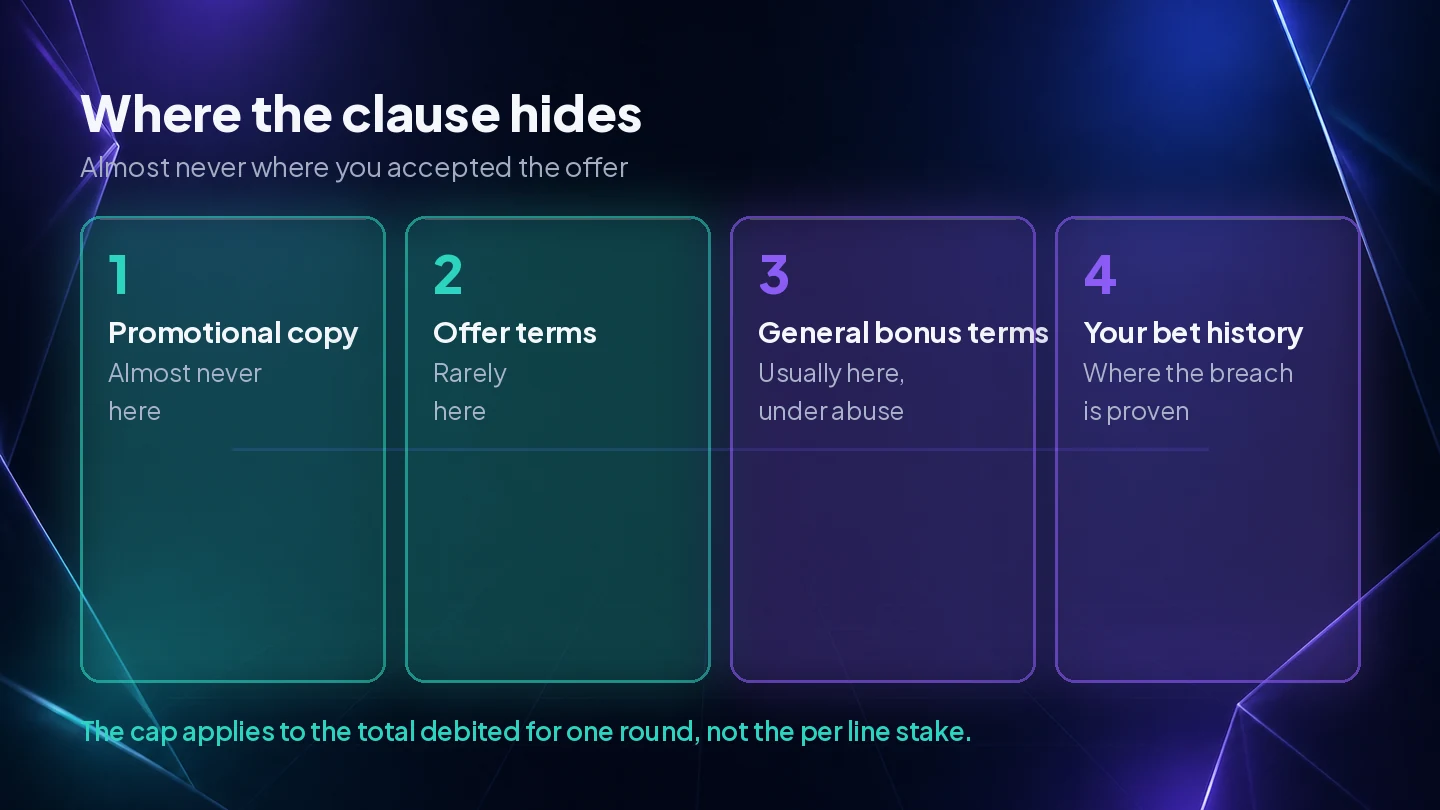
The part most players miss: total stake, not stake per line
This is the crucial misreading, and it causes more voided wins than anything else in bonus play. The cap applies to the total amount debited from your balance for one round. Not the per-line stake, not the coin value, not the bet level.
Interfaces make this easy to get wrong, because they show the components prominently and the total less so. A game showing “0.20 per line” across 25 lines is taking 5 per spin. Coin value 0.10 at bet level 5 across 20 lines is taking 10. The number that matters sits by the spin button, labelled Total Bet or Total Stake, and on some layouts it is the smallest figure on screen.
Four things count towards the total that players assume do not.
All active lines or ways. Twenty-five lines at 0.30 is a 7.50 bet, which breaches a 5 cap even though no line exceeded a third of a unit.
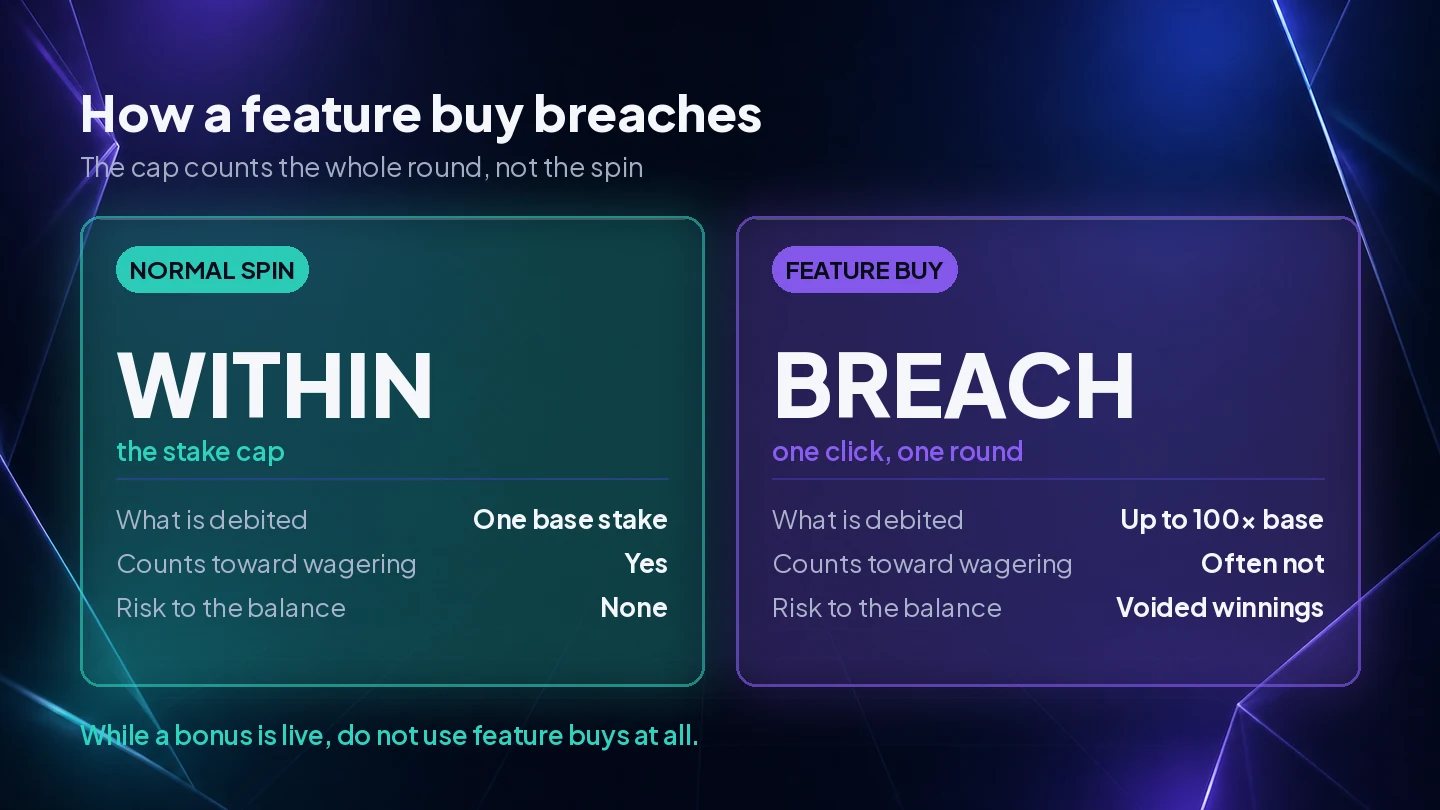
Feature buys and bonus buys. A purchase costing 100 times the base stake, at a 0.20 base, debits 20 units: four times over a 5 cap.
Ante bets and bet boosts. Paying 25 percent extra per spin to raise bonus round frequency raises the total by exactly that. A 4.50 spin with a 25 percent ante is 5.63, which breaches a 5 cap while the base stake on screen looks comfortably legal.
Gamble and double-up rounds. Where terms define a round to include the gamble feature, staking a 4 unit win on double-or-nothing reads as 8 units of exposure. Wording varies, so put this one to support in writing.
Real money bets are caught too. Hold a non-sticky bonus with a separate real balance, switch to a 50 unit spin on your cash, and plenty of terms treat that as a breach: the clause covers any bet placed during the bonus period, not only bets funded by bonus credit.
A worked example: one 6 unit spin on spin 200 of 700
A player deposits 100 and takes a 100 percent match, so 100 units of bonus. Wagering is 35x the bonus: 3,500 in turnover. The general terms cap any single bet at 5 units, and the player intends to grind it out on one slot at exactly 5 per spin.
| Stage | Figure |
|---|---|
| Deposit | 100 |
| Bonus credited | 100 |
| Wagering requirement (35x bonus) | 3,500 |
| Max bet per spin | 5 |
| Spins required at 5 per spin | 700 |
| Spin 200, quick-stake button mis-hit | 6 |
| Total turnover placed | 3,501 |
| Win landed on spin 640 | 2,400 |
| Amount actually paid after the audit | 100, or 0 |
Spin 200 is one unit over. The stake selector offers 4, 5, 6, 8 and 10 as presets, and 6 sits next to 5. There was no on-screen warning, the spin resolved as a small loss, and the player never looked at it again.
Five hundred spins later the player hits 2,400 on a 5 unit spin, finishes the wagering and requests a withdrawal. The request goes into manual review, as most large bonus-derived withdrawals do. The review audits every wager since the bonus was credited, finds one of 6 against a cap of 5, and applies the clause. Under the most common wording, all bonus-derived winnings are voided, the bonus removed and the deposit returned. Under harsher wording the deposit is retained too.
Look at the proportions. Of 3,501 in turnover, 1 unit sat outside the permitted range: 0.03 percent of stakes placed. At a 96 percent return to player, that extra unit costs the operator about 0.04 units in expectation. The penalty applied is 2,400.
The operator’s reasoning is that the clause is a bright line, and bright lines are not applied proportionately. The cap exists to stop bonus funds being converted into a few high-variance shots, and a rule saying “we will assess whether your breach was material” invites argument on every case. So it says “any bet above the cap voids the winnings” and is enforced mechanically. A rounding error and a deliberate 100 unit shot are treated identically. Note the timeline too: the breach happened at spin 200 and surfaced days later at withdrawal, with nothing in the account flagging it in between.
Why feature buys are the most common accidental breach
The single action most likely to void a win is buying a bonus feature while a bonus is active, and the arithmetic is brutal and invisible. Feature buys are priced as a multiple of the base stake, commonly 60x, 80x or 100x. At a 0.20 base a 100x buy debits 20 units; at a 1.00 base it debits 100. Against a 5 unit cap that is four or twenty times over, and the interface does not present it as a bet at all. It is a purchase, in its own panel, with its own price, and most players think they are buying an entry rather than placing a wager. The terms disagree. To the bet log it is a single wager at the purchase price, and to the audit it is the top row of the bet history sorted by stake.
Two interface patterns cause most of the accidents.
Quick-stake buttons. Presets near a 5 unit cap are typically 4, 5, 6, 8, 10, so on a touchscreen the gap between compliant and breaching is a few millimetres. Some games remember the stake from your last session, so a player who ended a real money session at 10 per spin can open the game already in breach.
Autoplay. Autoplay does not raise the stake, but it removes the moment of attention at which you would notice one. Set 200 auto spins, walk away, and a stake that was wrong at the start is wrong two hundred times.
The advice is unfashionable and it is the only reliable version: while playing through a bonus, do not use feature buys at all, and start autoplay only after confirming the total stake on screen. Plenty of terms ban feature buys during bonus play anyway. Our online slots section covers stake structures and volatility, and what RTP really means explains why a bigger bet does not improve your expected result.
Blocked or punished: does the cashier have to stop you?
No major European licensing regime obliges an operator to physically prevent a stake that breaches its own bonus terms. Most codes require terms to be fair, clear and not misleading, with significant conditions shown before acceptance. That is a disclosure standard, not a systems standard, so operators fall into two groups.
Preventive systems. The cashier or the game integration knows a bonus is live, knows the cap, and refuses the bet. In practice that is an error message, greyed-out stake buttons, or a feature buy button disabled while a bonus is active. Some operators cap silently, placing a 5 unit spin when you asked for 6.
Punitive systems. The bet goes through, the balance moves, the spin resolves, and nothing happens until you try to take money out. The check runs at withdrawal, weeks later, against a bet history you never looked at.
The preventive version is not technically hard. The operator already knows the bonus is active, because it tracks wagering progress in real time, and it knows the stake of every spin, because it counts that stake towards the same meter. Blocking the bet means comparing two numbers the platform is already holding.
Which is fairer is not a close question. A preventive system protects the player from an accident and stops a genuine abuser just as effectively, because an abuser who is blocked cannot execute the strategy. A punitive system stops the same abuse and additionally collects the winnings of every player who mis-taps a button. One design achieves the stated purpose with no side effect that benefits the house; the other achieves it with one.
A middle position is worth pushing for: a warning at the moment of the breach, telling you in session that a bet exceeded the limit and the bonus is gone. That preserves the rule and tells the player the truth on the day, and few operators do it. When we score bonus handling across the sites in our casino list, an in-session block or warning is one of the sharper differentiators, and it does not track brand size.
What a licensed operator can and cannot do
The remedies written into bonus terms are not unlimited.
Voiding bonus-derived winnings is the standard remedy. The winnings exist only because bonus funds were in play, the bonus was granted on conditions, the conditions were breached, so the grant falls away and everything downstream with it. Removing any remaining bonus funds follows from the same logic and is rarely contested.
Retaining your deposit is a different animal. Your deposit is your money, transferred under a contract for gambling services, not a gift conditioned on good behaviour. Terms allowing confiscation of a deposit for a stake-size breach are aggressive, and in closely supervised markets they attract regulatory attention. Most licensed operators return the deposit and void only the bonus and its winnings. Wording like “we reserve the right to retain all funds in the account” tells you something about the operator. Closing the account and keeping everything is reserved for fraud cases, and a stake-size accident is not fraud.
Two limits matter. Terms have to be capable of being understood before acceptance, so a clause buried where a reasonable player would not find it is weaker than one shown at the tick box. And the operator has to apply its terms as written: if the clause voids “winnings derived from the offending bet” and the operator voids a whole session, it has exceeded its own rule. That is one of the more winnable arguments a player has.
Where to complain
The route is the same across regulated European markets: exhaust the operator’s complaints procedure first, in writing, then escalate.
In Britain, licensees must have a complaints procedure and must give consumers free access to an alternative dispute resolution provider named in their terms. The Gambling Commission publishes the list of approved ADR entities and takes reports about operator conduct, but does not arbitrate individual payouts. See gamblingcommission.gov.uk, and our UK casino page for what that means in practice.
In Sweden, Spelinspektionen supervises licensees and takes reports at spelinspektionen.se, while disputes over money go to the national consumer disputes board. In the Netherlands, the Kansspelautoriteit at kansspelautoriteit.nl supervises licence holders and expects a documented complaints procedure, with a disputes route afterwards; check the terms for the body the operator names, and see our Dutch market page. In Denmark, Spillemyndigheden at spillemyndigheden.dk regulates the market, and the Danish consumer complaints system handles disputes over money.
Two notes. Named bodies and routes change, so confirm the current one on the regulator’s own site rather than any summary, including this one. And no published body of case outcomes tells you your odds on a max bet dispute, so be sceptical of anyone claiming otherwise. The arguments that get traction are procedural: the term was not accessible before acceptance, or the remedy applied was wider than the wording allowed. Have your evidence ready before you complain, because KYC checks get slower once a withdrawal is disputed.
The other clauses that void wins, and why they are broad
Max bet sits in a family of clauses with one structure: a broad prohibition, an operator-side judgement, and a remedy that voids winnings.
Irregular play patterns. The catch-all. Typical wording prohibits play “designed to guarantee a profit regardless of outcome” or “not consistent with normal play”. Defined by purpose rather than action, it reaches behaviour no specific rule names.
Low-risk and both-sides betting. The concrete version, aimed at roulette. Covering red and black, or odd and even, or most of the numbers generates turnover while risking very little per spin. It is exactly what someone clearing a wagering requirement with minimum exposure would do, which is why terms prohibit it and why roulette is usually excluded or discounted anyway. Similar wording covers hedged blackjack seats and both sides of a baccarat table.
Bonus abuse and multi-accounting. Second accounts, accounts opened by family members at one address, coordinated claiming of the same offer. This clause has the sharpest teeth and is where an operator will close accounts and keep funds. It is also the one most likely to catch someone innocently, since household members on one connection look like a duplicate account in the data.
Why so broad? Three reasons, one of them cynical. Bonus abuse is a real business, and a narrow rule is a map for getting round it. Drafting is defensive, because the clause has to cover a technique nobody has invented yet. And a broad clause is a discretionary clause, applied at withdrawal on a large win.
The defence is the same in each case: play in a way that is boring and legible. Consistent stakes below the cap, one or two games, no hedging, no second account, no shared device. If your bet history looks like someone enjoying a slot, no judgement clause has anything to work with. That is also what playing within your means looks like, and our responsible gambling page has the tools for when it stops being that.
Three term shapes and how much risk each puts on you
Three sets of wording that recur across the market, not taken from any one operator.
| Shape A | Shape B | Shape C | |
|---|---|---|---|
| Cap wording | Flat 5 per spin, in the offer terms | Flat 5 per round, general terms only | 10 percent of bonus, feature buys banned, irregular play clause |
| Cap on a 100 bonus | 5 | 5 | 10 |
| Cap on a 20 bonus | 5 | 5 | 2 |
| Enforcement | Cashier blocks or caps the bet | No block, audited at withdrawal | No block, audit plus discretionary review |
| Penalty | Offending bet’s winnings voided | All bonus winnings voided, deposit returned | Bonus and winnings forfeited, wider rights reserved |
| Warning in session | Yes | No | No |
| Risk carried by the player | Low | Moderate | High |
Shape A is what fair looks like: the rule is disclosed where you accept it, the system enforces it when it matters, and the remedy is scoped to the bet that broke it. Shape B is the market default. Nothing in it is unlawful, but the whole risk of a misclick sits with the player, from the breach through to the withdrawal.
Shape C is where you slow down. A percentage cap is fine on a large bonus and hostile on a small one, and small bonuses are what casual players take. A feature buy ban and an irregular play clause on top of an unenforced cap give the operator three independent grounds to void the same win, none of which announce themselves during play. Price it accordingly, or deposit without the bonus. Weighing terms like these is part of choosing a casino.
What to check in your own account before the first bonus spin
Four minutes, and it is the difference between a rule you comply with and one you gamble on.
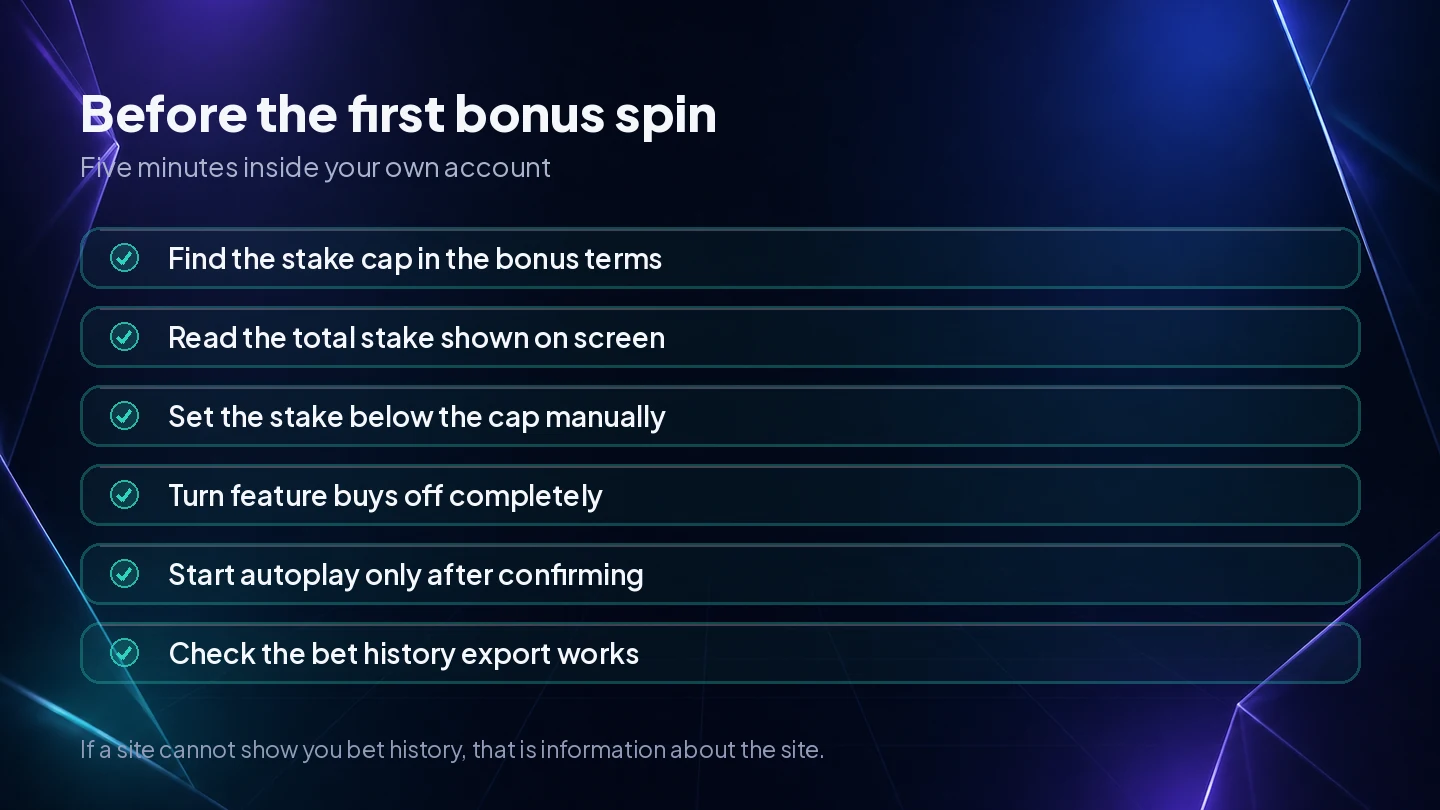
Screenshot the terms as they read today. Capture the max bet clause with the page URL and the date visible in the frame. Terms change and archives are not always available, so the version you accepted is the evidence that matters. Screenshot the offer page too: the copy, the tick box, and the confirmation that the bonus was credited, with its timestamp.
Get a support transcript naming the number. Ask, in writing: what is the maximum total stake per spin while this bonus is active, does it include feature buys, and does it apply to real money bets placed while the bonus is live? Save the reply. Those three parts close the ambiguities behind most disputes.
Set the stake, then read the total. Read the total bet figure by the spin button, not the per-line figure and not the coin value, and compare it to the cap. Turn off ante bet and bet boost first, since they are often on by default, then read it again.
Leave a margin. If the cap is 5, play at 4 or below. It costs you nothing in expectation, absorbs ante mechanics and rounding, and means a mis-tap onto the next preset up is still compliant. This is the most useful habit here.
No feature buys, and no autoplay early. Play fifty spins by hand and confirm the wagering meter moves as expected before automating anything.
Check your bet history at the halfway point. Sort by stake, descending. The top row is your largest bet since the bonus was credited. Do this before you request a withdrawal, because if you find a breach you can stop, forfeit the bonus deliberately and keep your own money rather than build a win you will not be paid.
If any of these steps is impossible on a site, that is information. A cashier with no readable bonus terms and no bet history export is one we mark down in how we review.
What to do next
Max bet clauses are, on the whole, legitimate. Bonuses without a stake cap are an invitation to convert house money into a lottery ticket, and operators that did not cap stakes would either stop offering bonuses or offer worse ones. Calling the clause a trap leads to the wrong behaviour: arguing about the rule instead of complying with it.
The problem is narrower and it is real. The rule is enforced at the end rather than the start, by a system capable of enforcing it at the start, and the whole cost of that decision falls on the player. A misclick that gains you nothing costs you everything. An operator that never built the block loses nothing and occasionally gains a great deal. That is not fraud, but it is an asymmetry worth weighing when deciding where to play.
So do three things. Before accepting any bonus, find the max bet clause, screenshot it, and confirm whether it covers feature buys and real money bets. While the bonus is live, stake below the cap with a margin, turn off ante bets, avoid feature buys, and check the largest bet in your history before requesting a withdrawal. And treat an in-session block or warning as a real feature when choosing where to play. Price the offer using the method in how wagering requirements work, then remember you can decline it, deposit clean, and bet what you like with nothing hanging over the withdrawal.
If the bonus is the reason you are depositing, or the reason you are depositing more than you planned, the arithmetic above has stopped being the issue. Set a deposit limit and use the tools on our responsible gambling page. None of this is legal advice.
In one paragraph
A max bet clause caps your stake while a bonus is active. One spin over the line can void the whole win. Here is how the rule works and how to stay under it.
Read next
Markets
Frequently asked questions
What is the maximum bet with a bonus active?
It varies by operator and by offer. The most common flat cap sits around 5 units per spin or round, and a percentage cap is usually 10 to 20 percent of the bonus credited. Neither is a legal standard. The only figure that binds you is the one written in the terms of the offer you accepted.
Does the max bet apply per line or per spin?
Per spin, in almost every set of terms. The cap measures the total amount debited from your balance for one round, so twenty lines at 0.30 is a 6 unit bet, not a 0.30 bet. A feature buy costing 100 times the base stake is a 100 times base stake bet. Read the clause for the words total stake.
Can a casino void my whole win for one oversized bet?
Under most published terms, yes. The usual wording lets the operator void winnings derived from the bonus, remove remaining bonus funds and return your deposit. It is a bright-line rule, so a stake one unit over the cap carries the same consequence as one ten times over. Proportionality is not written into the clause.
Will the casino stop me from betting over the cap?
Some will and some will not. A minority of cashiers hard-block an over-cap stake or grey out the feature buy button while a bonus is live. Most only log it and check at withdrawal. Assume no block exists until you have tested it, and set your stake so the highest button on the screen is still under the cap.
Who do I complain to if a win is voided?
Start with the operator's written complaints procedure, then escalate to the alternative dispute resolution body named in its terms. In Britain that ADR entity is required by the licence. Sweden, the Netherlands and Denmark each have a regulator and a consumer disputes route. Keep the bet history and the terms as they read on the day you accepted.
More from the blog
-
 safety How to Verify a Casino Licence in Five Minutes A licence badge is an image file. The only thing that counts is the entry on the regulator's public register, and checking it takes about five minutes.
 -
 safety KYC Checks at Online Casinos, Explained Verification is a licence condition, not an operator invention. But the moment an operator chooses to run it is a business decision, and that choice is what turns a ten minute upload into a fortnight of chasing support.
 -
 bonuses How Wagering Requirements Actually Work A wagering requirement is not a scam and it is not a formality. It is the price you pay for a bonus, and it is written in a way that makes that price hard to read. This is how to read it.

Marie-Louise Aubert
Head of Casino Research since 2024
Marie-Louise Aubert has led casino research at LSM99 since 2024, and she is the one who actually opens the accounts. Where most review sites summarise an operator from its own marketing, Marie-Louise registers, deposits, plays and requests a withdrawal, then records what really happened rather than what was advertised. The account is real, opened in her own name and funded with the site's own money, never a demo balance and never a media account handed over by an operator. She reads terms line by line so readers do not have to, and she owns the toplists, the market rankings and the country pages that come out of that work.



Play responsibly
Gambling is entertainment, not income. Set a deposit limit before you play, never chase a loss, and stop when it stops being fun. If it has become a problem, these services are free and confidential.
Our responsible gambling guide carries no affiliate links and no casino list.