
Guide
What RTP Really Means, and What It Does Not
Return to player is the single most quoted number in online casino games and the single most misread one. It tells you the long-run cost of playing a game. It tells you nothing at all about tonight.
Show moreShow less

Return to player, almost always written as RTP, is the percentage of total money staked on a game that the game is designed to pay back over its full mathematical cycle. A slot published at 96 percent is built so that for every 100 units wagered on it, across every player and every spin, about 96 come back out as wins. The remaining 4 are the house edge. That is the definition and it is not controversial.
The trouble starts the moment a player converts that into a personal expectation. “96 percent means I get 96 back from my 100” is wrong, and wrong in a way that matters. The figure is a limit the game approaches over millions of spins, not a rebate on a deposit. Deposit 100, stake it at 1 a spin and replay whatever you win, and you do not get 100 spins. You get closer to 2,500, because each win goes back through the same 4 percent charge. Your expected balance at the end is not 96. It is near zero. The charge is not taken once. It is taken on every unit that passes through the game, including units you have already won.
So RTP is a price, not a promise. It tells you how quickly a game consumes money on average, which makes it useful for comparing games. It does not tell you what happens in the next hour, and on any given evening it is drowned out by variance. What follows is where the number comes from, how to convert it into a cost per hour, the version problem almost nobody checks, and what RTP quietly excludes.
What RTP actually says, and what it does not
The published RTP is a theoretical figure calculated from the game’s maths model, not a measurement of what recently happened. For a simple game the studio computes it exactly, by enumerating every outcome and weighting each by its probability. For a modern slot with cascading reels, multipliers and a retriggering bonus, exact enumeration is impractical, so the figure comes from simulation over hundreds of millions of rounds.
The number is therefore a property of the design, fixed before a single real spin was placed. It is not a running average of what players won this month, and it does not adjust when a game has been cold or hot. Slots have no memory and no debt to settle. A game that has paid nothing for 800 spins has the same distribution on spin 801 as on spin one.
The second issue is scale. Consider a game whose top prize is 5,000 times stake and hits once in roughly 3 million spins. That outcome alone can carry two or three percentage points of the entire RTP, and a player who runs 5,000 spins has covered less than two tenths of one percent of the distance to it. They are playing a truncated version of the game with the biggest outcomes cut off, and truncating a skewed distribution from the top always makes the observed return worse than theory. The honest reading is therefore: over an unimaginably long run this game returns 96 percent, and your shortfall will usually exceed 4 percent, because you will never get near the long run.
House edge, and your expected cost per hour
House edge is 100 minus RTP. A 96 percent game has a 4 percent edge, a 94 percent game 6 percent, an 88 percent game 12 percent. Same information, stated from the operator’s side. It is the more useful of the two for costing, because it multiplies straight into turnover. The formula is short enough to remember:
Expected loss per hour = stake per spin x spins per hour x (1 minus RTP)
The only input people get wrong is spins per hour, and they underestimate it. In Great Britain, RTS 14D and 14E set a floor of 2.5 seconds from the start of one slot game cycle to the point the next can begin, and prohibit turbo, quick spin and slam stop. At that floor, 2.5 seconds a spin is 1,440 spins an hour. Real play with pauses and feature rounds lands most people between 500 and 800. Outside Great Britain, where turbo spin is often still available, 900 to 1,200 is achievable.
Here is the worked example. Stake 0.50 per spin, play at 600 spins an hour. Turnover per hour is 0.50 x 600 = 300.
| RTP | House edge | Turnover per hour | Expected loss per hour |
|---|---|---|---|
| 96.5% | 3.5% | 300 | 10.50 |
| 96.0% | 4.0% | 300 | 12.00 |
| 94.0% | 6.0% | 300 | 18.00 |
| 92.0% | 8.0% | 300 | 24.00 |
| 88.0% | 12.0% | 300 | 36.00 |
Read the ends of that table against each other. Same stake, same speed, same entertainment time, and the 88 percent game costs three times what the 96 percent game costs. That is the whole practical value of RTP, and a big enough gap to be worth two minutes of checking.
Now run your own. Take your real stake, multiply by a realistic spins per hour, multiply by the house edge as a decimal. At 1.00 a spin and 800 spins an hour, turnover is 800, so 96 percent costs 32 an hour and 88 percent costs 96. At 2.00 a spin and 700 spins an hour, turnover is 1,400 and the same two games cost 56 and 168.
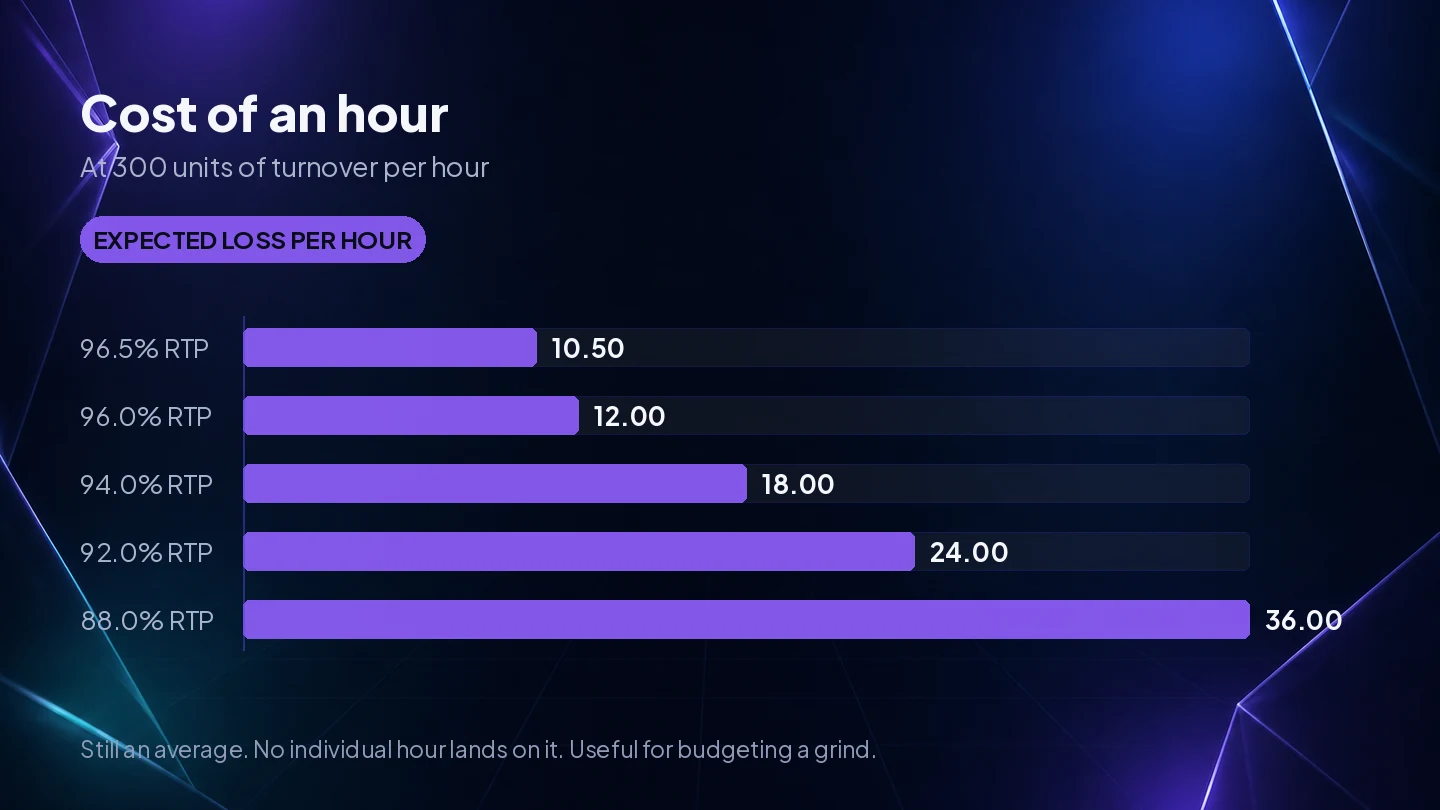
It is still an average, so any individual hour lands nowhere near it. Where it earns its keep is budgeting a long grind, which is exactly what clearing a bonus is.
Variance is why your session looks nothing like 96 percent
RTP is the average. Volatility is the shape of the distribution around it, and the shape is what you experience. Two games can share an identical RTP and produce completely different sessions, because RTP says nothing about how the returned 96 units are split between many small wins and a few enormous ones. Take two hypothetical titles, both certified at 96.0 percent.
| Game A | Game B | |
|---|---|---|
| Published RTP | 96.0% | 96.0% |
| Hit frequency | 31% | 17% |
| Maximum win | 500x stake | 25,000x stake |
| Share of RTP in base game | about 88 points | about 48 points |
| Share of RTP in the bonus round | about 8 points | about 48 points |
| Bonus round frequency | 1 in 90 spins | 1 in 320 spins |
| Typical 500-spin outcome | slow bleed, occasional recovery | balance gone, or one huge round |
Game B is the interesting one. If half its return is locked inside a feature that triggers once in 320 spins, the base game returns something like 48 percent. A player who runs 200 spins without triggering it is not playing a 96 percent game in any experiential sense. They are playing a 48 percent game and waiting for a lottery ticket. When the feature lands it may pay 4x stake or 900x, and the average across all triggers is what pulls the total back to 96.
That is the commonest source of the feeling that a game is broken or not paying. It is usually not low RTP. It is the return concentrated in outcomes you have not reached. The mechanics are in slot volatility explained, including why 1 to 5 star volatility scales are not comparable between providers.
So RTP and volatility have to be read together. A high-RTP high-volatility game can empty a small bankroll faster than a lower-RTP low-volatility one, even though it is cheaper per unit staked. If your goal is playing time, hit frequency matters more than the last half point of RTP. If your goal is the lowest cost for a fixed turnover, RTP is the only thing that matters.
The same slot ships in several RTP versions
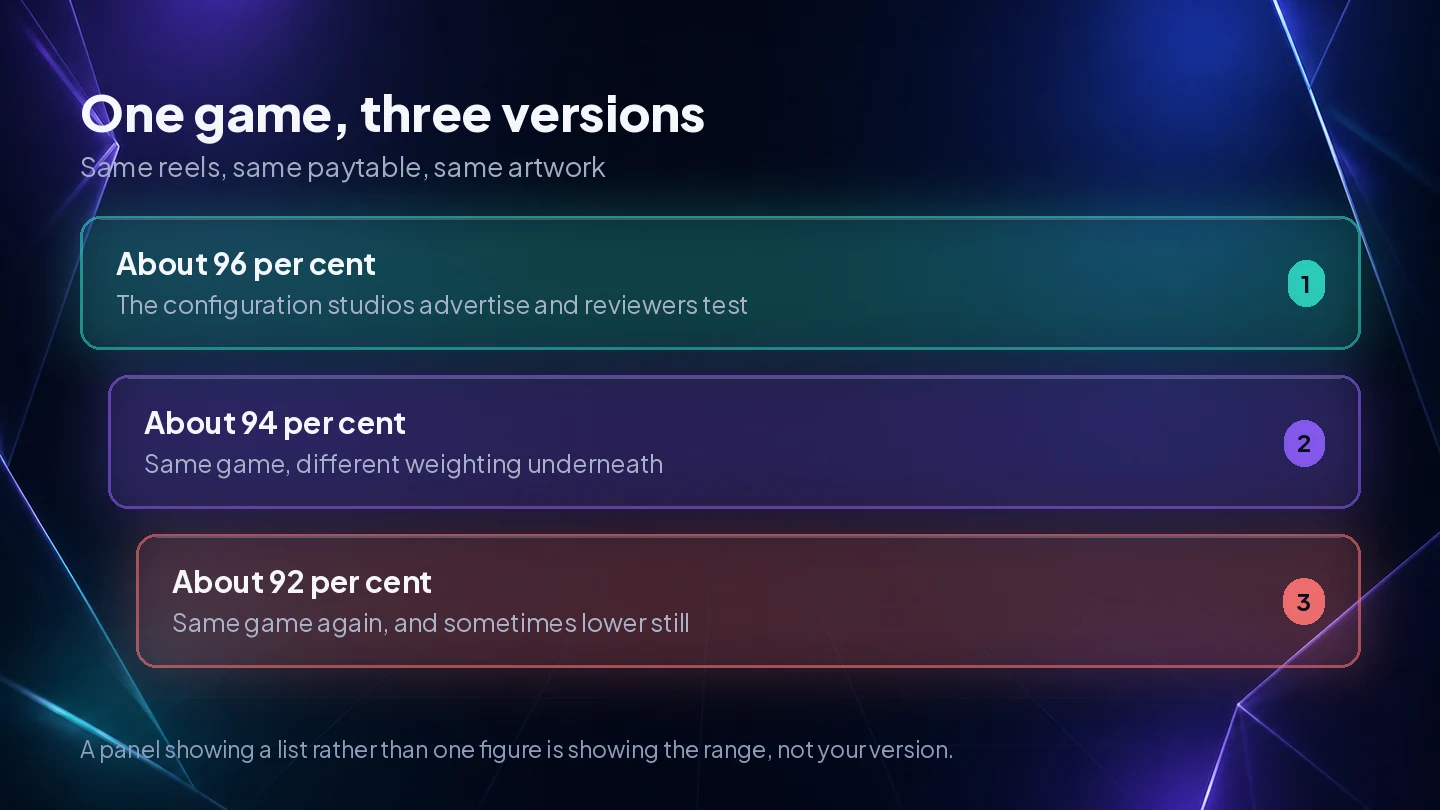
Here is the part almost nobody checks, and it is the most useful check available. Many slot titles are not built at one RTP. The studio produces the same game in several configurations, commonly around 96 percent, 94 percent and 92 percent, sometimes lower. The reels, paytable, features, artwork and maximum win are identical. What changes is the underlying weighting, and therefore the price you pay. The operator picks a configuration at integration, and that choice is commercial. Two casinos can list the same title, same thumbnail, same name, and charge you three times the house edge for it.
The check takes fifteen seconds. Inside the game, open the information panel, usually the “i” icon or the hamburger menu in the corner, and page through to the rules or paytable section. The theoretical return is nearly always on the last page, under a heading like “Game information” or “Return to player”. Read the number printed there, not the one quoted on any review site including ours.
A single figure is your version. A list such as “96.12% / 94.09% / 92.03%” means the title supports multiple configurations and the panel is showing the range, not your version. Some studios then say where the active version is indicated, and some never resolve it. A range with no resolution is an unknown, and an unknown here is not usually good news.
What the rules require you to be told
Great Britain is the clearest case. RTS 3, in the Gambling Commission’s remote technical standards, covers rules, game descriptions and the likelihood of winning. RTS 3A requires an explanation of the applicable rules to be easily available before the customer commits to gamble. RTS 3C requires information that may reasonably be expected to enable an informed decision about their chances of winning, and names the acceptable forms: house edge or margin, the return to player percentage, or the probability of the winning events.
Two details matter there. RTP is one of three permitted ways to satisfy the requirement, not a universal mandate to print a percentage, which is why some game types show a probability statement instead. And the information must be available before you commit, which makes the in-game panel the enforceable place to look. Whatever a lobby tile says, the panel inside the game is the disclosure.
Elsewhere the position varies, so do not assume a British-style rule applies. Malta sets a minimum rather than only a disclosure rule: the Malta Gaming Authority lowered the minimum RTP for operators offering games online from 92 percent to 85 percent in 2021, which is a floor far below what mainstream titles run at rather than a guide. Where we cannot verify a national rule we say so rather than guess. If you play from Australia or Thailand on offshore sites, the in-game panel is your only reliable source, because no local regulator is checking it for you. That is why our Australian slots page and UK slots coverage treat game information disclosure as a scoring factor rather than a footnote.
Live dealer and table games: where the maths is kinder
Slots are the expensive end of a casino. Table games and their live dealer versions sit far higher, for a structural reason. A slot’s return is engineered through a paytable and reel weighting, so the designer can set it anywhere. A table game’s return comes from a small advantage inside a fixed set of rules, and is bounded by those rules.
Two conditions apply first. Blackjack at 99.5 percent assumes correct basic strategy on every hand, and playing by instinct gives back one to two and a half points, which is slot territory. And the figure covers the main bet only. Side bets carry their own, much worse, numbers.
| Game and rule set | Approximate RTP | House edge |
|---|---|---|
| Blackjack, 3:2 naturals, favourable rules, basic strategy | 99.5% | 0.5% |
| Blackjack, same rules but 6:5 on naturals | 98.1% | 1.9% |
| Blackjack, eight decks versus single deck, all else equal | about 0.5 points lower | +0.5% |
| Baccarat, banker bet | 98.94% | 1.06% |
| Baccarat, player bet | 98.76% | 1.24% |
| Baccarat, tie bet at 8 to 1 | 85.64% | 14.36% |
| French roulette, even-money bet with la partage | 98.65% | 1.35% |
| European roulette, single zero | 97.30% | 2.70% |
| American roulette, double zero | 94.74% | 5.26% |
| Blackjack insurance | about 93% | about 7% |
| Common blackjack side bets | 89% to 96% | 4% to 11% |
The 6:5 line is the easiest way to lose 1.4 percentage points without noticing. It is one line in the rules, looks trivial, and roughly quadruples the house edge on an otherwise good table. At a live blackjack table the payout for naturals is the first thing to read, before the deck count and the dealer stand rule.
Roulette is the other easy win. European and American wheels are the same game with an extra pocket, and that pocket nearly doubles the cost, so if both are in the lobby there is no argument for the American one. A French wheel with la partage is better still on even-money bets, since half the stake comes back on zero. Our French roulette coverage goes through the variants, and the same reasoning underpins the banker-bet advice on our baccarat page for Thailand.
What the RTP number leaves out
The published figure describes the base game under normal play. Several common situations sit outside it.
Side bets are not in the headline number. A baccarat table quoted at 98.94 percent is quoting the banker bet. Perfect Pairs, 21+3, Dragon Bonus and the rest each carry their own RTP, generally 89 to 96 percent, and adding one to every hand can pull a 99 percent table below 96 percent overall.
Progressive jackpot contributions shift RTP away from the base game. A slice of every stake, often 1 to 2 percentage points, feeds the jackpot pool instead of the base paytable. Studios usually publish a total RTP that includes that contribution, so a game advertised at 96 percent may run a base game at 94 percent or lower. The contribution does come back to players, but to one player, once, at unpredictable intervals. For everyone who does not hit it, the experienced return is the base figure. That is why a progressive can look competitive on paper and feel considerably worse than a flat-paytable game at the same headline number.
Bonus feature buys are a separate calculation. Where a game lets you pay a multiple of stake to enter the bonus round directly, that purchase has its own RTP, a point or so either side of the base game, stated separately when it is stated at all.
Wagering requirements do not change RTP, they multiply your exposure to it. A bonus does not make a 96 percent game more generous. It obliges you to push a large turnover through at the same edge: staking 7,000 on 96 percent slots has an expected cost of about 280. Weighting makes it worse, because low-edge games count least. That is the core of how wagering requirements work.
Max bet clauses can void the outcome entirely. No RTP figure survives a term that lets an operator remove winnings after the fact, which is covered in max bet rules and voided wins. Gamble and double-up features sit at the other end: they are usually near 100 percent RTP and roughly neutral in cost, adding variance rather than expected value.
Published versus audited: what a certificate actually covers
Independent testing houses such as eCOGRA, GLI, iTech Labs and BMM test games and random number generators against regulator-defined standards. What they certify is worth knowing precisely, because the badge in a footer is routinely read as something it is not.
A testing house typically verifies that the random number generator produces output statistically indistinguishable from random and unpredictable from previous output; that the game in production matches the maths model and paytable the studio submitted; that the theoretical RTP for that model is correctly calculated, by full-cycle enumeration or large-scale simulation; and that the game behaves as its rules describe, including edge cases such as a disconnection mid-round. Some also publish realised payout percentages by game category each month. That figure measures what happened, and with enough volume it sits within a point of theory, though one jackpot can throw a category above 100 percent.
What a certificate does not do is tell you which configuration of a multi-version title the operator selected. It covers the maths model, and if a title has three certified models, all three are legitimate. Nor does it say anything about your outcome. A certified 88 percent game is a certified way to lose 12 units per 100 staked.
That is why testing status is a gate rather than a score in how we review: its absence is disqualifying, but a certificate earns no grade on its own. The operator pages under our casino reviews record what each site discloses in its game panels.
Realistic RTP bands and what they cost per 100 staked
Bands rather than point figures, because each varies by title and rule set.
| Game type | Typical RTP band | Expected cost per 100 staked |
|---|---|---|
| Blackjack, good rules, correct basic strategy | 99.2% to 99.6% | 0.40 to 0.80 |
| Video poker, full-pay tables, correct play | 98.0% to 99.5% | 0.50 to 2.00 |
| Baccarat, banker or player bet | 98.7% to 99.0% | 1.00 to 1.30 |
| European or French roulette | 97.3% to 98.7% | 1.30 to 2.70 |
| Casino Hold’em and Three Card Poker | 96.5% to 98.0% | 2.00 to 3.50 |
| Mainstream video slots, top configuration | 95.5% to 96.5% | 3.50 to 4.50 |
| American roulette | 94.7% | 5.26 |
| Video slots, downgraded configuration | 88.0% to 94.0% | 6.00 to 12.00 |
| Progressive jackpot slots, base game only | 88.0% to 94.0% | 6.00 to 12.00 |
| Blackjack and baccarat side bets | 89.0% to 96.0% | 4.00 to 11.00 |
| Scratchcards and instant-win titles | 85.0% to 95.0% | 5.00 to 15.00 |
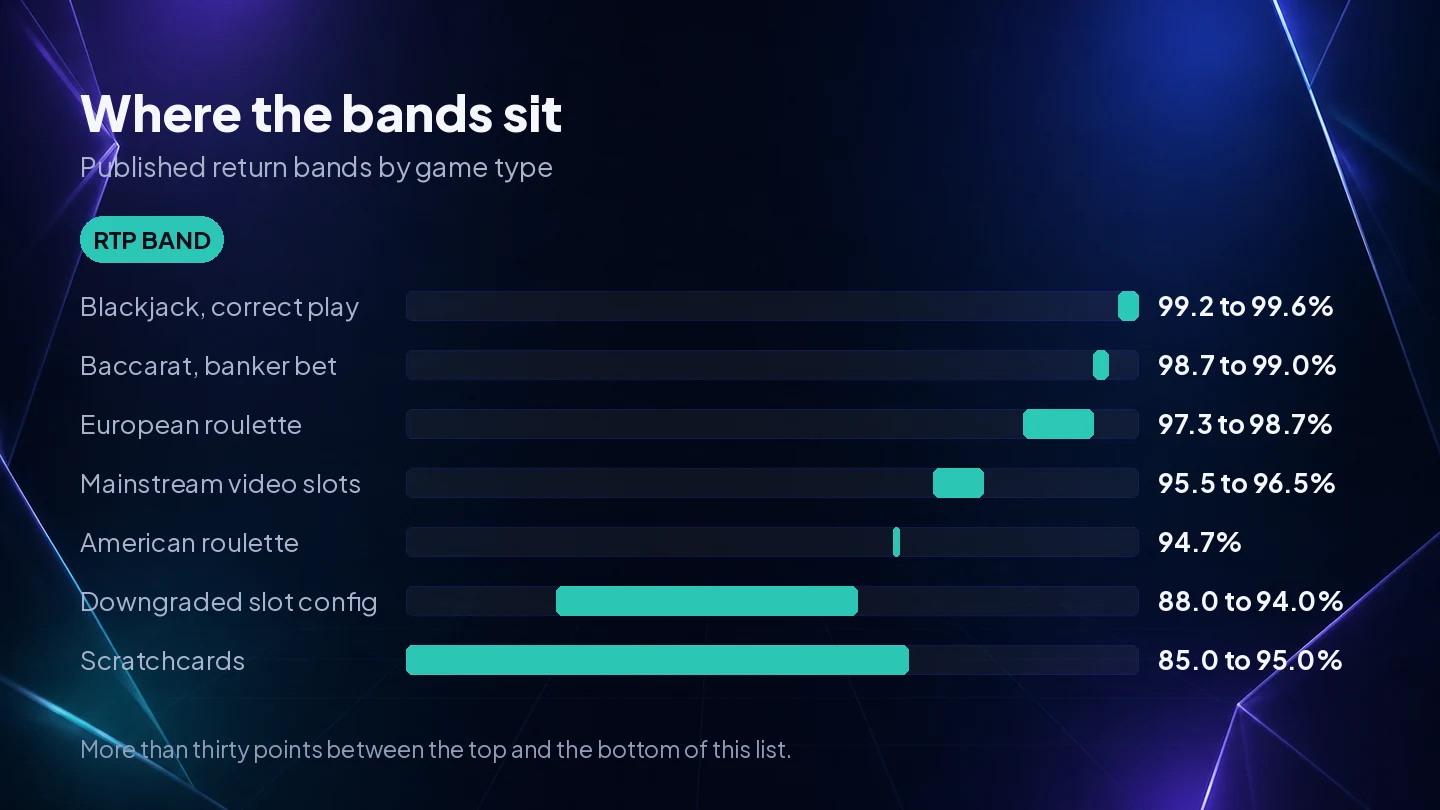
The spread across that table is more than thirty percentage points, which makes choosing between its top and its bottom a bigger financial decision than anything else a player controls, bonus selection included.
Three checks to run in the game info panel before you stake
Under a minute in total, once per title per casino.
1. Find the printed RTP for the version you are on. Open the in-game panel, page to the rules section, and read the theoretical return. One figure is your version. A list means an unspecified configuration, and you should treat the lowest as your working assumption until the game says otherwise. If the panel states neither a return nor a probability, that is a disclosure problem, and in a regulated market it may be a compliance one.
2. Check what the figure includes. Look for wording about jackpot contribution, feature buy and side bets. “Total RTP including progressive contribution” and “base game RTP” are different numbers and both may appear. If a feature buy is offered, find its own figure before using it.
3. Pair it with the volatility rating and maximum win. Both sit on the same screens. A 96.5 percent game with a 50,000x maximum win and low hit frequency behaves nothing like a 96.5 percent game capped at 500x. Neither is better in the abstract. The question is which your bankroll can absorb.
Occasionally do a fourth: open the same title at another casino and compare the printed figures, a first-session test our guide to choosing an online casino recommends. Any difference tells you which site configured it in your favour.
Using RTP correctly, and what to do next
RTP is a cost comparison tool, and used that way it is one of the few genuinely useful numbers a casino publishes. Used as a predictor of your session it is worse than useless, because it creates an expectation of getting most of your money back that the arithmetic does not support.
The correct sentence in your head is: this game costs about four units per hundred staked and that one costs twelve, so for the same time at the same stake I would rather pay four. Over a year of casual play, the gap between a 96 percent habit and an 89 percent habit runs into serious money for identical hours of entertainment.
Underneath all of it sits one thing. Every game covered here has a negative expected value for the player. Not most of them. All of them. The house edge is how the operator’s revenue is generated, and it applies to every unit you stake whatever the result of any particular round. A 99.5 percent blackjack table is still a losing proposition over time. It is simply a slower one.
RTP tells you how fast, not whether. If you take one thing from this, make it the fifteen-second check inside the information panel, the only lever here entirely under your control.
If you are reading this because you are trying to work out where your money went, RTP is not the answer you need. Deposit limits, session reminders, time-outs and self-exclusion are, and every licensed operator offers them without you having to ask. Those tools and the national schemes are on our responsible gambling page. Gambling is entertainment with a calculable cost. RTP is how you calculate it, and nothing here is legal or financial advice.
In one paragraph
RTP is a long-run theoretical average, not a promise about your session. The arithmetic, the hidden version problem, and how to use RTP as a cost comparison.
Read next
Markets
Frequently asked questions
Does 96 percent RTP mean I get 96 back from every 100?
No. It means that across the full mathematical cycle of the game, which runs to millions of spins, total returns approach 96 percent of total stakes. If you deposit 100 and keep replaying your winnings at 96 percent, your expected total turnover before the balance runs out is around 2,500, and your expected final balance is close to zero.
Can the same slot have different RTP at different casinos?
Yes. Many studios ship a title in several configurations, commonly something like 96 percent, 94 percent and 92 percent, and the operator selects one at integration. The game art, the paytable and the features are identical. Only the maths differs. The game information panel inside the game is where the live figure is stated.
Why is blackjack RTP so much higher than slots?
Because your decisions affect the outcome and the house edge is built from a small rule advantage rather than a paytable. Blackjack with 3:2 naturals and standard rules returns roughly 99.5 percent to a player using correct basic strategy. Play it badly and you give back one to two percentage points, which puts you closer to slot territory.
Does a game certificate mean the game is fair to me?
It means an independent testing house checked that the random number generator is statistically sound and that the game in production matches the maths model submitted, including its stated RTP. That is worth having. It is not a statement about your session, and it does not tell you which RTP version the operator chose to run.
Is a higher RTP game always the better choice?
It is always the cheaper choice per unit staked, which is not the same thing. Two games at 96 percent can behave completely differently because volatility decides how the return is distributed. Use RTP to compare cost between games, then use the volatility rating to work out whether the session shape suits your bankroll.
More from the blog
-
 safety How to Verify a Casino Licence in Five Minutes A licence badge is an image file. The only thing that counts is the entry on the regulator's public register, and checking it takes about five minutes.
 -
 safety KYC Checks at Online Casinos, Explained Verification is a licence condition, not an operator invention. But the moment an operator chooses to run it is a business decision, and that choice is what turns a ten minute upload into a fortnight of chasing support.
 -
 bonuses Max Bet Rules and How One Spin Voids a Win The max bet clause is the shortest sentence in most bonus terms and the one that costs players the most money. This is what it covers, how a single spin breaches it, and what an operator is allowed to do next.

Marie-Louise Aubert
Head of Casino Research since 2024
Marie-Louise Aubert has led casino research at LSM99 since 2024, and she is the one who actually opens the accounts. Where most review sites summarise an operator from its own marketing, Marie-Louise registers, deposits, plays and requests a withdrawal, then records what really happened rather than what was advertised. The account is real, opened in her own name and funded with the site's own money, never a demo balance and never a media account handed over by an operator. She reads terms line by line so readers do not have to, and she owns the toplists, the market rankings and the country pages that come out of that work.



Play responsibly
Gambling is entertainment, not income. Set a deposit limit before you play, never chase a loss, and stop when it stops being fun. If it has become a problem, these services are free and confidential.
Our responsible gambling guide carries no affiliate links and no casino list.