
Guide
Slot Volatility Explained: What It Does to Your Session
RTP sets the average. Volatility sets the shape of everything around it, and the shape is what you actually experience. This is how to read it before you stake.

Volatility is the second number on a slot’s information screen and the one that decides what your evening looks like. Return to player tells you how much of everything staked comes back over the game’s full mathematical cycle. Volatility tells you how that return is distributed: in a steady trickle of small wins, or in long empty stretches broken by rare large ones. The first number is the price. The second is the ride.
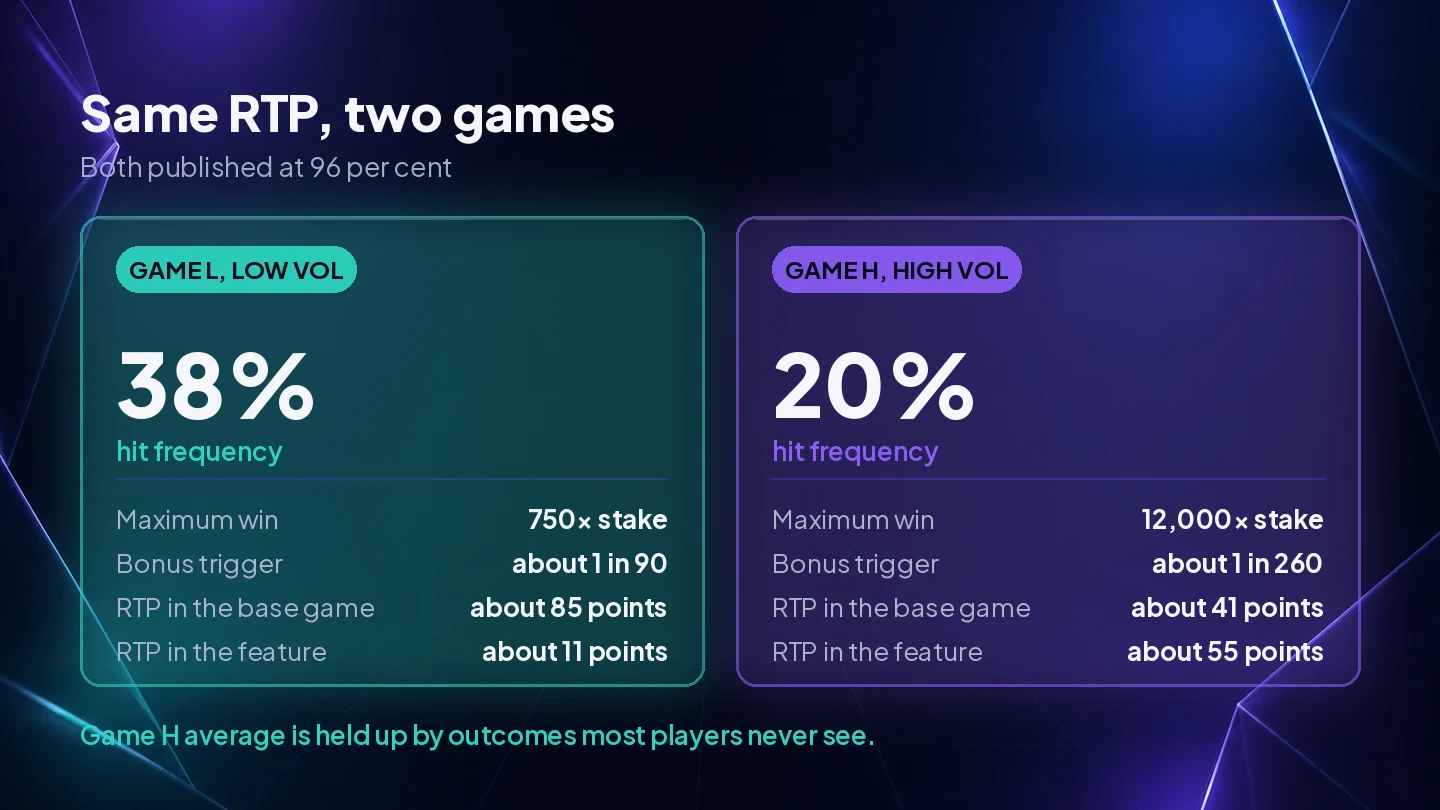
Two slots certified at exactly 96.0 percent can produce sessions with nothing in common. One pays on more than a third of spins and gives you a couple of hours from a modest deposit. The other pays on one spin in five, most of those below stake, and either empties the balance inside forty minutes or hands you a result that pays for the month. Same house edge, same cost per unit staked, completely different bankroll requirements.
That gap is why “which slot has the best RTP” is only half the question. The other half is whether the distribution of that RTP fits the money you brought.
What volatility is, and how it splits from RTP
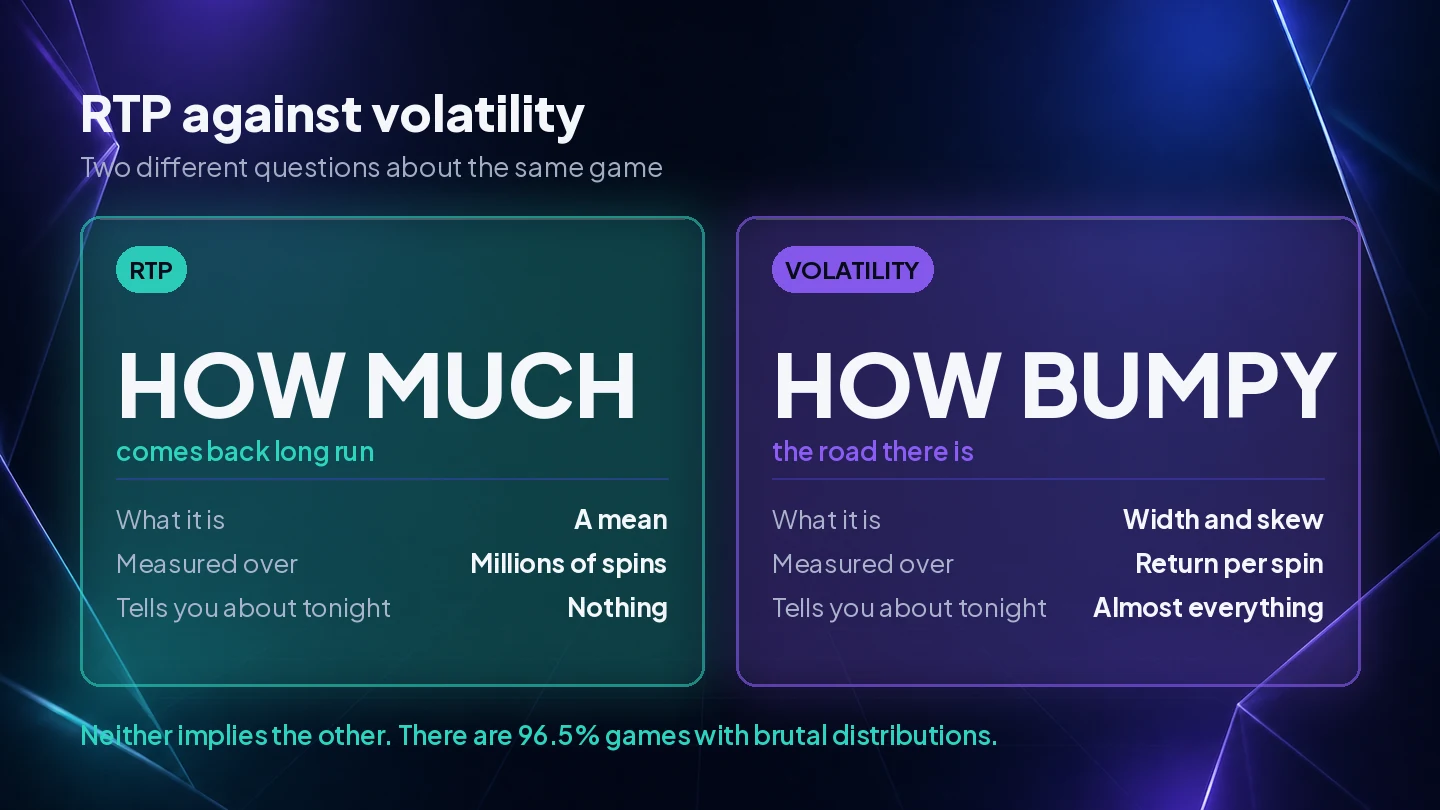
RTP is a mean. Volatility is the width and the skew of the distribution around that mean. Slot maths teams work in variance, or its square root, the standard deviation of return per spin, and the tile label is a rough translation of a number the studio calculated during design. A calm title has a standard deviation of return in the low single digits of stake. A modern high volatility release runs into the tens.
Hold the two ideas apart like this: RTP answers how much comes back over the long run, volatility answers how bumpy the road there is. Neither implies the other. There are 88 percent games with mild distributions and 96.5 percent games with brutal ones, and the second empties a small bankroll faster despite being three times cheaper per unit staked. The companion piece, what RTP really means, covers why the headline percentage is not a rebate on your deposit.
Hit frequency versus win size
Hit frequency is the share of spins that return anything at all. It is the most quoted volatility proxy and the most misread, because a hit is not a win. On most video slots a large proportion of hits pay back less than the stake that produced them: three of the lowest paying icon on a 0.20 line bet might return 0.06. The reels celebrate, the counter ticks up, and your balance went down. Strip out the sub-stake returns and the net-positive spin rate is often between a third and a half of the headline figure.
Even so, hit frequency explains most of the felt difference between two games at identical RTP, and the mechanism is dry runs. Take a 35 percent hit rate. The dead spin rate is 65 percent, so the chance that any given twenty consecutive spins are all dead is 0.65 to the twentieth power, about 0.00018, or one such run per 5,500 starting points. Now take a 20 percent hit rate. The dead rate is 80 percent, and 0.80 to the twentieth is about 0.0115, or one run per 87 starting points. The same drought is about sixty times more available on the second game.
Over a realistic session it gets sharper. Across 500 spins, the longest dead streak to expect on the 35 percent game is around fourteen spins. On the 20 percent game it is around twenty-eight. That is the difference between a lull and the point where a player decides the game is broken, and it is the same maths that pushes people to raise their stake mid-session to make it back.
The return has to go somewhere, so a lower hit frequency at the same RTP forces larger wins when they arrive. If two games return 96 units per 100 staked and one spreads them across 35 hits while the other uses 20, the second game’s average hit is 1.75 times the size, and in practice it concentrates far more aggressively than that, because the extra size loads into the rarest outcomes rather than spreading evenly.
Same bankroll, same stake, two very different games
Bankroll of 200 units, stake 1.00 per spin, both games certified at 96.0 percent. No bonus funds, no feature buys, straight play until the balance is gone.
| Game L (low volatility) | Game H (high volatility) | |
|---|---|---|
| Published RTP | 96.0% | 96.0% |
| Hit frequency | 38% | 20% |
| Maximum win | 750x stake | 12,000x stake |
| Bonus trigger | about 1 in 90 spins | about 1 in 260 spins |
| RTP held in the base game | about 85 points | about 41 points |
| RTP held in the feature | about 11 points | about 55 points |
Start with the number that is identical. Expected cost per spin is stake times house edge, so 1.00 times 0.04, which is 0.04 units on both games. Divide the bankroll by that and you get 5,000 spins. That is the arithmetic ceiling, and the right anchor, because everything below it is volatility and nothing else.
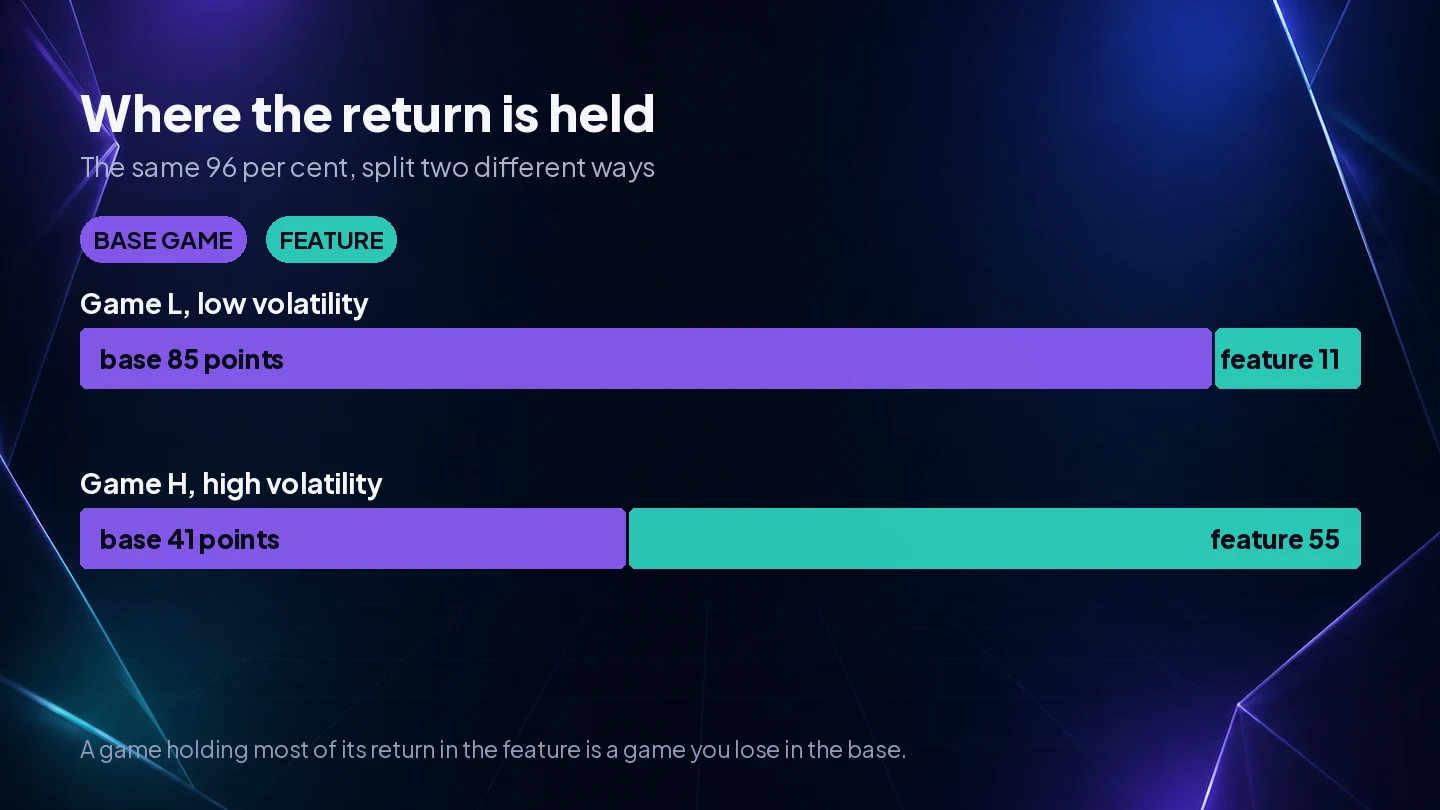
Game L keeps about 85 of its 96 points in the base game, so between bonus rounds it loses roughly 15 units per 100 staked. At 1.00 a spin, 200 units funds around 1,330 spins of that drift, and at one trigger per 90 spins you would expect around fifteen bonus rounds inside the window. Fifteen shots is enough for the average to start doing its work. The result is a long, gently declining balance with regular small recoveries, the occasional session finishing 30 or 40 percent up, and little chance of anything dramatic either way.
Game H keeps only about 41 points in the base game. Between features it loses roughly 59 units per 100 staked, four times Game L’s burn. Two hundred units funds about 340 spins of that, and at one trigger per 260 spins you would expect one or two bonus rounds before the money is gone. That is high volatility in a sentence: your bankroll buys one or two attempts at the thing holding more than half the game’s return.
Describing the outcome distribution honestly means avoiding precise percentages, because the exact shape depends on the maths model. On Game H, the large majority of 200 unit sessions end at or near zero, often within the hour. A meaningful minority end between half the bankroll and a small profit, because the one or two features that landed paid modestly. A few end well above the starting bankroll, and a very thin slice end at a figure the low volatility game cannot reach at any stake.
That shape is right skewed, so the average is not the typical result. Both games average 96 percent, but Game H’s average is held up almost entirely by outcomes most players never see. Its median session returns considerably less than 96 percent of stakes, while Game L’s median sits close to it. Both are true at once, and the median is the one describing your evening.
Why a 10,000x maximum win starves the base game
Maximum win is marketed as generosity. In the maths model it is a budget line competing with everything else. The contribution of any single outcome to RTP is its payout multiple times its probability, and that relationship constrains the design absolutely. Suppose a studio wants the top outcome of a 96 percent game to carry two percentage points of the return. If the top prize is 10,000x stake, then 10,000 times its probability must equal 0.02, so that probability is 0.000002, about one spin in 500,000. At 600 spins an hour, that is once per 833 hours of continuous play. The prize is real and certified, and it is functionally a lottery ticket bundled into every spin.
Points allocated to the top are points removed from everywhere else. Take that 96 percent budget, give three points to the extreme tail and forty more to the rest of the bonus round, and 53 are left for the base game. Every spin outside the feature is paid out of that 53, which is why a high max win title feels dead between features. It is not sentiment. The base game genuinely returns about half of what the certificate says, and the certificate is still accurate.
A game capped at 500x has no such constraint. With no tail to fund, the whole 96 spreads across outcomes that land often enough to sample in one session, which produces the steady rhythm of a low volatility slot. A max win figure is a compressed volatility statement. Read 50,000x on a lobby tile as a warning about the base game, not a promise about your afternoon.
Where volatility actually hides in the maths
The label on the tile is a summary. The real information sits in three places, two of them usually printed somewhere in the game.
Bonus round frequency. A feature triggering once in 80 spins and one triggering once in 400 are different games even at matched RTP and hit frequency. Trigger frequency sets how many attempts a bankroll buys, and attempts are the only route to the average.
The split of RTP between base game and feature. This is the real definition of a high volatility slot and it beats any star rating. A game where 85 of 96 points sit in the base game is low volatility whatever the marketing says. A game where 55 of 96 points sit inside a feature triggering once in 260 spins is high volatility even if the tile says medium. “Most of the RTP is in the bonus” and “this slot is high volatility” are the same statement.
You can often estimate the split. If the panel gives a trigger frequency and an average feature payout, multiply them. A feature landing once in 250 spins and averaging 80x stake contributes 80 divided by 250, so 32 percentage points. Subtract that from the published figure and the base game runs at about 64 percent. Where the average feature payout appears, it is the most informative number on the screen.
The paytable’s shape. Compare the top symbol’s five-of-a-kind value with the lowest symbol’s three-of-a-kind. A premium symbol paying fifty or a hundred times the low symbols says the distribution is stretched before any feature is factored in.
Feature buys concentrate variance rather than removing it
Feature buys look like a fix for the dead base game and are the opposite. Paying 75 to 100 times stake to enter the bonus strips out the low variance filler and leaves you holding only the high variance part, at a hundred times your normal exposure per click.
The pricing is not arbitrary. A buy has its own RTP, usually published separately at or a little below the base game figure, and that RTP is the feature’s average return divided by the buy price. Turn it round: average return equals price times RTP, and RTP is below one, so the feature’s average return is always less than the price. A 100x buy at a 96 percent buy RTP returns an average of 96x. No configuration puts the price below the feature’s expected value, because that would be a game selling money at a discount.
The bankroll effect is severe. Two hundred units at a 100x buy is two purchases. Not two hundred spins, two events. You are sampling a distribution twice when its average is propped up by rare outcomes needing far more samples than two to appear.
A buy at 100x base stake also breaches the maximum stake clause in most bonus terms instantly, and many operators ban feature buys outright while a wagering requirement is live. That voids wins regularly, as max bet rules and voided wins sets out, and the reason those clauses exist is explained in how wagering requirements work. Buy features with cleared cash, and read the terms first.
Megaways, clusters, cascades and multiplier trails
Modern mechanics are mostly volatility instruments, and each moves the distribution predictably.
Megaways and variable ways engines. The number of ways to win changes every spin, commonly between a few hundred and 117,649. That variation is itself variance, because a spin with 324 ways and a spin with 117,649 have very different potential from the same symbol set. Almost every Megaways title pairs the engine with cascades and a high ceiling multiplier in free spins, pushing a large share of the return into the feature. Treat the format as high volatility by default and let the panel argue you out of it.
Cluster pays. Wins come from adjacent groups rather than lines, usually on a large grid with tumbling symbols. Cluster maths can be tuned either way. What stretches the tail is the size curve: a paytable where a 5 symbol cluster pays a fraction of stake and a 25 symbol cluster pays hundreds of times stake is steep, and steep is volatile.
Cascades and tumbles. A single spin becomes a chain, which inflates apparent hit frequency while widening the distribution of what one spin is worth. A sequence stopping after one step returns a fraction of stake. One running eight steps with a rising multiplier returns hundreds. Measure hit frequency per spin, not per tumble, or the game looks far calmer than it is.
Multiplier trails. The most effective tool for moving RTP into the tail without touching the base game. A multiplier starting at 1x and climbing with each cascade turns an ordinary feature into an exponential one. The top outcomes of nearly every extreme slot live at the end of a multiplier chain, and the trail is exactly why the base game had to be starved to pay for it. Hold and win and symbol collection mechanics do something related: they delay payment until a condition completes, and delay is volatility.
How manufacturers label volatility, and why the labels do not compare
There is no standard. No regulator defines volatility bands, no testing house certifies a star rating, and no two studios calibrate the same way. The label is a marketing summary of an internal number scaled against that studio’s own catalogue.
The results are genuinely misleading. A studio whose entire portfolio is extreme will call its most severe title five out of five and its tamest three out of five, and that three is more volatile than another studio’s five. Some providers use stars, some a low to high word scale, some bombs or lightning icons, a few a numeric index on a scale they define themselves. None compare across brands, and the same title can carry different labels at different casinos, because the operator wrote the tile.
Look at the numbers instead. In rough order of usefulness: the share of RTP in the feature if stated, the bonus trigger frequency, the maximum win multiple, the hit frequency, and the feature buy price. That last is a proxy nobody uses. A buy priced at 40x stake is a small feature. A buy at 400x says the feature is enormous and the base game correspondingly thin.
Disclosure quality varies by market and by operator, which is one reason game information is a scored factor rather than a footnote in how we review sites. Our UK slots coverage and the Australian slots page both treat a panel that hides trigger frequency and max win as a mark against the operator, and the same applies to the offshore sites behind our Thai slots page, where no local regulator checks the disclosure for you.
The three bands, and stake sizing done properly
Bands rather than exact figures, because the boundaries are conventions and every title differs.
| Low volatility | Medium volatility | High volatility | |
|---|---|---|---|
| Typical hit frequency | 30% to 45% | 22% to 32% | 12% to 25% |
| Typical maximum win | 500x to 2,000x | 2,000x to 10,000x | 10,000x to 50,000x and above |
| Typical bonus trigger | 1 in 60 to 1 in 120 | 1 in 120 to 1 in 220 | 1 in 200 to 1 in 500 |
| Suggested stake per spin | 1/100 to 1/200 of bankroll | 1/200 to 1/400 of bankroll | 1/500 to 1/1000 of bankroll |
| Stake on a 200 unit bankroll | 1.00 to 2.00 | 0.50 to 1.00 | 0.20 to 0.40 |
| Session length | long and steady | moderate, punctuated | short unless a feature lands early |
| Who it suits | players buying time, and anyone clearing a wagering requirement | most casual play | players accepting a high chance of zero for a rare large result |
Note what that table does to the worked example. A 1.00 stake on a 200 unit bankroll is one two-hundredth, sensible for low and medium volatility. On Game H it was two and a half to five times too large, which is why that session lasted around 340 spins and funded barely one attempt at the feature. Drop to 0.30 and the same 200 units funds over a thousand base game spins and around four expected triggers. Same game, sampled enough times for its own maths to become visible.
RTP is chosen by the operator at integration. Volatility is chosen by the studio during design. Each spin is decided by a random number generator with no memory of the last one. The only variable on the screen that belongs to you is the stake, and through it the session length. Everything else sold as slot strategy is decoration.
One clarification, so the rule is not misapplied. Lowering your stake does not reduce the house edge, which is a percentage and ignores bet size. It cuts the cost per hour and stretches the sample, and stretching the sample is the only thing that brings your experience closer to the published number.
Four checks in the game info panel before you spin
Under a minute per title, and it will change which games you open.
1. Read the printed RTP and note whether it is one figure or a range. A single figure is your configuration. A list such as 96.1 / 94.0 / 92.0 means the title ships in several versions and the panel is showing the range, not your version. Assume the lowest until the game says otherwise.
2. Find the maximum win, as a multiple and in cash. Many games carry a currency cap alongside the multiple, and on a low stake the cash cap bites first. Read the multiple as a statement about how thin the base game is.
3. Find the bonus trigger frequency and the feature buy price. These tell you where the return lives more reliably than any star rating. If an average feature payout is printed too, multiply it by the trigger probability and subtract from the RTP for your working base game figure.
4. Check hit frequency and discount it. Hits below stake count as hits. A 30 percent figure on a cascading game measured per spin is not the same as 30 percent on a line game, and neither means you profit that often.
Then match the game to what you want. If you want two hours from a fixed budget, or you are grinding turnover through a wagering requirement, take the top of the hit frequency range and the bottom of the max win range, because survival is the objective and the tail is irrelevant to it. If you want a short session with a real chance of a memorable result, high volatility is the only place that exists, at a stake small enough to absorb the far more likely outcome. Our guide to choosing an online casino covers the operator side, and our casino reviews note how much game information each site exposes.
What volatility never changes
Volatility changes the shape of the outcome. It never changes the sign.
Every band in that table is negative expectation over time, at exactly the rate the house edge specifies. Low volatility is a slow, legible loss. High volatility is the same loss rearranged into long empty stretches and rare large results, and the rearrangement costs twice. The wait between defining results gets much longer, so a far larger share of sessions contain no defining result at all. And the chance of ending at zero rises steeply, because ruin is an absorbing state: a balance that hits zero before the feature arrives never collects the return reserved for it.
That is the honest core of it. The 96 percent belongs to the game, played across its full cycle by everyone who ever spins it. It does not belong to your 200 units, and high volatility widens the gap between the two.
So the practical sequence is short. Decide what you want from the session before you pick a game. Read the four items in the panel. Set the stake from your bankroll using the fraction for the band, not from what feels normal. Set a loss limit and a time limit in your account first, because a limit set in advance is the only one that holds during a dry run of thirty spins.
If any of this lands because your stakes have crept upward, or because you are working out where a balance went, game maths is not the tool you need. Deposit limits, loss limits, session reminders, time-outs and self-exclusion are, and every licensed operator provides them without you asking. They are set out with the national schemes on our responsible gambling page. Slots are entertainment with a calculable cost, never income, and nothing here is legal or financial advice.
In one paragraph
Volatility decides how bumpy the ride is, not how much comes back. Hit frequency, bonus RTP share, max win caps and how to size a stake against a bankroll.
Read next
Markets
Frequently asked questions
What does slot volatility actually mean?
It is the spread of outcomes around the game's average return. RTP fixes where the average sits. Volatility fixes how far individual spins and sessions scatter from it. A low volatility slot pays small amounts often, a high volatility slot pays almost nothing for long stretches and occasionally pays a great deal, and both can sit at the same RTP.
Is high volatility better or worse than low volatility?
Neither, because it changes the shape of the outcome and not the sign. Both bands lose money over time at the same rate if the RTP matches. High volatility gives you a longer wait between results that matter, a bigger chance of ending a session at zero, and a small chance of a result low volatility cannot produce.
How much should I stake on a high volatility slot?
Far less than on a low volatility one. A workable rule is a stake of one two-hundredth of your bankroll on low volatility titles, and one five-hundredth to one thousandth on high volatility ones. On a 200 unit bankroll that is roughly 1.00 a spin on a calm game and 0.20 to 0.40 on an extreme one.
Does buying the bonus reduce volatility?
No. It concentrates it. You skip the base game spins and stake 75 to 100 times your normal bet per round, so each click carries the whole spread of the feature. The buy price is always set above the feature's average return, which is why a published buy RTP sits at or slightly below the base game figure.
Why do 10,000x slots pay so little in the base game?
Because the top prize consumes RTP. Contribution equals payout multiple times probability, so a 10,000x outcome carrying two percentage points must land about once in 500,000 spins. Every point parked in the tail, and in the bonus round generally, is a point that is not in the base game, which is why the spins between features feel so thin.
More from the blog
-
 safety How to Verify a Casino Licence in Five Minutes A licence badge is an image file. The only thing that counts is the entry on the regulator's public register, and checking it takes about five minutes.
 -
 safety KYC Checks at Online Casinos, Explained Verification is a licence condition, not an operator invention. But the moment an operator chooses to run it is a business decision, and that choice is what turns a ten minute upload into a fortnight of chasing support.
 -
 bonuses Max Bet Rules and How One Spin Voids a Win The max bet clause is the shortest sentence in most bonus terms and the one that costs players the most money. This is what it covers, how a single spin breaches it, and what an operator is allowed to do next.

Marie-Louise Aubert
Head of Casino Research since 2024
Marie-Louise Aubert has led casino research at LSM99 since 2024, and she is the one who actually opens the accounts. Where most review sites summarise an operator from its own marketing, Marie-Louise registers, deposits, plays and requests a withdrawal, then records what really happened rather than what was advertised. The account is real, opened in her own name and funded with the site's own money, never a demo balance and never a media account handed over by an operator. She reads terms line by line so readers do not have to, and she owns the toplists, the market rankings and the country pages that come out of that work.



Play responsibly
Gambling is entertainment, not income. Set a deposit limit before you play, never chase a loss, and stop when it stops being fun. If it has become a problem, these services are free and confidential.
Our responsible gambling guide carries no affiliate links and no casino list.