
Guide
National Self-Exclusion Schemes Explained
A national self-exclusion scheme shuts one door across every licensed operator in a country at once. This is what each one covers, how long it holds, and what to put behind it.

A national self-exclusion scheme is a register held by, or on behalf of, a gambling regulator. You put your name in it once, and every operator licensed in that country has to check it and refuse you. One form, and the door closes across an entire licensed market rather than at a single brand.
Five run in the markets this site covers: GAMSTOP in the United Kingdom, Spelpaus in Sweden, Cruks in the Netherlands, ROFUS in Denmark and BetStop in Australia. France uses a different legal instrument that does the same job, and Ireland has one written into law but not yet operating. Each has a different minimum term, a different scope, and a different answer to the question people ask most: whether you can undo it.
If you are reading this in a bad moment, skip the comparison and go straight to the next section. Everything here points back to our responsible gambling page, which carries no casino list, no affiliate links and no call to action, only the helpline for every market we cover.
If you are reading this because today was bad
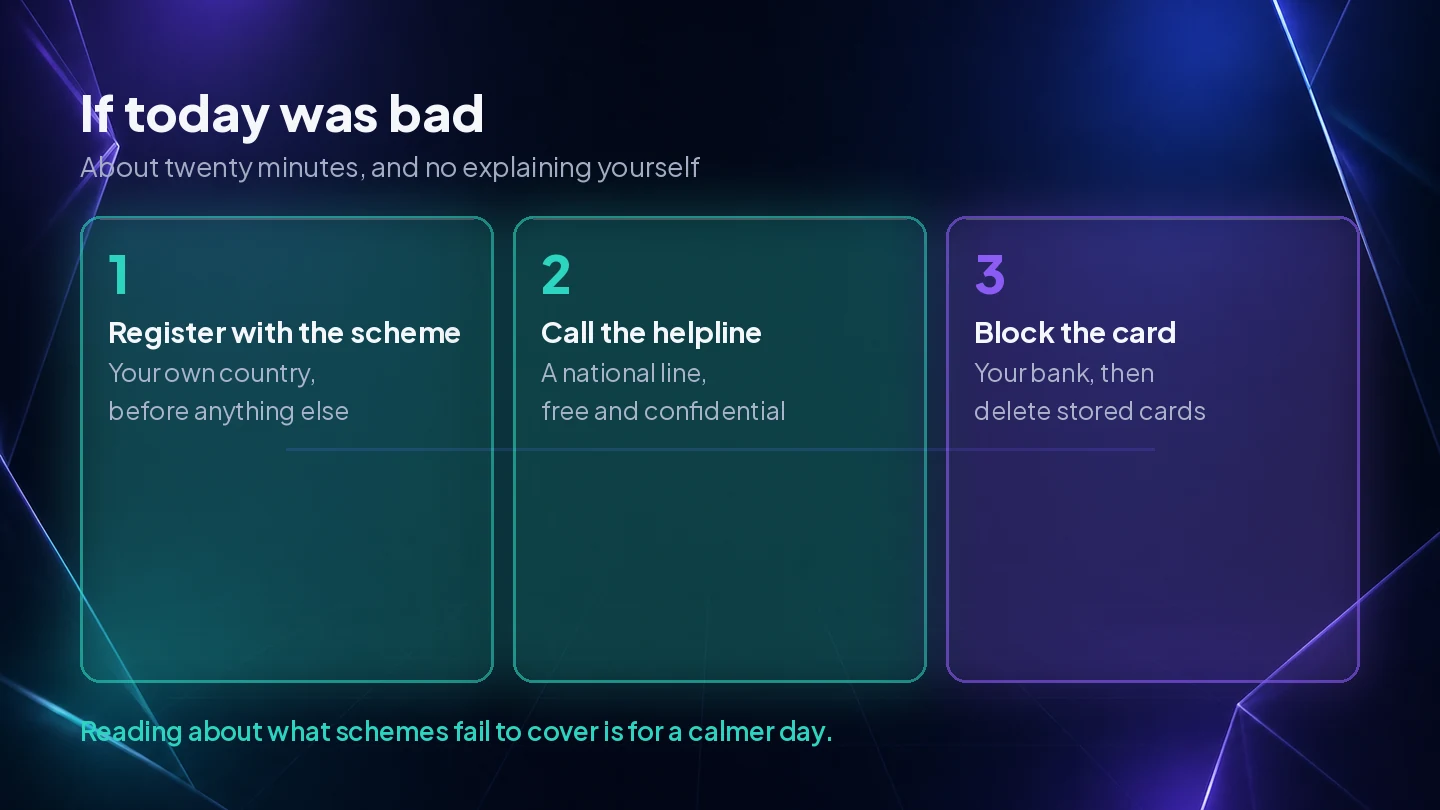
Three things, in this order. About twenty minutes, and none of them requires you to explain yourself to anyone.
One. Register with your country’s scheme now, before anything else. GAMSTOP at gamstop.co.uk, Spelpaus at spelpaus.se, Cruks at cruksregister.nl, ROFUS at rofus.nu, BetStop at betstop.gov.au, and in France interdictiondejeux.anj.fr. Free, minutes, and it needs only identity details you already have. Do it while the impulse to do it is still there, because it is binding once submitted, and that is exactly what you want from it.
Two. Call the helpline. In the United Kingdom the National Gambling Helpline is 0808 8020 133, free and open every hour of every day. In Denmark, StopSpillet is 70 22 28 25, run by the Danish Gambling Authority itself. Sweden’s helpline is 020-81 91 00, free and anonymous; you do not have to give your name. Every other market is listed on our responsible gambling page. Nobody on those lines will lecture you.
Three. Put a bank block on the card, then install blocking software. Both are covered further down. The bank block takes minutes in an app and cannot be reversed instantly, which is the feature, not the flaw. BetBlocker is free and installs on as many devices as you like.
Do not spend tonight reading about what schemes fail to cover. That research is for a calmer day.
A scheme, an operator exclusion and a closed account are three different things
People use all three phrases interchangeably and then get surprised. The gap between them is how easy each is to undo.
Closing an account is a customer service action. You ask, the operator closes it, and in most cases you can reopen it by asking again. It carries no protection: it does not reliably stop marketing, it does not stop you registering at the same company’s second brand, and it is recorded nowhere a regulator can see.
A time-out is a short lock at one operator, usually 24 hours to six weeks, set in your account settings. It expires on its own and the account comes back. Useful for interrupting a session, useless against a bad month.
An operator-level self-exclusion is a formal agreement with one licensee, binding for a minimum term, covering every brand that licensee runs. That last part is the catch: large operators run a dozen brands off one licence, small ones one.
A national scheme is the only one of the four that works across a market, reaching every operator holding that country’s licence, including ones you have never heard of and ones launching next month.
The concrete version. Say you have accounts at BoaBoa, Nomini and WinGaga, three of the brands we review. Close all three and you have done nothing: you can reopen any of them tonight. Take an operator-level exclusion at each and you have signed three agreements, none of which touches the fourth site you find at eleven o’clock. Register with the national scheme and all three refuse you at the login screen, along with everyone else in that market, without you ever naming them.
One further difference. Under British licensing conditions, an operator that receives a self-exclusion must close the account and return the money held in it. A closed account does not trigger that. A national exclusion does.
The schemes, market by market
Every figure below comes from the scheme’s own published material or its regulator’s.
| Scheme | Run by | What it covers | Minimum | Maximum | Cancel early? | Official site |
|---|---|---|---|---|---|---|
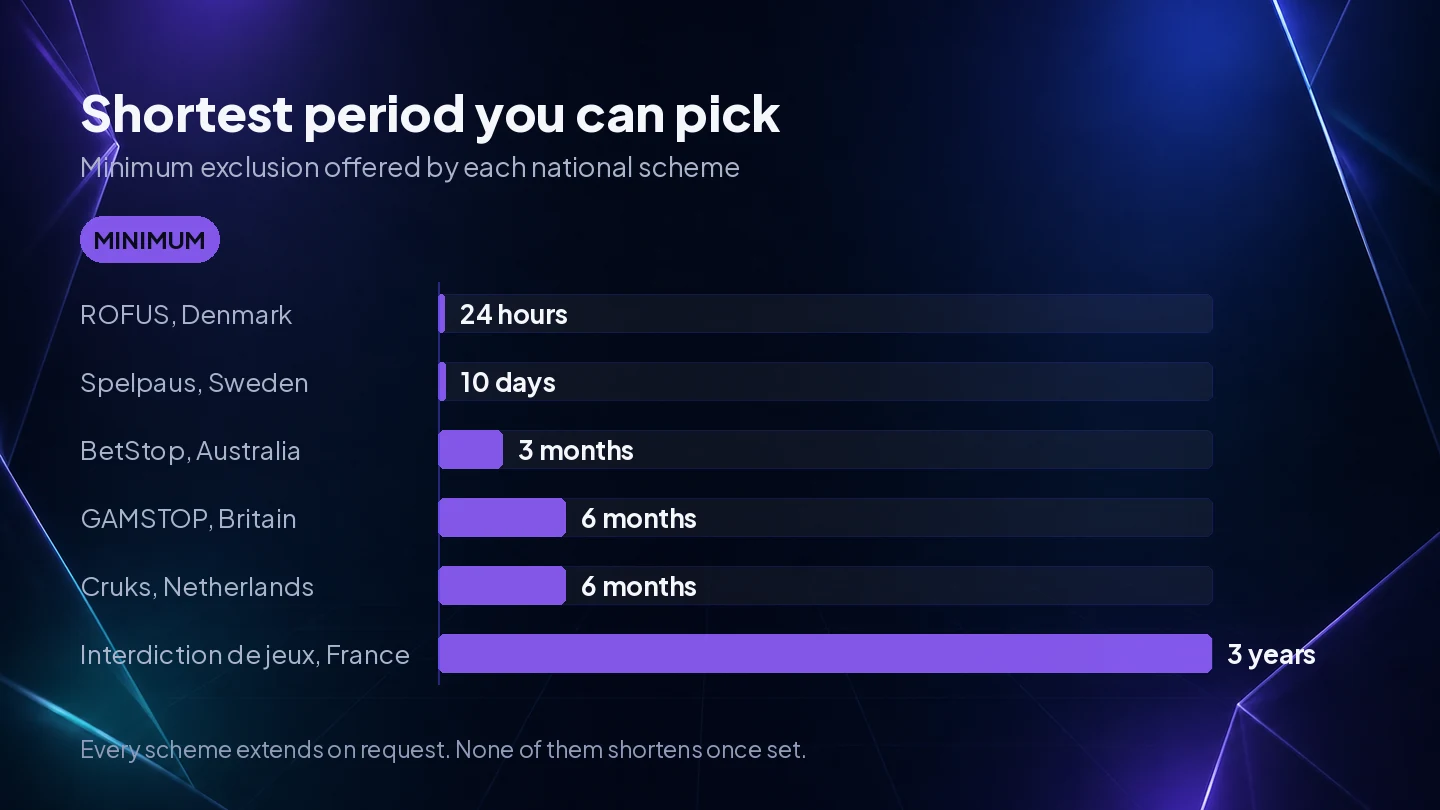
| GAMSTOP (UK) | The National Online Self Exclusion Scheme Limited | Remote gambling from Great Britain licensed operators | 6 months | 5 years, auto-renewable | No | gamstop.co.uk |
| Spelpaus (Sweden) | Spelinspektionen | All gambling licensed in Sweden, online and land-based, plus marketing | 10 days | Until further notice, endable after 12 months | No | spelpaus.se |
| Cruks (Netherlands) | Kansspelautoriteit | Dutch licensed online operators, casinos and arcades | 6 months | Permanent | No | cruksregister.nl |
| ROFUS (Denmark) | Spillemyndigheden | Danish licensed online gambling, land-based casinos and betting | 24 hours | Permanent, deletion after one year | No | rofus.nu |
| Interdiction de jeux (France) | ANJ | Licensed French online operators, casinos and gaming clubs | 3 years | Renews tacitly | No | interdictiondejeux.anj.fr |
| Exclusion register (Ireland) | Gambling Regulatory Authority of Ireland | Required by statute, not yet in service | n/a | n/a | n/a | grai.ie |
| BetStop (Australia) | Register operator overseen by the ACMA | Licensed Australian online and phone wagering | 3 months | Lifetime | No | betstop.gov.au |
GAMSTOP
Registration offers six months, one year, five years, or five years with automatic renewal. The terms are blunt about reversal: you cannot deactivate before the end of the minimum period you chose. When it expires nothing happens by itself, and if you never contact them the terms keep the exclusion running for up to a further seven years. Auto-renew can only be switched off in the final six months of a five-year term.
Spelpaus
Sweden’s scheme is the widest in scope here, reaching every operator licensed in Sweden across online casino, betting, bingo, lotteries and physical gaming machines. It gates marketing too: licensees must query the register before sending promotional material. Periods are 10 days, one month, three months, six months, or until further notice, and the shorter ones lapse automatically. The indefinite option cannot be ended until 12 months have passed.
The plumbing behind those checks changed on 1 August 2026. Spelinspektionen’s regulation SIFS 2026:3 gives every licensee a unique Actor ID and API key and requires purpose-matched queries: a dedicated marketing interface for checks before promotional contact, a separate one for registration and login. Outsourcing the integration does not move responsibility off the licence holder. For players the effect is cleaner logging of who asked the register what, and why. More in our piece on the credit ban and the Spelpaus changes.
Cruks
The Dutch register runs on DigiD, the national electronic identity system, with passport and in-person registration as alternatives. The minimum stop is six months. Presets run to one year, two years, five years and permanent, and registering without choosing gives you two years by default. The published guidance is unambiguous that you cannot make changes during the stop. Cruks covers land-based venues too, reaching arcades and casinos as well as websites. Deposit limits in the Netherlands sit alongside it rather than replacing it.
ROFUS
Denmark offers the shortest option in the table, 24 hours, then one, three or six months, then permanent. Spillemyndigheden states the case for irreversibility directly: the strength of ROFUS is that your registration cannot be cancelled even if you regret it. Temporary periods simply end. A permanent one can be deleted, but no earlier than a year after registering, and the process needs an initial request and a confirming one between seven and 30 days later.
France and Ireland
France does not run a register in the sense the others do. It runs an interdiction, a prohibition recorded by the ANJ, closing existing accounts at licensed French operators and barring entry to physical casinos and gaming clubs. It lasts three years minimum, cannot be shortened or lifted inside that window, then renews tacitly unless you ask for removal. It is the heaviest instrument here.
Ireland is the gap. The Gambling Regulation Act 2024 requires the Gambling Regulatory Authority of Ireland to establish a National Gambling Exclusion Register, and integration with it is part of what licensees must build. Licensing is phasing in, with the first remote betting licences issuing from 1 July 2026 and in-person licensing later in the year. Until the register is in service, Irish players rely on operator-level exclusions, blocking software and bank blocks, so treat the layered approach below as the primary tool.
BetStop
Australia’s register covers licensed online and phone wagering providers, roughly 150 of them. Periods run from three months to lifetime, extendable at any time, never reducible. Removal is unavailable during the first three months, and after that needs a statutory declaration confirming you have discussed the decision with a counsellor or a doctor, then about seven days’ processing during which you can withdraw the request. Providers must close accounts, refund money held in them, and not market to registrants.
What each scheme leaves out inside its own country
A scheme can be national and still not cover everything you can gamble on in that nation. Great Britain is the clearest case: GAMSTOP covers remote gambling only, and physical premises run separate multi-operator schemes listed by the Gambling Commission itself, a betting shop scheme, SENSE for land-based casinos, BISES for bingo premises and arcade schemes for adult gaming centres and holiday parks. Registering with GAMSTOP registers you with none of them, and several require you to attend in person or phone.
Sweden goes the other way, covering licensed land-based machines and lotteries as well as online. The Netherlands covers arcades and casinos, Denmark land-based casinos and betting, Australia interactive wagering only. So ask one question about your own scheme: does it reach the format that actually hurts you?
The coverage gap, stated plainly
A national scheme binds operators holding that country’s licence. That is the entire boundary. A site licensed somewhere else has no legal relationship with the register and no obligation to query it. Nobody is defeating the scheme. It was never built to reach past the licence.
This is where a lot of sites in this industry get cheerful about the alternatives. We are not going to. Four things a self-excluded player gives up outside the licence.
The regulator. No authority can sanction the operator on your behalf. Some offshore regulators state explicitly that they do not handle individual player complaints. If the account closes and the balance disappears, no enforcement route means anything to you.
The dispute service. British licensees must offer an alternative dispute resolution provider, and Danish, Dutch and Swedish players have national complaint routes. Outside those, a dispute is you emailing a support address with no adjudicator.
The deposit limits. Regulated markets require deposit limit tooling and affordability intervention. None of that exists by default outside a licence, and the absence is most dangerous to exactly the person a self-exclusion was protecting.
The scheme itself. No check at registration, no check at login, no marketing gate. The thing you registered for stops at the border.
We do publish pages describing sites outside these registers, because readers search for them and because describing what something is beats pretending it does not exist. Non-GamStop casinos, casino utan Spelpaus, casino uden ROFUS and bookmakers zonder CRUKS exist here as factual descriptions of a category. None is a recommendation, and if you are self-excluded, none is for you. What those pages document is the trade on offer: access, in exchange for every protection listed above. If reading this made you want to open one, that is the moment to ring the number in the second section instead. Our editorial policy sets out why these pages carry no commercial links.
Layered blocking, for when the scheme alone is not enough
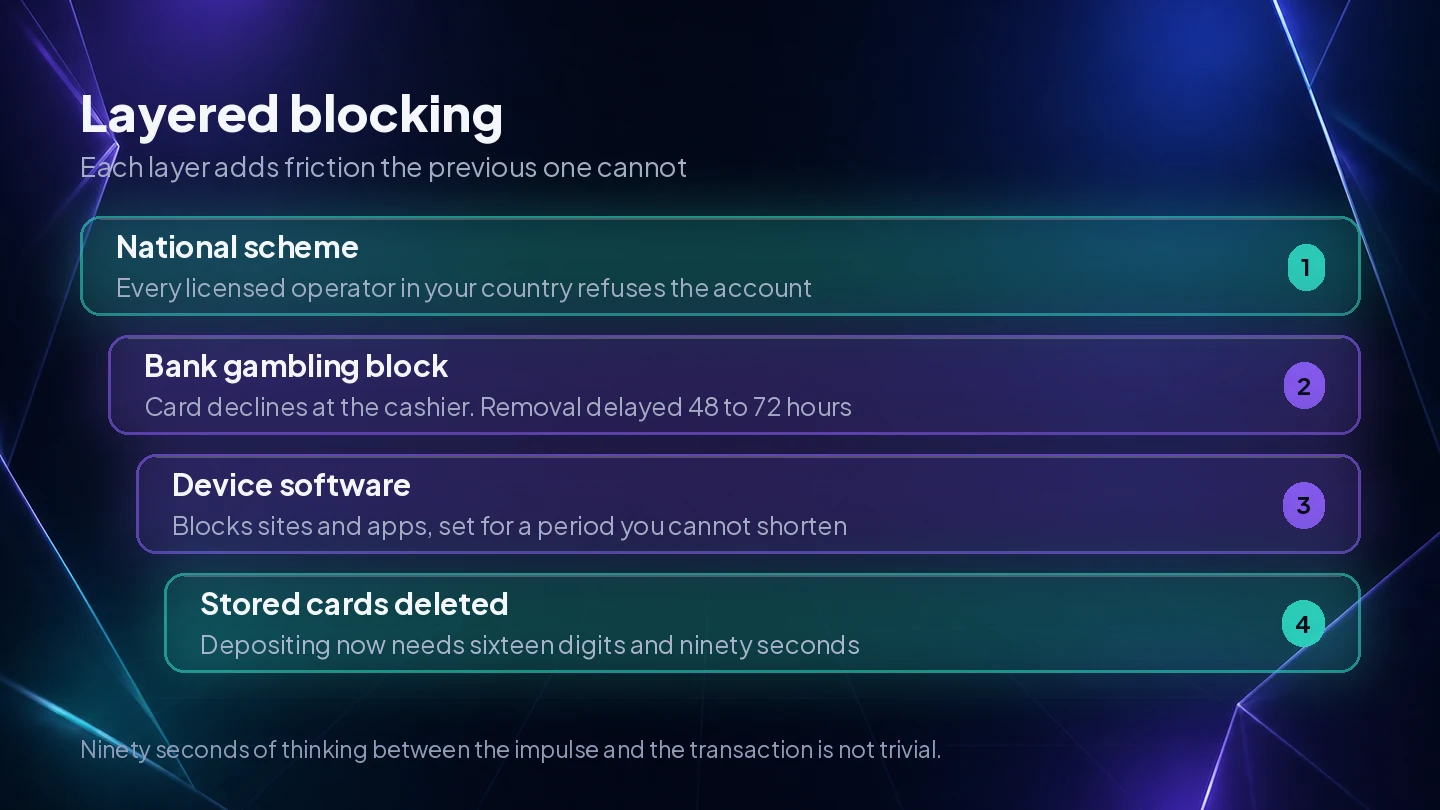
A scheme is one layer, the strongest single one, but one. People who stay stopped tend to have three or four, each with its own delay on removal, so no single moment of resolve failing is enough to get through.
Bank and card blocks
Most banks now offer a gambling block that refuses transactions coded as gambling by the merchant category code. The important detail is the removal delay. GamCare’s published summary groups the major providers like this.
- 48 hours: Chase, Halifax, Lloyds, NatWest, Royal Bank of Scotland, Santander, Starling, TSB, Ulster Bank, Zempler.
- 72 hours: Barclays, Bank of Scotland, Danske Bank, First Direct, HSBC, Nationwide, PayPal.
- Configurable: Monzo, from two days up to one year.
Three limitations. The block is set per card, so a second card needs its own. It works on merchant category coding, so a miscoded transaction can slip through. And it does not reliably catch bank transfers or money routed through an e-wallet. Turning it on does not affect your credit score and does not close the account.
Device and network blocking
BetBlocker is free, permanently, from a charity registered in Scotland, number SC049565. It runs on Windows, macOS, Linux, Android, iOS and Fire OS, on unlimited devices. Restriction periods run from one day to five years and cannot be lifted before the end date once started. Gamban is the main paid alternative, with a short free trial and then a subscription.
Above the device, point your home router at a DNS resolver that filters gambling domains. That covers everything on the network, including a console or a television. Mobile data goes round it, but it removes the easiest path, which is the one used at midnight.
Stored payment methods
The layer people skip, and the cheapest. Delete saved cards from browsers and phone wallets. Remove card details from e-wallet accounts, or close the e-wallet if it exists mainly for gambling. Turn off browser autofill for card numbers. Leave the card at home if you can.
The logic is friction. If depositing means fetching a card and typing sixteen digits, you have inserted about ninety seconds of thinking between the impulse and the transaction. That sounds trivial. It is not.
A worked example: what the layers add up to
A player registers with GAMSTOP on 3 February 2026 and picks the six-month minimum. The same evening they set a bank gambling block with a 72-hour removal delay, install BetBlocker with a 12-month restriction, and delete every stored card.
- 3 February 2026: the exclusion starts. Accounts at Great Britain licensed operators close and funds held in them are returned.
- 3 August 2026: the minimum expires. Nothing changes automatically; if they never contact GAMSTOP, the terms keep it running for up to seven further years.
- To come back they must contact GAMSTOP and pass a minimum 24-hour cooling-off. Earliest effect: 4 August.
- The bank block needs its own removal request, 72 hours. Earliest: 7 August.
- BetBlocker runs to 3 February 2027 and cannot be lifted early on that device.
- Cards then have to be re-entered by hand.
Count from the decision on 3 August: 24 hours on the scheme, then 72 on the bank, so 96 hours of enforced waiting before a deposit could clear, and six further months on the blocked device. Every one of those hours was bought in February. That is what layering is for.
If a self-excluded person does get through
It happens, usually through a data mismatch, an old account that was never linked, or a control that failed. What the operator owes you is defined, and worth knowing before you write.
Under the Gambling Commission’s remote social responsibility code, a licensee must close the accounts of anyone who has entered a self-exclusion agreement, return the funds held in the customer account, and operate procedures designed to ensure a self-excluded person cannot access gambling. In Australia, providers must close BetStop registrants’ accounts and refund money in them, with a carve-out only for settling bets already placed. The treatment of winnings varies by market and by the operator’s terms and is genuinely contested. Do not assume they are payable, and do not assume they are forfeit.
The escalation route is the same in structure everywhere.
- Complain to the operator in writing. Give the exclusion date, the account name and the deposits made. Ask specifically for account closure and return of deposits made after that date.
- Escalate to the alternative dispute resolution provider named in the operator’s terms if the answer is unsatisfactory or slow. That is the body that can direct an outcome.
- Report it to the regulator separately. The Gambling Commission does not adjudicate individual disputes, but it uses reports to open regulatory action, and it has suspended a business for failing to participate in GAMSTOP. In Sweden report to Spelinspektionen, in the Netherlands the Kansspelautoriteit, in Denmark Spillemyndigheden, in Australia the ACMA.
- Tell the scheme. GAMSTOP and its equivalents want to hear when a participating operator lets a registrant through, because that is an integration failure they can chase.
Reporting is not only about your money. A register failure is almost never unique to one player, and a report is often the only way anyone finds out.
Marketing: what should stop, and what to do if it does not
A working exclusion should end gambling marketing from licensed operators. In Great Britain, licensees must take all reasonable steps to prevent marketing reaching a self-excluded customer and must remove their details from marketing databases within two days, and that obligation extends to the affiliates and contractors they use. In Sweden the check happens before the message is sent, through the marketing interface described above. Australia’s providers must not market to BetStop registrants.
The Commission’s own guidance lists why it still fails: recycled marketing lists, staff overriding system controls, gaps in the technical controls, and confusing a self-excluded customer with one who took a time-out.
If messages keep arriving, screenshot each one with date and sender, because the pattern is the evidence. Send the set to the operator and ask for written confirmation of removal, and send the same set to the regulator, since this is a licence matter and not an annoyance. Unsubscribe too, but treat that as least important. If the sender is a third-party affiliate, report it to the operator anyway and name the sender, because British licensees are responsible for their affiliates’ compliance.
Coming off an exclusion
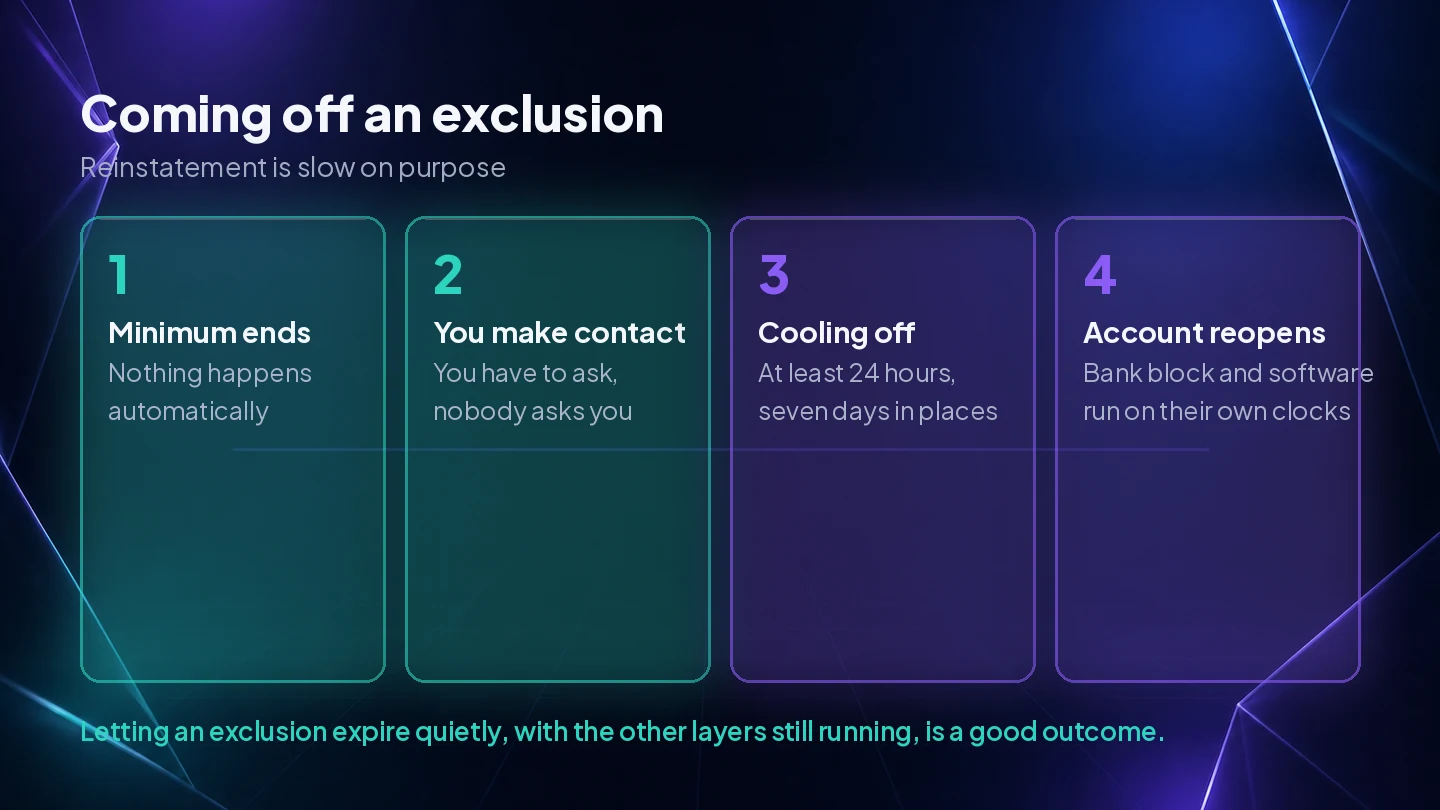
Reinstatement is slow on purpose. GAMSTOP makes you contact them after the minimum period, then holds a minimum 24-hour cooling-off. BetStop requires a statutory declaration that you have talked to a counsellor or a doctor, then about seven days in which you can change your mind. Denmark makes you ask twice, between seven and 30 days apart. France gives you no route for three years and then requires an active request. Sweden holds an indefinite exclusion for at least 12 months.
None of that is bureaucracy for its own sake. The decision to come back is usually made in a very different mood from the decision to stop, and the design puts a mandatory gap between the two.
One honest note, and it is the most important line here. The end of an exclusion period is not evidence that anything has been solved. A calendar ran out. Six months of not gambling because you could not gamble tells you nothing about six months of not gambling when you can. If the only thing that changed is the date, extend rather than test it. Extending is always available and always instant.
There is also no obligation to come back. Letting an exclusion expire quietly, with the bank block and the software still running, is a perfectly good outcome.
What to check in your own account
A short audit, whether or not you are excluded.
- Is your registration current? Log in and read the end date rather than remembering it. Check the email address on file still works, since that is where the expiry notice goes.
- Do the details match? Registers match on identity data. An old address, a maiden name or a second email address can leave an account unlinked.
- Is the bank block on every card? Each card on the account, not just the main one, plus any second bank or e-wallet.
- Is blocking software actually running? Reinstalling an operating system, buying a phone or resetting a browser removes it silently.
- Are stored cards really gone? Browser saved cards, phone wallet, e-wallet accounts, any page holding a card on file.
- Do old operator exclusions still apply? Those run on their own clocks and expire on their own schedule.
- Do you know your escalation route? The dispute resolution provider in the operator’s terms, and the regulator’s reporting page.
To check whether a site is licensed where it claims to be, the register check in how to verify a casino licence is the same skill applied to a different question.
What to do next
If you are self-excluded and it is holding, add the layers you have not added yet and check the audit list every few months.
If you are self-excluded and looking for a way around it, the honest answer is that a way exists because a licence has a border, not because anyone built you a door, and it hands you a market with no regulator, no adjudicator, no deposit limits and no register behind it. You would be trading every protection you have for access you decided you did not want. Ring the helpline instead. In the United Kingdom that is 0808 8020 133, day or night; every other market’s number is on our responsible gambling page.
If you are reading this to understand the system rather than to use it: these registers are the strongest consumer protection tool any of these regulators has built, they are free and fast, and in Denmark one lasts as little as 24 hours.
Gambling is entertainment with a cost attached and never income. If the cost has stopped feeling like entertainment, our responsible gambling page is where all of this starts.
In one paragraph
GamStop, Spelpaus, CRUKS, ROFUS and BetStop compared: who runs each scheme, how long it lasts, whether it can be cancelled, and what it does not cover.
Read next
Markets
Frequently asked questions
Can I cancel a national self-exclusion if I change my mind?
No scheme in this guide lets you cancel during the period you chose. GAMSTOP, Spelpaus, Cruks, ROFUS, the French interdiction and BetStop are all binding for their minimum term. That is the whole point of them. You can always make an exclusion longer, never shorter, and reinstatement afterwards is deliberately slow.
Does GamStop cover betting shops and land-based casinos?
No. GAMSTOP covers online and other remote gambling from operators licensed in Great Britain. Physical premises run separate schemes: SENSE for land-based casinos, BISES for bingo halls, a multi-operator scheme for betting shops, and arcade schemes for adult gaming centres. You have to register with each one separately.
Why can a self-excluded player still open an account somewhere?
Because a national register only binds operators holding that country's licence. A site licensed elsewhere is not connected to the register and never queries it. That is not a loophole in the scheme, it is the edge of the scheme's legal reach, and outside it you also lose the regulator, the dispute service and the deposit limits.
What should a licensed operator do if I gambled while self-excluded?
Under the Gambling Commission's remote social responsibility code, a licensee must close the account and return funds held in it. Complain to the operator in writing first, escalate to its alternative dispute resolution provider if the answer is unsatisfactory, and report the failure to the regulator separately.
How do I stop gambling marketing after self-excluding?
The scheme should do it. Swedish licensees must query Spelpaus before sending marketing, and British licensees must remove self-excluded customers from marketing databases within two days. If messages still arrive, screenshot them with dates, send them to the operator and to the regulator, and unsubscribe as a secondary step.
More from the blog
-
 safety How to Verify a Casino Licence in Five Minutes A licence badge is an image file. The only thing that counts is the entry on the regulator's public register, and checking it takes about five minutes.
 -
 safety KYC Checks at Online Casinos, Explained Verification is a licence condition, not an operator invention. But the moment an operator chooses to run it is a business decision, and that choice is what turns a ten minute upload into a fortnight of chasing support.
 -
 bonuses Max Bet Rules and How One Spin Voids a Win The max bet clause is the shortest sentence in most bonus terms and the one that costs players the most money. This is what it covers, how a single spin breaches it, and what an operator is allowed to do next.

Aristotelis Kourtelis
Licensing & Player Protection Analyst since 2024
Aristotelis Kourtelis is the Licensing and Player Protection Analyst at LSM99, and the reason a brand does not reach the top of a list on its bonus alone. He joined in 2024 and works at the front of the review process, before any scoring happens. LSM99 rates every casino across six weighted sections, licensing and safety, payouts, bonus fairness, game range, support and mobile, and Aristotelis owns the first of those. If the licensing work fails, the other five sections do not rescue the brand. He reads bonus terms, KYC triggers and self-exclusion rules closely, because those are the clauses that decide whether a win is really a win.



Play responsibly
Gambling is entertainment, not income. Set a deposit limit before you play, never chase a loss, and stop when it stops being fun. If it has become a problem, these services are free and confidential.
Our responsible gambling guide carries no affiliate links and no casino list.