
News
Dutch Deposit Limits and the Mandatory Contact Moment
Dutch-licensed sites cap what you can put in each calendar month and must phone or chat with you before you set a higher limit. Here is what that looks like from the player's side of the cashier.
Show moreShow less
A Dutch-licensed casino will not let you deposit whatever you feel like. Since 1 October 2024 every site holding a Kansspelautoriteit licence has to hold you to a net deposit ceiling for each calendar month: EUR 700 if you are 24 or over, EUR 300 if you are under 24. Net means deposits minus withdrawals at that operator inside that month. Reach the ceiling and the deposit button stops working until the first day of the following month.
Below that ceiling sits a second, lower number that catches far more players. If you want a monthly deposit limit above EUR 350, or above EUR 150 when you are under 24, the operator cannot simply let you type it in. It has to hold a mandatory contact moment, a verplicht contactmoment, by phone or chat, in which you confirm you understand you might lose the entire amount you are setting. That is the call people find odd, because it arrives from a company that would rather take your money.
This piece walks through what the regime actually looks like from the cashier: the limit screen at registration, the conversation when you try to raise a number, the moment deposits are cut off halfway through a month, and where the exclusion register CRUKS fits into all of it. It also deals plainly with the reason a lot of Dutch players start searching for sites outside the licence, and with what they hand over when they do.
The two thresholds, and why players confuse them
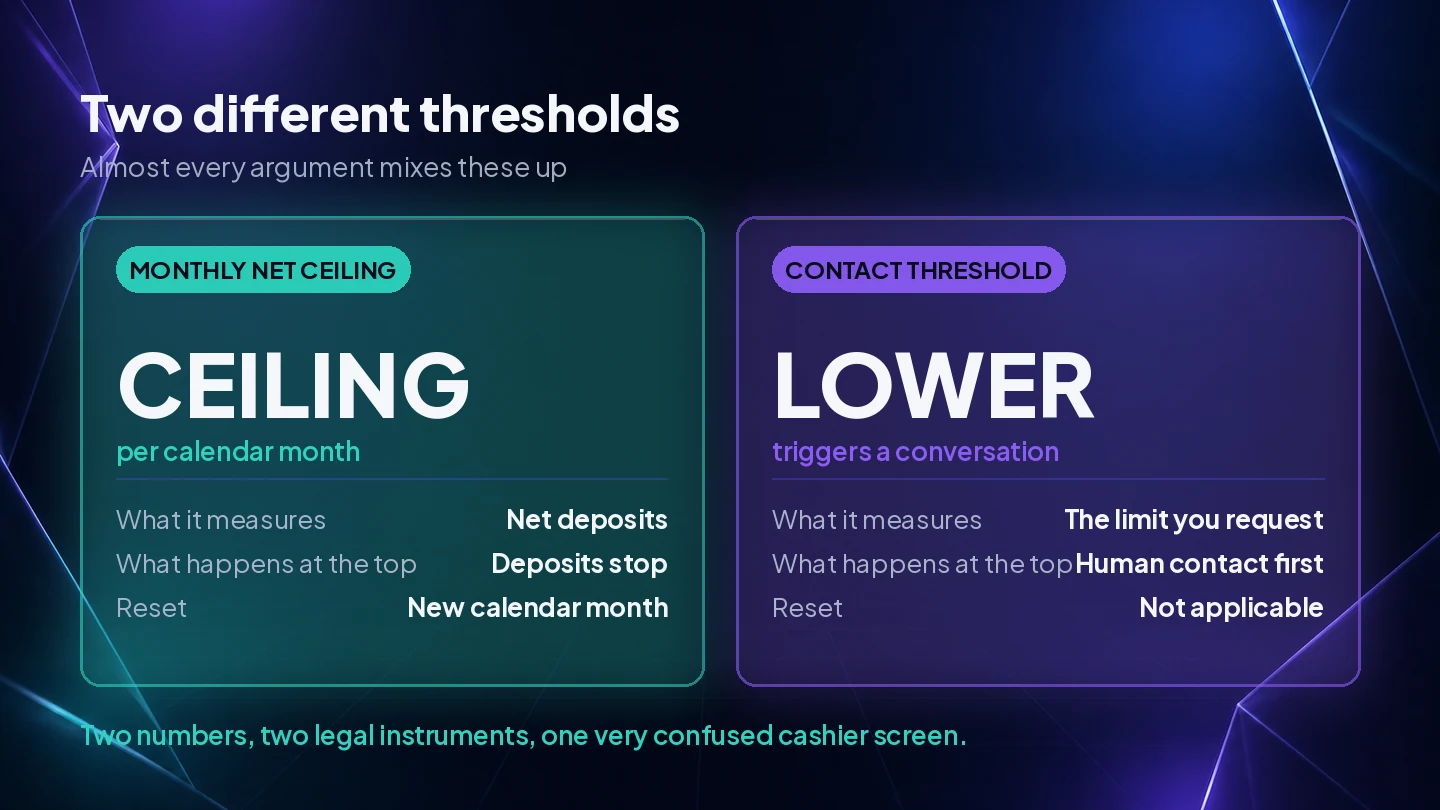
Almost every argument about Dutch limits comes from mixing up two different numbers that live in two different legal instruments.
The ceiling is the net deposit threshold, set out in the Kansspelautoriteit’s Beleidsregel verantwoord spelen. It is EUR 700 a month for players aged 24 and over and EUR 300 for players under 24. It is calculated net, so withdrawals you take during the month reduce the figure again. Once you pass it, the operator has to shut off your deposit facility, and the regulator expects that to happen within an hour of the trigger rather than at the end of the day.
The trigger is the gross deposit limit that starts a mandatory contact moment. It comes from the Regeling speellimieten en bewuster speelgedrag, published in the Staatscourant on 20 June 2024 and in force since 1 October 2024. It is a much lower number, and it is expressed three ways because you can set a limit per day, per week or per month.
| Limit you set | Age 24 and over | Under 24 |
|---|---|---|
| Per month | EUR 350 | EUR 150 |
| Per week (no monthly limit set) | EUR 87.50 | EUR 37.50 |
| Per day (no weekly or monthly limit) | EUR 12.50 | EUR 5.35 |
Set anything at or above the figure in your column and the operator must contact you before it applies.
The two numbers do different jobs. The EUR 350 figure is about a conversation. The EUR 700 figure is about a hard stop. You can trigger the first without ever coming close to the second, and plenty of players do exactly that in their first week.
One more distinction matters: both numbers apply per operator. Open accounts at three Dutch-licensed sites and, as the rules stand in August 2026, you have three separate EUR 700 ceilings. A single market-wide limit that follows the player rather than the account has been under discussion since a policy letter in February 2025 and remains a legislative proposal, not law. Anyone telling you the Netherlands already caps total monthly deposits at EUR 700 across the whole market is describing a plan, not the current rulebook.
The limit screen at registration
Registration at a Dutch site does not end with your address and a password. Before you can fund the account you have to pass a screen that asks you to set a deposit limit. It is compulsory. There is no “skip” and no default that quietly lets you deposit freely.
Most sites present three boxes, day, week and month, and let you fill any combination. The daily box is the one that trips people. If you leave the weekly and monthly boxes empty and type EUR 20 a day, you have set something above the EUR 12.50 daily trigger, and the contact moment applies even though EUR 20 hardly feels dramatic. The thresholds are graded so that a daily limit that would add up to a large month is caught at the daily stage.
Most sites carry loss limits and session-time limits on the same screen. They are not part of the same regulation but they bite differently, and a deposit limit does nothing about a session where you deposit EUR 100, run it to EUR 900, and give it back.
Lowering a limit takes effect immediately, raising it does not. That asymmetry is deliberate and standard across the Dutch market. If you drop your monthly figure from EUR 400 to EUR 100 on a Friday night, EUR 100 is your number from that moment. If you want to go the other way, you are in the queue for a conversation, and possibly for a document check as well.
Deposits themselves are almost always iDEAL in this market. That matters for one small reason people forget: iDEAL settles instantly, so a deposit that pushes you over a threshold does so in real time, not overnight. There is no float period in which the number is still officially unspent.
The mandatory contact moment, step by step
The contact moment is where the Dutch regime stops resembling anything else in Europe. It is not an email, not a pop-up, and not a checkbox. The rule requires actual contact through a channel where a human is on the other end, in practice a phone call or a live chat session.
Here is the sequence a player runs into.
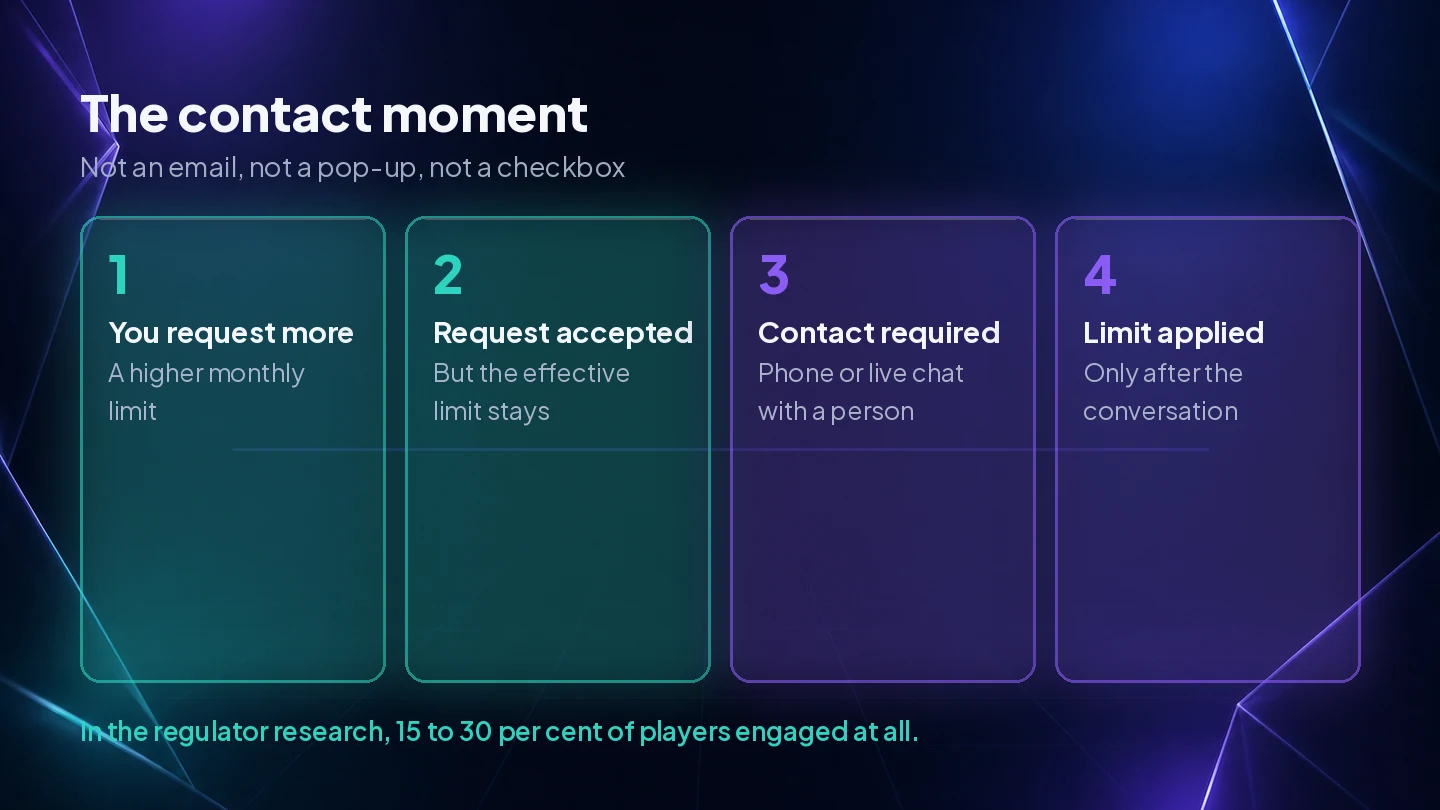
You set a monthly limit of EUR 500. The site accepts the request but shows your effective limit as unchanged, usually with a note that your request is pending. Somewhere between minutes and a couple of days later, depending on how the operator staffs it, you get a call or a chat invitation. If you asked for a phone call and never pick up, the request sits there. Some operators will retry, some will let it lapse after a set window.
The conversation itself is short. Staff are required to make sure you understand that the money you are proposing to deposit is money you can lose in full, and that the limit is not a target or a budget the site expects you to reach. Expect questions about whether the amount is affordable, whether anything has changed in your circumstances, and whether you are aware of the help routes, including the national gambling helpline. You confirm your awareness of the loss risk, and only then does the new limit go live.
Two things surprise people. The first is that saying the wrong thing can cost you the increase. If the conversation turns up signals of harm, the operator is not permitted to simply grant the number and move on. The second is that the contact moment is only the first tier. Where a licence holder suspects excessive play or addiction, a heavier intervention called a persoonlijk onderhoud applies, and the Kansspelautoriteit published guidance on that on 31 March 2026 spelling out when it must be started, which channels count and what has to be covered.
That guidance also carried an uncomfortable statistic for anyone who assumes these conversations are theatre. In the regulator’s research, only 15 to 30 percent of contacted players were willing to engage at all, and roughly half of those completed the conversation. The regulator’s response was not to soften the duty but to tighten the guidance around it.
Why the deposit button stops working mid-month
This is the complaint that fills Dutch forums. A player is mid-session on the 18th, tries to add EUR 50, and the cashier refuses. Nothing was announced, no limit was changed, and support says the account is fine.
What happened is the net ceiling. Work through a month for a 31 year old player at a single Dutch-licensed site, with a monthly deposit limit set at EUR 700.
| Date | Movement | Net so far | Headroom |
|---|---|---|---|
| 3 March | Deposit EUR 250 | EUR 250 | EUR 450 |
| 6 March | Withdraw EUR 100 | EUR 150 | EUR 550 |
| 9 March | Deposit EUR 300 | EUR 450 | EUR 250 |
| 14 March | Deposit EUR 200 | EUR 650 | EUR 50 |
| 18 March | Deposit EUR 50 | EUR 700 | EUR 0 |
| 18 March | Deposit EUR 50 attempted | Refused | EUR 0 |
The player never set a limit lower than EUR 700 and never breached the limit they chose. They simply reached the statutory ceiling and the deposit facility closed. Playing on with the balance already in the account is still allowed. Adding new money is not, until 1 April.
Two edge cases are worth spelling out because they cause most of the confusion.
The first is withdrawals late in the month. Because the ceiling is net, a withdrawal generally restores headroom. If our player had withdrawn EUR 400 on 20 March, most operators’ help pages describe the net figure dropping back to EUR 300 and the deposit facility reopening with EUR 400 of room. Implementations are not identical across the market, and some operators are more conservative than others, so treat this as the general design rather than a guarantee at your specific site.
The second is the calendar month boundary. The reset is not rolling. It happens on the first day of the month, which means a heavy last week of March and a heavy first week of April are, from the rule’s point of view, two clean slates a few days apart. That is a known weakness of a calendar-month design and it is one of the arguments used by people who want the market-wide limit instead.
There is a related trap on the way out. If you deposit close to the ceiling and then request a large withdrawal, expect the verification queue rather than an instant payout, because deposit patterns near a limit are exactly the sort of thing that gets an account reviewed. We covered the mechanics of that in why casino withdrawals are delayed.
Raising a limit: income documents and the draagkrachttoets
If EUR 700 genuinely does not fit your circumstances, there is a route above it, and it involves showing your income. This is the draagkrachttoets, the affordability test.
The working figure operators use is roughly 30 percent of net income. That number is not arbitrary. The regulator derived the EUR 700 ceiling from Centraal Bureau voor de Statistiek data on what Dutch households spend on recreation and saving, and the 30 percent guidance sits in the Kansspelautoriteit’s published good and bad practices for affordability testing.
What counts as evidence is narrower than players expect. Payslips and a tax assessment are the accepted documents, and operators typically ask for three recent payslips or the most recent aanslag. What does not count: your own statement of income, a plausibility assessment, or a questionnaire in which you tick a box saying you earn enough. The regulator has explicitly listed those as bad practice, on the basis that they establish nothing.
The most significant change of 2026 landed here. On 2 July 2026 the Kansspelautoriteit updated its good and bad practices for the draagkrachttoets and removed the previous allowance for savings. Under the earlier guidance some operators counted a slice of liquid assets towards the affordable amount. The updated position is that liquid assets such as savings must not form part of the assessment at all, and that the test has to rest on the player’s structural income. Operators are also expected to work from more than a single payslip and to fold the player’s risk profile into the outcome.
That update came with teeth. The regulator ran follow-up checks at 20 licence holders and reported ten improvement discussions, three warnings and one binding instruction, and said it would keep sampling.
For players the practical effect is simple. If you were planning to argue that a savings buffer justifies a higher limit, that argument no longer works. And if you are under 24, the route is largely closed regardless: the EUR 300 ceiling for that age group is not generally liftable on income evidence.
One more thing to be clear-eyed about. Sending payslips to a gambling operator is a real disclosure, and the file sits with them under their retention rules. That is a separate consideration from whether the limit increase is a good idea, and it belongs in the same mental drawer as the identity checks every licensed site runs, which we set out in KYC checks explained.
What changed in 2026
The core numbers did not move. EUR 700 and EUR 300, EUR 350 and EUR 150, the daily and weekly equivalents: all of them stand as they were on 1 October 2024. What changed in 2026 was the pressure around them.
1 January 2026. New Beleidsregels vergunningverlening kansspelen op afstand came into force. The trigger is that the first batch of remote gambling licences, issued in September 2021, expires on 1 October 2026, so the whole licensed field has to be reassessed. Renewal explicitly reopens an operator’s addiction prevention policy, its marketing, and its connection to the control database. Operators with a compliance history have to show what they changed.
31 March 2026. The regulator published guidance on persoonlijk onderhoud and on CRUKS notifications. It added no new rules, it pinned down how existing duties have to be carried out, including the point that a licence holder who advises a player to register in CRUKS and is refused must file a notification with the regulator rather than just closing the account.
2 July 2026. The draagkrachttoets guidance update described above, removing savings from the affordability calculation.
Still pending. A market-wide deposit limit that travels with the player, a higher minimum age for higher-risk products, and an affordability test built on open banking data were all recommended or announced across 2025. As of August 2026 none of them is law. A report delivered in October 2025 set out an open banking design in which net income minus fixed costs, with a reserve for emergencies, would drive the number. It remains a proposal.
The direction is unambiguous even if the timetable is not.
How CRUKS sits alongside the limit regime
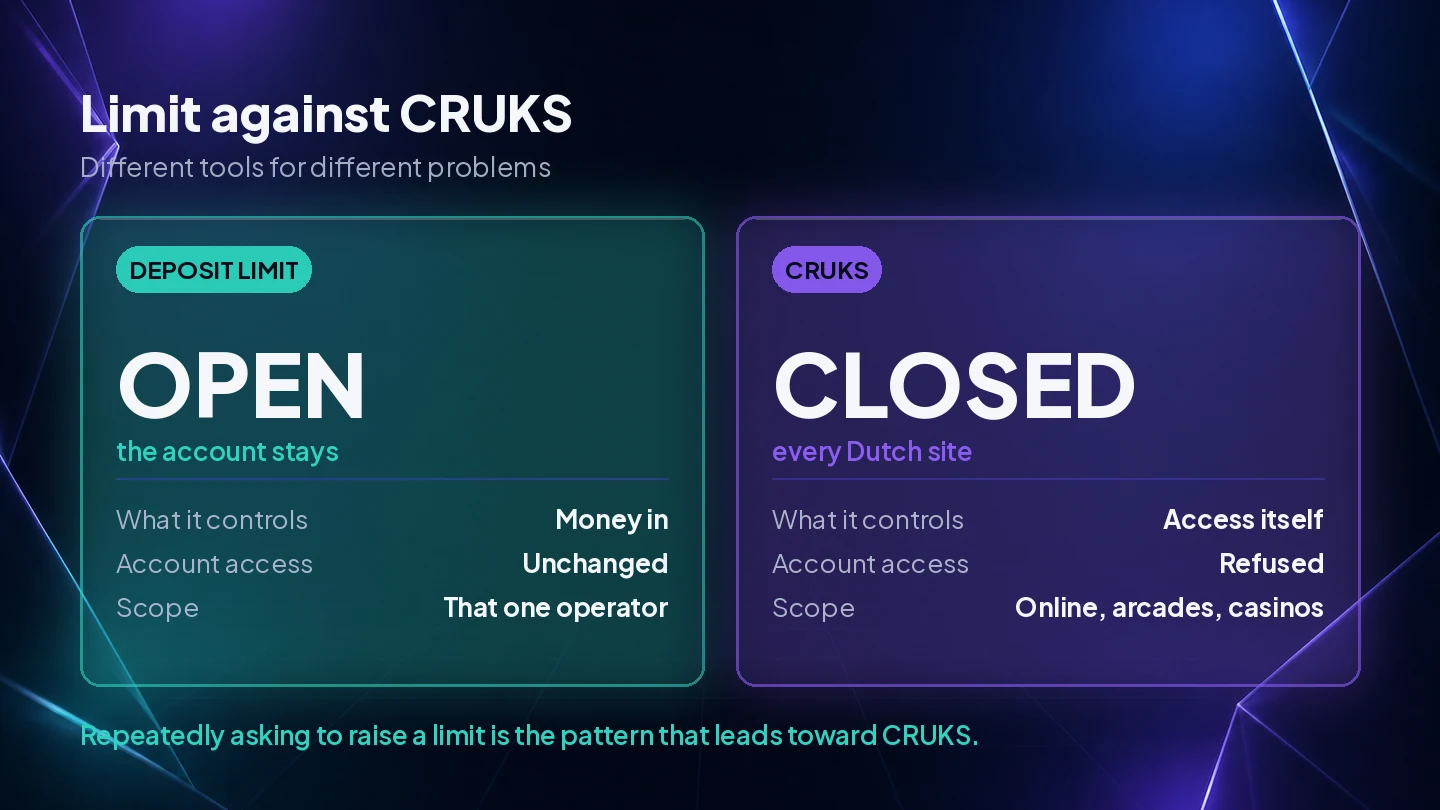
CRUKS, the Centraal Register Uitsluiting Kansspelen, is a different tool for a different problem, and the two get conflated constantly.
A deposit limit governs how much money you can move into an account that stays open. CRUKS closes the door entirely. Register and every Dutch-licensed online site, every arcade and every casino in the Netherlands has to refuse you. Registration is done through cruksregister.nl with DigiD and takes effect immediately, or on paper within a few days. The minimum period is six months and it can be set as long as 99 years. Inside the first six months you cannot cancel it. At the end it lapses on its own.
There is also an involuntary route. A licence holder who sees serious signals of problem play must advise the player to register, and if the player declines, notify the regulator, which can enrol someone without their agreement. The regulator’s own March 2026 guidance is candid about the limitation that drives this: blocking one account does nothing market-wide, because the player simply opens another one somewhere else.
CRUKS is enforced, not decorative. In July 2026 the regulator fined a land-based venue EUR 25,000 for admitting players who were on the register.
The two systems interact in a way worth planning for. If you set a low deposit limit and repeatedly ask for it to be raised, you generate exactly the pattern that leads to a persoonlijk onderhoud and, in the worst case, to a CRUKS conversation. If what you actually want is a hard stop rather than a friction point, CRUKS is the honest instrument, and the general mechanics of registers like it are covered in self-exclusion schemes explained.
Why some Dutch players go looking outside the licence
It is not a mystery and it does not need moralising. A recreational player who deposits EUR 900 across a good month, takes most of it back out, and has never missed a bill finds the ceiling absurd. A player who does not want to email payslips to a gambling company finds the affordability route intrusive. Someone who registered in CRUKS during a bad autumn and feels fine in spring finds a six month minimum with no early exit unbearable. Those are the three stories behind almost every search for a site outside the Dutch system, and none of them is irrational on its own terms.
What is worth being precise about is the trade. Here is what actually differs.
| Dutch-licensed site | Site outside the Dutch licence | |
|---|---|---|
| Deposit ceiling | EUR 700 net monthly, EUR 300 under 24 | Operator’s choice, often none |
| Contact moment | Compulsory above EUR 350 monthly | None |
| CRUKS | Checked and enforced | Not checked, exclusion irrelevant |
| Complaint route | Kansspelautoriteit and Dutch law | Foreign regulator, if any |
| Identity checks | Standardised by Dutch rules | Varies, often deferred to withdrawal |
| Payment methods | iDEAL and Dutch rails | Cards, crypto, varies |
The row that costs people the most is not the first. It is the fourth. Inside the licence, a dispute you cannot resolve with the operator has a Dutch destination, and the regulator has demonstrated in 2026 that it issues fines and binding instructions. Outside it, your leverage is whatever the operator’s own licensing regime gives you, which in some jurisdictions is meaningful and in others is close to nothing. The other expensive row is the third: if you are in CRUKS, an unlicensed site will not enforce it, which is precisely the situation the register exists to prevent.
We keep pages on this because pretending the demand does not exist helps nobody. If you want to see how offshore sites are structured, which regulators sit behind them and how we assess them, the market overview is at online casino buitenland, the sportsbook equivalent is bookmakers zonder CRUKS, and the broader Dutch section starts at our Netherlands hub. Read them as a description of a real market with real downsides, not as encouragement.
And the direct version, stated once: if the reason you are looking outside the licence is that the limit is stopping you doing something you have already decided you should not be doing, the site is not the problem. Start at responsible gambling instead.
What to check in your own account
Five checks, each of which takes under a minute in a Dutch account.
Which limits are actually set. Open the responsible play section and look at all three boxes. A daily limit you set at registration and forgot is the usual explanation for a cashier that refuses a deposit on a Tuesday and accepts one on Wednesday.
Your net figure for the month so far. Most Dutch sites show it, sometimes as a progress bar rather than a number. If yours does not, add your deposits and subtract your withdrawals since the first of the month and you have it.
Whether you have accounts at more than one operator. Because the ceilings are per operator, three accounts mean three ceilings, and it is easy to lose track of a total that no single site displays. Nothing stops you writing that total down yourself.
What your bank shows. Your iDEAL history is the one record no operator controls. Compare it against what you believe you deposited. Gaps here are worth taking seriously.
Whether any pending limit increase is sitting unanswered. If you asked for a higher number and the contact moment never happened, the request is likely still open. That is a reasonable moment to withdraw it rather than complete it.
What to do next
If you are playing on a Dutch licence and the limits feel restrictive, the correct order is: understand the two thresholds, decide which one you are actually hitting, and only then consider whether the affordability route is worth the disclosure. Most players who think they have hit the EUR 700 ceiling have in fact tripped the EUR 350 contact trigger, which is a conversation rather than a wall.
If you are choosing where to play at all, treat the limit regime as one factor among several rather than the deciding one, and weigh it against the dispute route, the payment rails and the withdrawal record. Our general framework for that comparison is in how to choose an online casino, and the primary source for every rule described above is the regulator itself at kansspelautoriteit.nl.
If you are reading this because a limit is the only thing currently standing between you and a worse month, do not spend the afternoon looking for a way around it. Set the limit lower, not higher, and read responsible gambling. Gambling is entertainment with a cost attached, never a way to make money, and a rule that gets in your way at exactly the wrong moment is doing the job it was written to do.
Nothing here is legal or financial advice, and operator implementations differ, so check your own site’s terms and the regulator’s current guidance.
In one paragraph
How the Dutch net deposit ceiling works, when a mandatory contact moment is triggered, why deposits stop mid-month, and how CRUKS fits alongside it.
Read next
Markets
Frequently asked questions
What is the maximum I can deposit at a Dutch licensed casino per month?
Net deposits are capped at EUR 700 a calendar month if you are 24 or over, and EUR 300 if you are under 24. Net means deposits minus withdrawals at that operator inside the month. The cap applies per operator, not across the whole market, and it resets on the first day of the month.
Why did the casino phone me when I raised my deposit limit?
Because you crossed the contact moment threshold. A Dutch licence holder must speak to you by phone or chat before a monthly deposit limit above EUR 350 takes effect, or EUR 150 if you are under 24. In that conversation you confirm you understand you could lose the whole amount.
Does a withdrawal give me room to deposit again?
Usually yes, because the ceiling counts net deposits rather than gross. If you deposit EUR 600 and withdraw EUR 200, most operators show EUR 300 of headroom left. Implementations differ, so check the help page of the site you use rather than assuming your balance will free up.
Can I raise my limit above EUR 700?
Only by passing an affordability check. You send payslips or a tax assessment, and the operator works from roughly 30 percent of net income as guidance. Since July 2026 savings no longer count towards that calculation. Players under 24 generally cannot lift the EUR 300 ceiling at all.
Is CRUKS the same thing as a deposit limit?
No. CRUKS is the national exclusion register. Once you are in it, every Dutch-licensed online site, arcade and casino must refuse you for at least six months. Deposit limits control how much you can fund an open account with. One is a door lock, the other is a spending tap.
More from the blog
-
 safety How to Verify a Casino Licence in Five Minutes A licence badge is an image file. The only thing that counts is the entry on the regulator's public register, and checking it takes about five minutes.
 -
 safety KYC Checks at Online Casinos, Explained Verification is a licence condition, not an operator invention. But the moment an operator chooses to run it is a business decision, and that choice is what turns a ten minute upload into a fortnight of chasing support.
 -
 bonuses Max Bet Rules and How One Spin Voids a Win The max bet clause is the shortest sentence in most bonus terms and the one that costs players the most money. This is what it covers, how a single spin breaches it, and what an operator is allowed to do next.

Aristotelis Kourtelis
Licensing & Player Protection Analyst since 2024
Aristotelis Kourtelis is the Licensing and Player Protection Analyst at LSM99, and the reason a brand does not reach the top of a list on its bonus alone. He joined in 2024 and works at the front of the review process, before any scoring happens. LSM99 rates every casino across six weighted sections, licensing and safety, payouts, bonus fairness, game range, support and mobile, and Aristotelis owns the first of those. If the licensing work fails, the other five sections do not rescue the brand. He reads bonus terms, KYC triggers and self-exclusion rules closely, because those are the clauses that decide whether a win is really a win.


Play responsibly
Gambling is entertainment, not income. Set a deposit limit before you play, never chase a loss, and stop when it stops being fun. If it has become a problem, these services are free and confidential.
Our responsible gambling guide carries no affiliate links and no casino list.